Culture Making is now archived. Enjoy five years of reflections on culture worth celebrating.
For more about the book and Andy Crouch, please visit andy-crouch.com.

Nate:
"Life Through the Viewfinder," a post by blogger mrs tulip, 6 April 2009 :: via Tomorrow Museum

Two schools I have taught at in the past couple of years ban camera use at their high school musical night. One of the reasons is because students look out to the audience to see if mum and dad are watching. If they see only a sea of lenses instead of adoring eyes they are met with technology rather than soul.

We are obsessed with recording life from our point of view, even when it is only 30 cm from the next person’s POV.

The Mona Lisa is photographed by every visitor to the Lourve when we have ready access to pristine images of her taken in optimum lighting etc.

We humans are strange creatures.

excerpt Adoration
Andy:

Praise God, men and women dressed in brown, carrying your lives on your backs. Praise God, street-side café with your goggle-eyed Chihuahua sign. Praise God, scrap metal horse. Praise God, basement shop full of silky foreign scarves.

Praise God, shoe store so proud of being in Collegetown since before you were born.

Praise God, little tattoo parlor with the brass sign on your inner door, Confessions, 3-5 pm.

"Gopangane," sung by KS Chithra and KJ Yesudas, music by Raveendran, from the film Bharatham (1991)
Nate:
excerpt Blue law blues
Nate:
from "The Past as Peep Show," by Susan Dominus, The New York Times, 3 April 2009 :: via Freakonomics

When it comes to illicit media, the agents for good and evil, even outside New York, are always symbiotic: pornography, in the experience of many moral crusaders, is like an infuriating weed that loves nothing more than a good pesticide, its strength only enhanced by efforts to tamp it down. But Long also chronicles the way that initiatives to eradicate vice only helped pave the way for its further evolution in the city. Try to eliminate drinking on Sunday by limiting it to hotels, as did the Raines Law of 1896, and suddenly every bar and saloon in Manhattan is putting up cheap dividers to create makeshift accommodations, ideal breeding grounds for prostitution, which thrived in the era of the so-called Raines Law hotels. Try to provide a place where working-class men can find a bathroom that isn’t in a bar, and from that solution — public restrooms — will come another challenge: gay (semipublic) sex.

newsPreaching and tweeting

On Monday night, 20 April, I’ll have the great pleasure of moderating a discussion on the state of preaching at Fuller Theological Seminary, part of the Lloyd John Ogilvie Preaching Summit for 2009. The panel is a stellar lineup of preachers from diverse generations, regions, cultures, and nations: Lloyd John Ogilvie, James Earl Massey, William Willimon, Renita Weems, Peter Storey, Ken Fong, Jana Childers, and Mark Labberton. If you are anywhere near Pasadena, California, that evening, I’d love to see you there.

Also, if you follow me on Twitter or Facebook, or (heaven forfend) tweet yourself, watch my Twitter updates later this week for some ways you may be able to participate in helping us explore the potential of social media to completely disrupt and undermine—er, I mean, um, create new participatory forms of engagement with—contemporary preaching.

—Andy Crouch

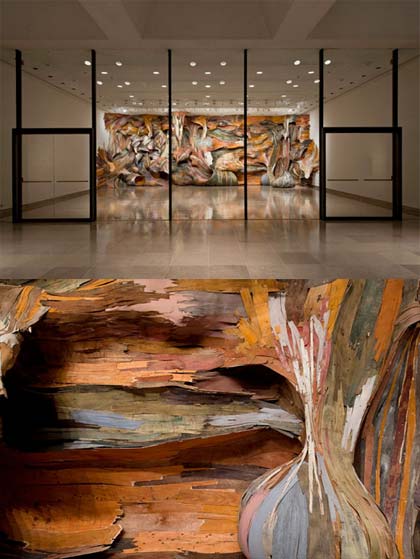
photo
Installation from Tapumes, by Henrique Oliveira, at the Rice University Art Gallery, 26 March–9 May 2009, photos by Nash Baker :: via designboom
Nate:
Nate:
from The Fragrance of God (2006), by Vivian Guroian :: via Speaking of Faith, thanks Emily!

When Adam gardened, he imitated his Maker in a purely recreative act of cultivation and care. He did not need to subdue the earth in order for it to yield fruit. Rather, the plants were Adam’s palette, and the earth was his canvas. There was nothing but delight in the Garden, for Eden itself means “garden of delight.” When I dug my garden in Culpeper, I was preparing a canvas. And when I arranged the flowering plants and shrubs on the freshly turned ground, I saw already the pink peony blossoms with their heads turned down toward the blue iris, and the white phlox standing straight beside the slouching crimson bee balm. I breathed in the sweet honeysuckle and the citrus-scented bergamot.

I have said on occasion that I think gardening is nearer to godliness than theology. (By “theology” I mean the kind of formal written discourse that my special guild of academic theologians does, not the praise of God and communion with divine life that ought to inspire theology at its core.) True gardeners are both iconographers and theologians insofar as these activities are the fruit of prayer “without ceasing” (1 Thess. 5:17, NKJV). Likewise, true gardeners never cease to garden, not even in their sleep, because gardening is not just something they do. It is how they live.

excerpt Babel undone

Nate

:

So the LORD scattered them from there over all the earth, and they stopped building the city. That is why it was called Babel —because there the LORD confused the language of the whole world. From there the LORD scattered them over the face of the whole earth.

English–Albanian–Arabic–Bulgarian–Catalan–Chinese–Croatian–Czech–Danish–Dutch–Estonian–Filipino–Finnish–French–Galician–German–Greek–Hebrew–Hindi–Hungarian–Indonesian–Italian–Japanese–Korean–Latvian–Lithuanian–Maltese–Norwegian–Polish–Portuguese–Romanian–Russian–Serbian–Slovak–Slovenian–Spanish–Swedish–Thai–Turkish–Ukrainian–Vietnamese–English

Then stop developing city and region. Yes, more than one world language. Reverse direction in this area.

by Nate Barksdale for Culture Making
image

Yesterday Comment Magazine has posted an interview Gideon Strauss conducted with me over email a few weeks back, about my role as a curator for Culture-Making.com and, inevitably, my love of Swahili dictionaries. It’s part of their new “Comforts and Delights” feature; a few times a year I’ll be weighing in there with my thoughts about interesting cultural artifacts.

from "Punk rock starts here," Very Short List, 9 April 2009, with help from wikipedia

Nate

:

Andy

:
from "The Passover Song," by Nathan Englander, NYTimes.com, 9 April 2009 :: via TitusOneNine

I remember when the herbs were dipped, the horseradish eaten, and I can still see the grown-up faces turning fiery red. I remember the egg served in salt water (a family tradition). And I remember all the sweet wine drunk, and a drunk little boy sliding under the table, which I retell here but don’t recall. I remember — a strange thought in this year of my father’s death — that, aside from my mother, sister and me, everyone else from those dinners is gone. The individual Passovers now melt together into warm memories of relatives long dead.

What I most remember, though, what stays most vivid, is the Haggadah itself — the words and the rhythms, rendered here in the translation I’ve been working on:

Were it our mouths were filled with a singing like the sea,
And our tongues awash with song, as waves-countless,
And our lips to lauding, as the skies are wide,
And our eyes illumined like the sun and the moon,
And our hands spread-out like the eagles of heaven,
And our feet as fleet as fawns,
Still, we would not suffice in thanking You, Lord God-of-us…

In studying this tale built around remembering, I came to see how much it’s also one of looking ahead. These are times of great uncertainty. Even the dream of returning to Zion as “our mouths swell with laughter, and our tongues are overspread with songs of joy,” will take us to a country of walls and war. It is nice then to come away from the translation feeling that the Haggadah is as focused on promise as it is on rescue. As the psalm, from which the above line is taken, ends,

For those that sow with tears, with joy will reap.
Walks-on the walker crying, bearing the sack of seed;
then comes the comer, rejoicing, carrying his sheaves.

image
from "Astrid Stampe's Picture Book," Odense City Museums :: via Fed by Birds

Nate

:

Andy

:
from "Primates on Facebook," The Economist, 26 February 2009

The Economist asked Cameron Marlow, the “in-house sociologist” at Facebook, to crunch some numbers. Dr Marlow found that the average number of “friends” in a Facebook network is 120, consistent with Dr Dunbar’s hypothesis [that individual human being’s social networks are limited to about 150], and that women tend to have somewhat more than men. . . .

What also struck Dr Marlow, however, was that the number of people on an individual’s friend list with whom he (or she) frequently interacts is remarkably small and stable. The more “active” or intimate the interaction, the smaller and more stable the group.

Thus an average man—one with 120 friends—generally responds to the postings of only seven of those friends by leaving comments on the posting individual’s photos, status messages or “wall”. An average woman is slightly more sociable, responding to ten. When it comes to two-way communication such as e-mails or chats, the average man interacts with only four people and the average woman with six. Among those Facebook users with 500 friends, these numbers are somewhat higher, but not hugely so. Men leave comments for 17 friends, women for 26. Men communicate with ten, women with 16.

What mainly goes up, therefore, is not the core network but the number of casual contacts that people track more passively. This corroborates Dr Marsden’s ideas about core networks, since even those Facebook users with the most friends communicate only with a relatively small number of them.

Nate

:
from "You are not your brain," by Alva Noe (interviewed by Gordy Slack), Salon, 25 March 2009 :: via 3quarksdaily

It’s one thing to say you wouldn’t be you if not for your brain, that your brain is critical to what you are. But I could say that about your upbringing and your culture, too. It’s another thing entirely to say that you are your brain.

I don’t reject the idea that the brain is necessary for consciousness; but I do reject the argument that it is sufficient. That’s just a fancy, contemporary version of the old philosophical idea that our true selves are interior, cut off from the outside world, only accidentally situated in the world. The view I’m attacking claims that neural activity is enough to explain consciousness, that you could have consciousness in a petri dish. It supposes that consciousness happens inside the brain the way digestion occurs inside the GI tract. But consciousness is not like digestion; it doesn’t happen inside of us. It is something we do, something we achieve. It’s more like dance than it is like digestion.

Even if we had a perfect way of observing exactly what a brain was doing, we would never be able to understand how it made us have the kinds of experiences we do. The experiences just aren’t happening inside our skulls. Trying to understand consciousness in neural terms alone is like trying to understand a car driving down the road only in terms of its engine. It’s bad philosophy masquerading as science….

Just as an engine is necessary in a car. But an engine doesn’t “give rise” to driving; driving isn’t something that happens inside the engine. The engine contributes to the car’s ability to drive. Consciousness is more like driving than our philosophical tradition leads us to expect. To be conscious is to have a world. The fact is, you and I don’t have what it takes to make a world on our own. We find the world, we don’t make it in our brains.

The brain is essential for our lives, physiology, health and experience. But the idea that it is the whole story, or even the key to understanding the story, is not a scientific conclusion. It’s a prejudice. Consciousness requires the joint operation of the brain, the body and the world.

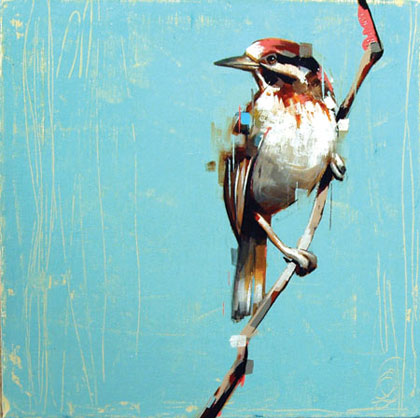
image
"Sharp VII," 12×12" acrylic on canvas, by Frank Gonzales

Nate

:

The quotations, images, and embedded media in this blog are the work of the credited authors, artists, and publications, and are employed in the spirit of fair use, commentary, and criticism. We always link to the original source of material we cite. If you think we’ve missed something, let us know. The inclusion of media on this site should not imply its owners’ endorsement (or for that matter awareness) of this book, blog, or the blog’s curators and commentators. Though we hope they’d like us.

[Culture Making] was smart, challenging, and most of all very humane. I couldn’t stop thinking about it and talking about it long after I finished reading.


?

Tara, educator living
in Cambridge, Mass.

horizons of the possible  cultural worlds  music  photography  art  technology and change  food and drink  europe  community  gardens and cities  cultivation and creation  asia  books  africa  language  children  literature  writing  painting  movies  video  cities  family  changing the world  gestures and postures  power  internet  business  medicine  poverty  grace  consumption  government  technology  education  color  reading  animals  india  architecture  maps  money  poetry  visual arts  trends  performing arts  disciplines  transport  agriculture  3 12 120  design  travel  war  south america  economics  transit  sculpture  tv  communication  film  science  revelation  work  advertising  psychology  churches  clothing  france  infrastructure  sport  england  home  unintended consequences  fashion  politics  street view  failure  generations  bible  copying  history  story  craft  women  humor  christmas  china  creativity  pop culture  water  california  museums  time  landscape  development  nature  remixes  play  discipline  creation  new york  computers  dance  kevin kelly  suburbs  parents  furniture  middle east  least of nations  charity  naming  primordial stories  japan  stories  stewardship  journalism  religion  russia  neighborhoods  germany  light  church  mission  mexico  words  law  love  australia  cell phones  islam  traces of god  italy  names  drawing  games  media  heroes  libraries  david taylor  entertainment  creation and cultivation  new jerusalem  statistics  shopping  typography  twitter  redemption  space  graffiti  buildings  change the world  pentecost and beyond  philanthropy  translation  beauty  visual art  marriage  risk  data  tradition  safety  rob walker  cultivation  race  finance  cars  alphabets  engineering  sound  wilderness  lists  signs  military  death  innovation  service  modernity  condemnation  critique  google  environmentalism  christianity  collage  south africa  television  taste  happiness  natural sciences  lamin sanneh  migration  environment  philosophy  illustration  noise  memes  19th century  reconciliation  ideas  prison  crime  memory  nigeria  genesis  wealth  nostalgia  pets  recreation  tools  metaphor  heaven  monasticism  friendship  leisure  irony  multiculturalism  canada  prayer  oceana  kenya  vision  john stackhouse  news  latin america  paper  stone  afghanistan  convergence  turkey  voice  babel  public space  future  wonder  animation  peru  walls  invention  small towns  illness  physics  israel  radio  vocation  donald miller  consumerism  criticism  walking  scripture  jesus as culture maker  universities