
Nate
:
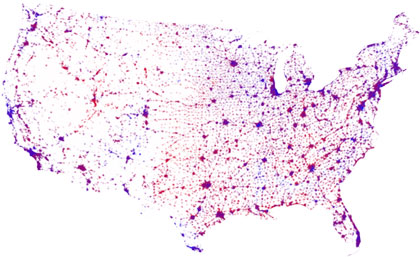
 They vote by night
Nate
: Cicero, Illinois
Nate
: Worship first, then farm
Nate
:

To Schmidt and others, these new findings suggest a novel theory of civilization. Scholars have long believed that only after people learned to farm and live in settled communities did they have the time, organization and resources to construct temples and support complicated social structures. But Schmidt argues it was the other way around: the extensive, coordinated effort to build the monoliths literally laid the groundwork for the development of complex societies.
The immensity of the undertaking at Gobekli Tepe reinforces that view. Schmidt says the monuments could not have been built by ragged bands of hunter-gatherers. To carve, erect and bury rings of seven-ton stone pillars would have required hundreds of workers, all needing to be fed and housed. Hence the eventual emergence of settled communities in the area around 10,000 years ago. “This shows sociocultural changes come first, agriculture comes later,” says Stanford University archaeologist Ian Hodder, who excavated Catalhoyuk, a prehistoric settlement 300 miles from Gobekli Tepe. “You can make a good case this area is the real origin of complex Neolithic societies.”


Nate
:Think globally, lunch locally
Andy
:Several years ago, I lost my patience with our alienated, unattached world at lunch one day. I was waiting to get a sandwich at a place called Au Bon Pain. It’s a chain, it’s cheap enough, it’s fine. I was in a bit of a hurry. I eat late and the place was empty. There was no one in line, but I obediently stood in the proper place between the stanchions and waited to be told to approach the counter. Two sandwich makers were talking to each other behind the counter. They looked up, and I stepped forward meekly, and they continued their conversation. Fine, I waited. And waited. They laughed, I presume at me. I gave the customary attention-seeking cough and laser stare. Eventually one of them asked what I wanted in a surly tone and with a put-out look. The other guy slowly made the sandwich. I went back to the office to eat. The sandwich had tomato on it. I asked for no tomato.
I vowed never, ever buy lunch on a workday from a stranger again. It was a solemn vow that I break only under drastic circumstances. So, now I get lunch from Frank, Art, or Tommy, guys I have come to be friends with who run three different places. I like them. I think all three are funny, and they usually laugh at my jokes, which is key. I don’t see them except for lunch, but that’s fine. I enjoy spending money where I know the people. Lunch is now a little social part of my day, and I feel like I work in a real neighborhood, which it really isn’t. I love being a regular. I love purposefully limiting my choices instead of expanding them. Most of all, I think that I enjoy being loyal just for the sake of being loyal.
I don’t ever hate lunch anymore. I consider lunch one of my greatest triumphs.
Getting beyond “I don’t know”
Nate
:This organization, and this sanitary pads project, comes as a result of many years of working with girls in Kenya, seeing problems, and searching for solutions. And it comes from living in Kenya for more than seven years now, and revising the way I see the world in light of new information and new experiences.
When I worked for five years with former street children, our organization’s biggest costs per child were bread and sanitary pads. I realized this was a national problem, that girls across the country went through horrible things during their periods.
This to me was a question of social justice. The poverty that mires 64% of Kenyans is unjust. To allow girls and their future families to sink further into poverty because they lack the funds necessary to stem the flow of their monthly menstruation and sit out of school four days a month—I cannot be the person who knows but remains on the sidelines. I believe the words of my high school mentor, Denise Fuller, who said, “the easiest words for someone to say are ‘I don’t know’. Because, once we know, we are required to do something.”
Keeping the Internet at bay
Andy
:Really, it’s terrible. How this prototype ever made it into production I don’t know. It’s as if its creators had never seen an iPhone. Or a Walkman, for that matter. Where have they been? And the Internet capability that the device offers (almost exclusively so you can download books and other reading material from Amazon) is so poor — its parameters so hard to determine, its browser so ungracious and inaccessible — that you’re discouraged from ever exploiting it.
At the same time, and you’d be justified in thinking I’m just seeking a silver lining to rationalize my homely new purchase (it cost $360, after all), there’s some way in which the Kindle’s weak Internet connection and elusive browser are the best parts of the machine. As I said, the Kindle feels insular and remote from the wild world of commerce and buzzing data swarms. But the fact that it’s connected to the Web sort of — it has to be, right? Or how else could I download all these books? — makes the Kindle somehow better than a book. Because while I like a few hours on an airplane, I can’t say I want to move into a locked library carrel and never visit the Internet again. And I like that the Kindle, which connects to the Web through some proprietary Amazon entity called a Whispernet, is not completely out of it. The Kindle acknowledges the Internet; it hears its clamorous demands. It just ignores those demands. For the user, this means the Kindle bestows on the contemporary reader the ultimate grace: it keeps the Internet at bay.
 Inshallah

Finance | Too bad nobody in the West thought of it: Islamic banking is better weathering the meltdown because sharia law curbs excessive risk-taking, with bans on interest and trading in debt. The strictures on usury mean investments only in “productive enterprises.” [Washington Post]
Old man, look at my ride
Nate
:This is the sort of work that’s making Goodwin famous in the world of underground car modders. He is a virtuoso of fuel economy. He takes the hugest American cars on the road and rejiggers them to get up to quadruple their normal mileage and burn low-emission renewable fuels grown on U.S. soil—all while doubling their horsepower. The result thrills eco-evangelists and red-meat Americans alike: a vehicle that’s simultaneously green and mean. And word’s getting out. In the corner of his office sits Arnold Schwarzenegger’s 1987 Jeep Wagoneer, which Goodwin is converting to biodiesel; soon, Neil Young will be shipping him a 1960 Lincoln Continental to transform into a biodiesel—electric hybrid.
His target for Young’s car? One hundred miles per gallon.

Nate
:No one ever knows how much power they have. You know, certainly, when you are having sex. You can count your money. But there is no way to reliably measure power, especially at the moments when we most want and need it.
—Culture Making, p.222
We don’t call it music at all
Nate
:‘Are you fond of music, Mr. West?’ Edith asked.
I assured her that it was half of life, according to my notion.
‘I ought to apologize for inquiring,’ she said.
‘It is not a question that we ask one another nowadays; but I have read that in your day, even among the cultured class, there were some who did not care for music.’
‘You must remember, in excuse,’ I said, ‘that we had some rather absurd kinds of music.’
‘Yes,’ she said, ‘I know that; I am afraid I should not have fancied it all myself. Would you like to hear some of ours now, Mr. West?’
‘Nothing would delight me so much as to listen to you,’ I said.
‘To me!’ she exclaimed, laughing. ‘Did you think I was going to play or sing to you?’
‘I hoped so, certainly,’ I replied.
Seeing that I was a little abashed, she subdued her merriment and explained. ‘Of course, we all sing nowadays as a matter of course in the training of the voice, and some learn to play instruments for their private amusement; but the professional music is so much grander and more perfect than any performance of ours, and so easily commanded when we wish to hear it, that we don’t think of calling our singing or playing music at all.

Andy
: Publishers Weekly: One of the best books of the year
In embarrassingly good company including books by Kathleen Norris, Shane Claiborne and Chris Haw, Phyllis Tickle, and Gustav Niebuhr, Culture Making: Recovering Our Creative Calling has been named one of the best religion books of the year.
Though aren’t there still two months left? Well, in any case, it’s a great honor.


I can’t recall a time when I’ve had to read anything other than the Scriptures so slowly and deliberately—Culture Making was that thought provoking.
?
Ben, professor of management
living in Winneconne, Wisconsin