Culture Making is now archived. Enjoy five years of reflections on culture worth celebrating.
For more about the book and Andy Crouch, please visit andy-crouch.com.

Andy

:
from "Following Christ 2008 Theme: Human Flourishing," InterVarsity Christian Fellowship, 8 March 2008

Are there universal elements of human flourishing, things that every person needs to flourish? If so, which of these are immediate gifts of God and which can be created, shaped, or nourished by the practice of the academic and professional disciplines?

Why do men and women fail to flourish? To what extent does sin, both personal and systemic, account for this failure?

In the face of such failure, how is the gospel good news and how does it help us flourish ourselves within our vocations and beyond?

Is it really true that to fully flourish one must be a follower of Jesus? How can such an outrageous claim be presented compellingly in our culture?

Must our bodies be doing well for us to flourish? In what ways does our embodiment affect our flourishing?

What does pursuing excellence have to do with human flourishing? Is elitism inherent in excellence, and does it impede human flourishing in a diverse society?

Will the career and personal path I’m on lead to my flourishing and that of others? Are my vocation and occupation in sync? Should I perhaps change paths, and how can I know?

What kinds of suffering stifle human flourishing, and what kinds can contribute to it?

How can we prepare to flourish and help others flourish in the face of an uncertain future and rapid social, cultural, economic, and technological change?

image
Tundra quilt, 20 by 23 inches, by Leah Evans Textiles :: via Design Boom

Nate

:
newsViews Chestertonian and canine

Gratifying reviews of Culture Making continue to appear, and two recent ones are especially great to see. Karl Johnson, who directs the marvelous program at Chesterton House in Ithaca, New York, has posted an in-depth review, mostly positive but also including some judicious expansion on themes I treated too scantily in the book. Karl writes,

Culture Making is an exceptional book. It is a manifesto of sorts, challenging Christians to live differently in the 21st century than we have in the 20th. It is a clarion call to stop whining, to stop uncritically imitating and consuming, and above all to stop pretending that we are not part of the problems we perceive in “the Culture.” What would it take, he asks, for Christians to be known primarily as creators—“people who dare to think and do something that has never been thought or done before, something that makes the world more welcoming and thrilling and beautiful?” Great question! My hope and prayer is that this book might accomplish for a generation of young Christians what Walsh and Middleton’s Transforming Vision accomplished a quarter of a century ago—inspiring and motivating them to lead more faithful and culturally meaningful lives.

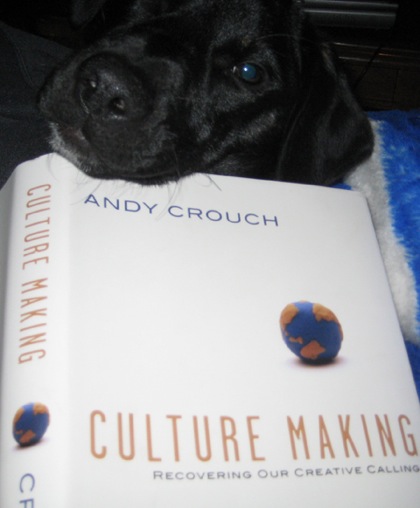
But even more unique and therefore valuable is today’s review of Culture Making by Guinness in Comment magazine from Cardus, who is (to judge by the accompanying photographs) a black Labrador of uncommon intelligence.

For all his enthusiasm, though, Guinness does make the strong case that the book falls short in one crucial respect:

Food is not just an adequate analogy for culture making; in fact, food is the highest form of culture making. If I were to ask you how you contributed to making culture, what response could possibly make me happier than if you said, “I prepare food”?

Fair enough. Many thanks to Karl and to Guinness (and whoever among his human pets helped to transcribe his review). Keep cultivating and creating!


Nate

:

He was describing the ballet of the train station. But his description could just as easily have applied to the Internet. Think about it: Serendipitous encounters between people who know each other well, sort of well, and not at all. People of every type, and with every type of agenda, trying to meet up with others who share that same agenda. An environment that’s alive at all hours, populated by all types, and is, most of the time, pretty safe. What he was saying, really, was that New York had become the Web. Or perhaps more, even: that New York was the Web before the Web was the Web, characterized by the same free-flowing interaction, 24/7 rhythms, subgroups, and demimondes.

Andy

:

In 1982, the neighborhood surrounding Harambee Center had the highest daytime crime rate in Southern California. The corner of Howard and Navarro, where we are located, was called “blood corner” because it was where the most drive-by shootings and failed drug deals occurred. Residents were held captive in their homes and there was little hope for change.

We believed the only legitimate way to become change-agents in this community was to become a part of it. Led by our founder, Dr. John Perkins, we moved into the community and became neighbors. For 20+ years we have served a 12-block target area, working with African American and Latino children and families.

“Harambee” means “Let’s get together and push” in Swahili. We seek to nurture and equip leadership that will wholistically minister to the community by sharing Biblical truths, in order to achieve the re-building of urban neighborhoods through relocation, reconciliation and redistribution.

Andy

:
from "Online shopping and the Harry Potter effect," by Richard Webb, New Scientist, 22 December 2008

So why, with the cornucopia of goodies now available to us, are blockbusters not just still here, but getting bigger? On the face of it, Anderson’s idea of a divergence of tastes in the digital era is logical. But if the long tail effect does not exist, or is not as pronounced as was thought, what is really going on?

Elberse says it’s a bit like the influence of multichannel television on the economics of sport. In the old days, if you wanted to watch soccer, you went to watch your local team in the flesh. Now, she says, in the UK you are more likely to decide to stay at home and watch Chelsea play Arsenal. This change of allegiance cuts the cash flowing into the ticket office of your local club while boosting advertising revenues for TV, which accrue disproportionately in favour of the already wealthy top clubs.

It is a phenomenon known to economists as the Matthew effect, after a quotation from the gospel of that name: “For unto every one that hath shall be given.” Just as for the long tail effect, there is a plausible explanation of why it should be happening in the modern media environment: easy digital replication and efficient communication through cellphones, email and social networking sites encourage fast-moving, fast-changing fads. The result is a homogenisation of tastes that boosts the chances of popular things becoming blockbusters, making the already successful even more successful.

Nate

:
from Love in the Ruins, by Walker Percy

Barbecuing in my sackcloth.

The turkey is smoking well. The children have gone to bed, but they’ll be up at dawn to open their presents.

The night is clear and cold. There is no moon. The light of the transmitter lies hard by Jupiter, ruby and diamond in the plush velvet sky. Ellen is busy in the kitchen fixing stuffing and sweet potatoes. Somewhere in the swamp a screech owl cries.

I’m dancing around to keep warm, hands in pockets. It is Christmas Day and the Lord is here, a holy night and surely that is all one needs.

On the other hand, I want a drink. Fetching the Early Times from a clump of palmetto, I take six drinks in six minutes. Now I’m dancing and singing old Sinatra songs and the Salve Regina, cutting the fool like David before the ark or like Walter Huston doing a jig when he struck it rich in the Sierra Madre.

photo

Andy

:

Nate

:

Andy

:
from "a Christmas Eve thought," by Alan Jacobs, Text Patterns, 24 December 2008

There is no more dangerous or disgusting habit than that of celebrating Christmas before it comes, as I am doing in this article. It is the very essence of a festival that it breaks upon one brilliantly and abruptly, that at one moment the great day is not and the next moment the great day is. Up to a certain specific instant you are feeling ordinary and sad; for it is only Wednesday. At the next moment your heart leaps up and your soul and body dance together like lovers; for in one burst and blaze it has become Thursday. I am assuming (of course) that you are a worshipper of Thor, and that you celebrate his day once a week, possibly with human sacrifice. If, on the other hand, you are a modern Christian Englishman, you hail (of course) with the same explosion of gaiety the appearance of the English Sunday. But I say that whatever the day is that is to you festive or symbolic, it is essential that there should be a quite clear black line between it and the time going before. And all the old wholesome customs in connection with Christmas were to the effect that one should not touch or see or know or speak of something before the actual coming of Christmas Day. Thus, for instance, children were never given their presents until the actual coming of the appointed hour. The presents were kept tied up in brown-paper parcels, out of which an arm of a doll or the leg of a donkey sometimes accidentally stuck. I wish this principle were adopted in respect of modern Christmas ceremonies and publications. Especially it ought to be observed in connection with what are called the Christmas numbers of magazines. The editors of the magazines bring out their Christmas numbers so long before the time that the reader is more likely to be still lamenting for the turkey of last year than to have seriously settled down to a solid anticipation of the turkey which is to come. Christmas numbers of magazines ought to be tied up in brown paper and kept for Christmas Day. On consideration, I should favour the editors being tied up in brown paper. Whether the leg or arm of an editor should ever be allowed to protrude I leave to individual choice.

image
from "Ben's Chili Bowl," by Christian Tribastone, Flickr, 8 December 2008 :: via Urban Sketchers

Nate

:
excerpt Goat, $75

Andy

:

The early-morning bleating of a dairy goat is a happy sound for children in countries like Haiti and Kenya — they know it’s ready to be milked. A goat nourishes a family with protein-rich milk, cheese, and yogurt, and can offer a much-needed income boost by providing offspring and extra dairy products for sale at the market. It even provides fertilizer that can dramatically increase crop yields!

by Andy Crouch for Culture Making

Every three months—in March, June, September, and December—the Crouches do something absolutely essential to our spiritual health as a family. We give away a substantial amount of money.

I am not reticent about disclosing the exact amounts that we make, save, spend, and give. In fact I believe that no church or Christian community can be healthy without talking about real dollars rather than the absurdly vague hand-waving that often passes for discussion of financial stewardship. Several times over the past few years I have handed out a complete Crouch family income and expense statement to fellow members of our church. Not so much because we are models of stewardship—we are by many standards absurdly wealthy and absurdly stingy—but because I am convinced that our spiritual health requires transparency and vulnerability in this area. And believe me, distributing a complete statement of how you have handled your money (or, more precisely, the money God has entrusted to you) is transparent and vulnerable!

Disclosing these details online is a different matter. Somehow our culture has gotten things exactly upside down. We are vulnerable and transparent online in ways we never would be in person. This is cheap transparency, based on virtual intimacy, and I won’t indulge in it here.

But at this time when the whole world is reeling from the effects of an economic crisis brought on, among other things, by a series of extraordinary conspiracies of silence about the truth of money—including millions of Americans taking on debts they could not reasonably expect to repay, thousands of companies taking risks they could not calculate using financial instruments no one could understand, and most recently hundreds of investors entrusting their wealth to a man who refused to tell them what he did to make it grow—it seems worth saying that by far the best thing Catherine and I have done with our money, in fat years and lean years, was to give some of it away, and to try to order our lives so that we could give away more and more.

So during these last days of the year, I want to celebrate the cultural goods created by the amazing non-profit organizations Catherine and I have the privilege of supporting. I’ll also post a few thoughts about how we give, and why—in the hope that as all of us prepare for whatever 2009 may bring, we will enter it with the joy of people who have entrusted everything to the one who gave everything for us. Merry Christmas.

image
from "A clock for identity designers," by Tanner Woodford, fill/stroke.com , 15 December 2008 :: via Brand New

Nate

:

Nate

:
a Tomorrow Museum aside by Joanne, 19 December 2008

If you were on the Internet this week you probably heard that love can no longer exist in the age of the romantic comedy. But like all cultural artifacts, while 95% of the output is rubbish, there are some real gems. I love Sliding Doors and Bridget Jones’ Diary isn’t all that bad. Next Stop Wonderland is one of my all-time favorite movies. (NYT captures it perfectly in this 1998 review.) Little Black Book is actually a weird Network-inspired satire and I’d consider Neil LaBute ’s The Shape of Things a rom-com too. To believe the genre is inherently stupid is like dismissing horror because Eli Roth makes movies.

The quotations, images, and embedded media in this blog are the work of the credited authors, artists, and publications, and are employed in the spirit of fair use, commentary, and criticism. We always link to the original source of material we cite. If you think we’ve missed something, let us know. The inclusion of media on this site should not imply its owners’ endorsement (or for that matter awareness) of this book, blog, or the blog’s curators and commentators. Though we hope they’d like us.

[Culture Making] was smart, challenging, and most of all very humane. I couldn’t stop thinking about it and talking about it long after I finished reading.


?

Tara, educator living
in Cambridge, Mass.

horizons of the possible  cultural worlds  music  photography  art  technology and change  food and drink  europe  community  gardens and cities  cultivation and creation  asia  books  africa  language  children  literature  writing  painting  movies  video  cities  changing the world  family  gestures and postures  power  business  internet  medicine  consumption  government  technology  poverty  grace  education  color  reading  animals  india  architecture  poetry  maps  money  visual arts  performing arts  trends  agriculture  3 12 120  design  disciplines  transport  south america  travel  war  transit  sculpture  tv  communication  film  science  economics  work  advertising  psychology  churches  revelation  england  clothing  france  infrastructure  sport  home  unintended consequences  fashion  politics  bible  copying  street view  failure  generations  women  humor  christmas  china  creativity  history  story  craft  museums  time  landscape  development  nature  pop culture  water  california  new york  computers  dance  kevin kelly  suburbs  remixes  play  discipline  creation  least of nations  charity  naming  japan  primordial stories  parents  middle east  furniture  religion  russia  neighborhoods  germany  light  church  stories  stewardship  journalism  australia  love  cell phones  islam  traces of god  italy  names  drawing  games  media  mission  mexico  words  law  shopping  typography  twitter  redemption  space  graffiti  buildings  change the world  pentecost and beyond  philanthropy  translation  libraries  heroes  entertainment  david taylor  creation and cultivation  new jerusalem  statistics  cultivation  race  finance  cars  alphabets  engineering  sound  wilderness  lists  signs  military  death  beauty  visual art  marriage  risk  data  tradition  safety  rob walker  google  environmentalism  christianity  collage  south africa  television  taste  happiness  natural sciences  lamin sanneh  migration  environment  illustration  philosophy  noise  memes  19th century  reconciliation  ideas  prison  crime  innovation  service  modernity  condemnation  critique  irony  multiculturalism  canada  oceana  prayer  kenya  vision  john stackhouse  news  latin america  paper  stone  afghanistan  convergence  turkey  voice  babel  public space  future  wonder  animation  memory  nigeria  genesis  wealth  nostalgia  recreation  pets  tools  metaphor  monasticism  heaven  friendship  leisure  scripture  universities  jesus as culture maker  gospel  scale  haiti  ministry  communities  social sciences  toys  plastic  quotes  bodies  breakfast  nations  sports