Nate
:
The society which scorns excellence in plumbing because plumbing is a humble activity, and tolerates shoddiness in philosophy because philosophy is an exalted activity, will have neither good plumbing nor good philosophy. Neither its pipes nor its theories will hold water.
—John Gardner, in Excellence (1961)
 In the form of a baby
Andy
:
Human beings, left to themselves, have imagined God in all sorts of shapes; but – although there were one or two instances, in Ancient Greece and Ancient Egypt, of gods being pictured as boys – it took Christianity to introduce the world to the idea of God in the form of a baby: in the form of complete dependence and fragility, without power or control. If you stop to think about it, it is still shocking. And it is also deeply challenging.
God chose to show himself to us in a complete human life, telling us that every stage in human existence, from conception to maturity and even death, was in principle capable of telling us something about God. Although what we learn from Jesus Christ and what his life makes possible is unique, that life still means that we look differently at every other life. There is something in us that is capable of communicating what God has to say – the image of God in each of us, which is expressed in its perfection only in Jesus.
Hence the reverence which as Christians we ought to show to human beings in every condition, at every stage of existence. This is why we cannot regard unborn children as less than members of the human family, why those with disabilities or deprivations have no less claim upon us than anyone else, why we try to make loving sense of human life even when it is near its end and we can hardly see any signs left of freedom or thought.
 Greenback, Tennessee
Nate
: Gained in translation

 Mr. Anubis comes to America
Andy
:
Anubis, that wacky Egyptian god with the head of a jackal and the body of a human, is hanging around Dallas/Fort Worth International Airport.
Actually, a 26-foot-tall statue of Mr. Anubis, known as the god of the dead or the underworld, was installed Friday at Founders Plaza, at the airport’s northwest corner.
There he’ll stand for a while, watching airplanes take off and land with the other Founders Plaza planewatchers.
Mr. Anubis, with his back to the airport as he faces north, is there to celebrate the King Tut exhibit at the Dallas Museum of Art. Says airport CEO Jeff Fegan:
The placement of Anubis at our highly popular Founders’ Plaza observation area highlights the cultural and economic significance of DFW International Airport to the North Texas region.
This will allow thousands of local citizens and international tourists to get a up-close look at this unique statue and allow DFW a great opportunity to support the DMA as part of our Owner Cities Program.
To see this fine bit of statuary, go south on Texas Trail off of State Highway 114 until you can’t go any more.
And yes, that is a candy cane in Mr. Anubis’ hand.

Nate
:Passport census
Nate
:I also admire the State Department’s evident desire to create an Album of America—a collection of snapshots that, over the course of the passport’s twenty-eight pages, catalogues the members of our national family. And I am impressed with the diversity the State Department has achieved. Aside from (i) the distant silhouettes of the passengers and crew of the Mississippi Steamer and the Yankee Clipper, (ii) a shadowy herd of cows, and (iii) the identification photograph of the passport holder, the new passport depicts American life in the following numbers:
| Geese: | 13 |
| Male Humans: | 11 |
| Longhorn Cattle: | 8 or 9 |
| Bald Eagles: | 6 |
| Horses: | 3 |
| Totemic Spirits: | 3 |
| Bison: | 2 |
| Oxen: | 2 |
| Seagulls: | 1 |
| Grizzlies: | 1 |
| Salmon: | 1 |
| Female Humans: | 1 |
Of the eleven men, nine are white. The other two are cowboys whose race is rendered indeterminate by their Stetson hats. The lone woman is the Statue of Liberty.
 Making of a chair
Andy
:One hand, one heart, two tongues
Nate
:Added excitement comes from the bilingual reworking of the libretto. When Maria sings I Feel Pretty it comes out as: “Hoy me siento/Tan Hermosa/Tan preciosa que puedo volar/Y no hay diosa, en el mundo, que me va a alcanzar.”
Lin-Manuel Miranda, creator of the recent hit musical In The Heights, which focuses on a poor neighbourhood of Manhattan’s Washington Heights faced with gentrification, was recruited to rewrite the lyrics. The Sharks sing in Spanish, with English surtitles, while the delinquent Jets sing in English.
Laurents was given the idea of a bi-lingual show after his companion, Tom Hatcher, who died two years ago, saw an all-Spanish staging of the musical in Colombia in which the Sharks – the Capulets of Shakespeare’s play – were transformed into heroes, the Jets into villains.
Laurents intends to make the new version darker and more threatening than previous stagings, certainly more so than the film, of which he is disparaging. “I thought the whole thing was terrible. Day-Glo costumes and fake accents!” he told the Washington Post.
 AsLOLn
Nate
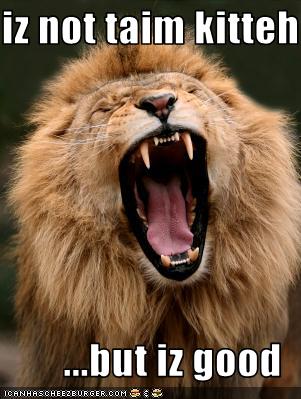
:LOLCat-tharsis
Nate
:Internet | The meaning of LOLcats, explained by a Psychology Today editor: “Just as the dogs in the New Yorker cartoons don’t represent actual dogs, these cats don’t represent cats at all, but people. By using cats, icanhascheezburger can access themes more tragic and poignant than it could using people.” [Salon]
Not just optimistic
Andy
:Perhaps we’re on the verge at getting much better at making useful things, spreading ideas that matter and helping people, and not quite so good at leveraging capital for financial institutions. Imagine what would happen if 5,000 investment bankers or 500 M & A lawyers put their talents to work doing something else…
As I look through all the notes and applications I received for the program I’m running next year, I’m not just optimistic. I’m thrilled. There must be hundreds of thousands of movers and shakers out there, people of all ages who are smart and get things done. And more and more, they’re being motivated by the quest, or the outcome, or the people they work with, not just the cash payout. It’s exciting beyond words. The ten people I’ve chosen are just astonishing, each and every one of them.
If you can’t find people like these, you’re not looking in the right places. And if you can’t figure out how to work with them, you’re missing out.
Andy
:The presence of Father Christmas [in The Lion, the Witch and the Wardrobe] bothered many of Lewis’s friends, including J.R.R. Tolkien. Tolkien, whose Middle-earth was free of the legends and religions of our world, objected to Narnia’s hodgepodge of motifs: the fauns and dryads lifted from classic mythology, the Germanic dwarfs and contemporary schoolboy slang lumped in with the obvious Christian symbolism.
But Lewis embraced the Middle Ages’ indiscriminate mixing of stories and motifs from seemingly incompatible sources. The medievals, he once wrote, enthusiastically adopted a habit from late antiquity of “gathering together and harmonizing views of very different origin: building a syncretistic model not only out of Platonic, Aristotelian and Stoical, but out of pagan and Christian elements.” . . .
The unifying principle of Narnia, unlike the vast complex of invented history behind Middle-earth, isn’t an illusion of authenticity or purity. Rather, what binds all the elements of Lewis’s fantasy together is something more like love. Narnia consists of every story, legend, myth or image — pagan or Christian — that moved the author over the course of his life.
Hymn 101, by Joe Pug
Nate
:


This is must-read stuff, and not just for artists. It’s food for thought for any Christian wishing to make a meaningful contribution to their world.
?
Jennifer, professional soprano living in Madison, Wisconsin