Nate
:

And the Oscar for best Hollywood courtroom drama goes to . . . the Academy of Motion Picture Arts and Sciences. The golden statuette was awarded Monday by a Los Angeles Superior Court jury, which ruled that if Mary Pickford’s heirs want to sell it, they have to offer it to academy officials for $10 instead of auctioning it off for as much as $800,000. Academy leaders took a Rancho Mirage woman, her daughter and a cousin to court after the women announced plans to sell the Oscar presented in 1930 to the silent-movie star known as “America’s sweetheart” and donate the proceeds to charity.
 Baby on board
Nate
:
In truth, experts say, the developing world doesn’t need more incubators. It needs incubators that work. Over the years, thousands have been donated from rich nations, only to end up in “incubator graveyards” — most broken, some never opened. According to a 2007 study from Duke University, 96 percent of foreign-donated medical equipment fails within five years of donation — mostly because of electrical problems, like voltage surges or brownouts or broken knobs, or because of training problems, like neglecting to send user manuals along with the devices.
To compensate for this philanthropic shortsightedness, medical staffs either crank up the temperature in “incubator rooms” to 100 degrees or more, or swaddle babies in plastic to hold in body heat. Such makeshift solutions led the Boston team to ask: How can we make an incubator for the developing world that will get fixed? . . .
In his discussions with doctors who practice in impoverished settings, Dr. Rosen learned that no matter how remote the locale, there always seemed to be a Toyota 4Runner in working order. It was his “Aha!” moment, he recalled later: Why not make the incubator out of new or used car parts, and teach local auto mechanics to be medical technologists?
The MagnifiCat (srsly)
Nate
: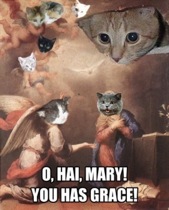
Mary sed “Ceiling Cat is laik a big deal, Mai I is happy about Ceiling Cat… bcz he kepted me in maind an now evribodi knowz i can haz cheezburgr. Thank u Ceiling Cat, u iz cool. U iz niec to evribodi. Xcept peeplz who doant dizrv it LOL. U haz pwned teh r00lrz whiel stil bein niec to teh n00bz. U givd cookies to teh hungri whiel u tolded teh rich “Niec trai.” U wuz niec to Israel an to all Abraham’s famili liek u promist.”

Nate
:
Literature | How would Jack Kerouac cope with Microsoft Word? Not very well, a blogger imagines, for “the birth of the computer has led, largely, to the death of the genuine stream of consciousness novel.” It “allows us to delete, shift sections around and continually edit, in the way that Kerouac, writing on his lengthy scrolls [for “On the Road”], could not.” [Guardian]
Texting in cuneiform
Nate
:
Held in the hand, a typical cuneiform tablet is about the same weight and shape as an early mobile phone. Hold it as though you were going to text someone and you hold it the way the scribe did; a proverb had it that ‘a good scribe follows the mouth.’ Motions of the stylus made the tiny triangular indentations of cuneiform characters in the clay. The actions would have been much quicker and more precise, but otherwise rather like the pecks you make at a phone keypad.
Some tablets are of course larger. Gilgamesh, thousands of words long, is an epic in 12 tablets more than a foot high, and inscriptions carved in rock are more expansive still. But it is the small tablets with tiny writing that are the most tantalising objects in Babylon, Myth and Reality (at the British Museum until 15 March). Can one, through them, get beyond archaeological evidence and inference, bypass the fevered imagination of William Blake’s and John Martin’s Bible illustrations and hear the voice of a Mesopotamian Pepys?
Well, not exactly, but the range and character of what is written down give some idea of the texture of everyday life in Nebuchadnezzar’s Babylon. The majority of tablets may be the equivalent of office files – letters, legal documents, contracts, mortgages, lists of goods – but there are also messages addressed to the gods, some of them expressing indignance that good behaviour has not been rewarded. Astronomical observations are detailed and medical texts full of diagnostic descriptions. There are records of refurbishments: the kings, who had responsibility not just for religious ceremonies but for the maintenance of temple structures, celebrated their building works.
When the kings come marching in, then, they bring the best of their nations—even the cultural goods that had been deployed against God and his people. The final vision of the City is one filled, not just with God’s glory and presence, not just with his own stunningly beautiful architectural designs, not just with redeemed persons from every cultural background—but with redeemed human culture too.
—Richard Mouw, When the Kings Come Marching In: Isaiah and the New Jerusalem, p.24
Nabokov on the translator’s art
Nate
:It was as if someone, having seen a certain oak tree (further called Individual T) growing in a certain land casting its own unique shadow on the green and brown ground, had proceeded to erect in his garden a prodigiously intricate piece of machinery which in itself was as unlike that or any other tree as the translator’s inspiration and language were unlike those of the original author, but which, by means of ingenious combinations of parts, light effects, breeze-engendering engines, would, when completed, cast a show exactly similar to that of Individual T—the same outline, changing in the same manner, with the same double and single spots of sun rippling in the same position, at the same hour of the day.


Nate
: People of the screen, part deux
Andy
:The overthrow of the book would have happened long ago but for the great user asymmetry inherent in all media. It is easier to read a book than to write one; easier to listen to a song than to compose one; easier to attend a play than to produce one. But movies in particular suffer from this user asymmetry. The intensely collaborative work needed to coddle chemically treated film and paste together its strips into movies meant that it was vastly easier to watch a movie than to make one. A Hollywood blockbuster can take a million person-hours to produce and only two hours to consume. But now, cheap and universal tools of creation (megapixel phone cameras, Photoshop, iMovie) are quickly reducing the effort needed to create moving images. To the utter bafflement of the experts who confidently claimed that viewers would never rise from their reclining passivity, tens of millions of people have in recent years spent uncountable hours making movies of their own design. Having a ready and reachable audience of potential millions helps, as does the choice of multiple modes in which to create. Because of new consumer gadgets, community training, peer encouragement and fiendishly clever software, the ease of making video now approaches the ease of writing.
This is not how Hollywood makes films, of course. A blockbuster film is a gigantic creature custom-built by hand. Like a Siberian tiger, it demands our attention — but it is also very rare. In 2007, 600 feature films were released in the United States, or about 1,200 hours of moving images. As a percentage of the hundreds of millions of hours of moving images produced annually today, 1,200 hours is tiny. It is a rounding error.
We tend to think the tiger represents the animal kingdom, but in truth, a grasshopper is a truer statistical example of an animal. The handcrafted Hollywood film won’t go away, but if we want to see the future of motion pictures, we need to study the swarming food chain below — YouTube, indie films, TV serials and insect-scale lip-sync mashups — and not just the tiny apex of tigers. The bottom is where the action is, and where screen literacy originates.

Nate
:Not as I do
Nate
:One surprising truth about hypocrisy is its irrelevance: the fact that someone is a hypocrite does not mean that his or her position on an issue is false. Environmentalists who litter do not by doing so disprove the claims of environmentalism. Politicians who publicly oppose illegal immigration but privately employ illegal immigrants do not thereby prove that contesting illegal immigration is wrong. Even if every animal-rights activist is exposed as a covert meat eater, it still might be wrong to eat meat.
More generally, just because a person does not have the fortitude to live up to his or her own standards does not mean that such standards are not laudable and worth trying to meet. It therefore seems that charges of hypocrisy prove nothing about a topic. Why, then, are they so potent?
The answer is that such allegations summon emotional, and often unconscious, reactions to the argument that undermine it. Such indictments usually serve as attacks on the authority of their targets. Once the clout of an advocate is weakened, the stage is set for dismissal of the proponent’s position.
Nate
:Architecture | Can you copyright an iconic building? That’s the issue raised by an expensively marbled clone of India’s Taj Majal built in Bangladesh by a wealthy filmmaker, who says he built it for Bangladeshis too poor to travel to see the real thing. Indian official: “You can’t just go out and copy historical monuments.” Bangladeshi: “Show me where it says that emulating a building like this can be illegal.” [Times of London]
Obey

Nate
:
Side 1
Alowo Majaiye
Aiye Laba Ohun Gbogbo
Rora
Gba Mi Lowo Ota
Ma Di Oni Kanra
Ile Baba MI
Side 2
Miliki
Pepeiye Bimo
Maje Nyo Aiye Wa
Baiye Nsata
 Arrivals and departures
Andy
:After all not to create only,
or found only,
But to bring perhaps from afar
what is already founded,
To give it our own identity,
average, limitless, free,
To fill the gross the torpid bulk
with vital religious fire,
Not to repel or destroy so much as accept,
fuse, rehabilitate,
To obey as well as command,
to follow more than to lead . . .
—Walt Whitman, Leaves of Grass


[Culture Making] was smart, challenging, and most of all very humane. I couldn’t stop thinking about it and talking about it long after I finished reading.
?
Tara, educator living
in Cambridge, Mass.