Posts tagged cultural worlds


 So many different kinds of lines


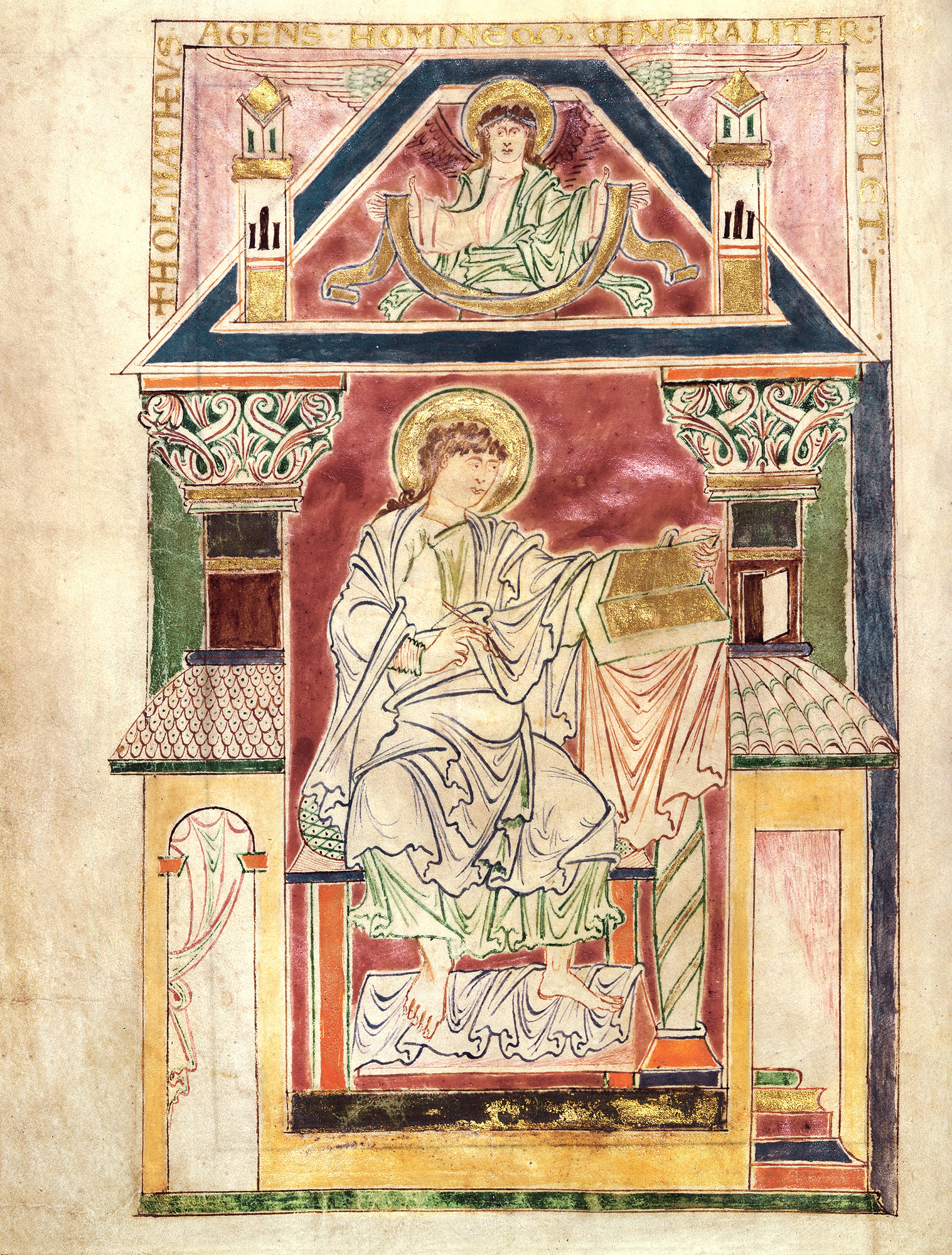
The exhibition is a knockout, at once sumptuous and restrained. The entire show fits into three galleries, but what galleries they are! Holcomb has gathered books and manuscripts from museums, libraries, and religious institutions in Europe and the United States. And it is in these bound volumes that the signal graphic achievements of the Middle Ages are to be found. Everybody, of course, knows the illuminated manuscripts of those centuries, with their dazzlingly colored pages, finished to a jewel-like shimmer. Holcomb’s great idea has been to set those works aside for the time being, and focus instead on what have traditionally perhaps been regarded as humbler fare. These are the pictures done with black or brown or sometimes colored ink, many of which have, at least at first glance, a more casual, more informal character. Such works, she argues, put us in touch with the medieval artist’s most immediate impressions and responses. I think she is absolutely right. There is an easygoing, wonderfully lowdown quality about a lot of the work in this show. We have gotten beyond the delicious formality of the illuminated manuscript. We are seeing artists in a variety of moods, sometimes ruminative or contemplative, at other times more intuitive, more playful. Even when the artists are doing something wonderfully elegant, it is an off-the-cuff elegance, an improvisational elegance. There are so many different kinds of lines to be seen in this show, from skeletal and attenuated to athletic and even frenetic. We see flashes of humor and wit, but also agitation, anxiety, and melancholy.

 Flannery’s voice

 A tale of two counties
D: So the problem isn’t small-town Kansas—it’s a toxic mixture of small-town Kansas plus adolescence?
R: I think so. I like the small-town Kansas where we are now but, believe it or not, small-town Kansas is very heterogeneous. The town where we live now and where I grew up have a lot of significant differences in culture.
D: Tell me more…
R: Mainly it has to do with how people treat each other and how people approach problems. Here, problems are meant to be solved and people have a lot of respect for one another. We have “community conversations” when there’s something that impacts the whole town, and everyone who wants to speak can have their say. Where I grew up, on the other hand, people say all manner of things about other people, and if there’s a problem that affects the town everyone just complains to everyone else. The population even since I left has declined really sharply and everyone just says, “Oh, poor us, look at our dying town, who will save it?” Whereas here they formed an economic development commission and went out looking for new businesses to bring to the community. Some problems are similar, but by and large I think this is a positive place to grow up, and the graduating seniors we know well have said so too.
The other great example of small-town heterogeneity is to look at the counties to the north and south of us. To the north we have County A, where people routinely farm well into their 80’s, have active sex lives into their 90’s, and there has not been a teen pregnancy in almost 10 years. These are the ruddy-cheeked insanely healthy country folk you may have read about. To the south, then, we have County B, where everyone over 40 has diabetes, the obesity rate seems like it’s about 90%, STI’s are rampant and there are currently 8 pregnant girls in the high school. What’s the difference? I have been trying to figure this out. The medical care is exactly the same (it’s our group). The physical infrastructure is not that different. But culturally, people in County B have this victimizing, back-biting mentality.
D: It’s that stark a difference, huh? That’s astonishing.
R: It really and truly is.
 Mongolian Bling
 Merci
Merci
 Whitman sampler
47 kinds of greens
Whitman sampler
47 kinds of greens
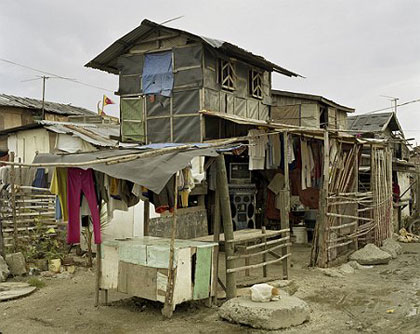
There’s a profound yet simple proverb about ethnocentrism in many African societies (e.g., the Baganda, Akamba, Kikuyu, Bemba, Haya, Igbo, and Yoruba). Translated, it means “The one who has not traveled widely thinks his/her mother is the best cook.”
This proverb often comes to mind when I hear Americans talking about African food, especially Sub-Saharan African food, in a patronizing, superior way, and also lumping a whole continent together in a way they would never dream of doing for other global locations. A missionary in Ghana once sniffed and said to me disparagingly “They eat grass,” when referring to the greens cooked in stews. In Pennsylvania we carefully distinguish among varieties of apples (Rome, Gala, Granny Smith, Red or Golden Delicious, Macintosh, Pink Lady, Ginger Gold, Braeburn, Crispin, Cameo, etc., etc.). In Ghana that discrimination applies to greens, of which it’s documented that people savor 47 different kinds. Just because our palates haven’t been trained to detect the textures, degrees of bitterness, saltiness, etc. doesn’t mean that the food is inferior.
Similarly, people often say that Africans eat some kind of starch, but they lump them all together, without detecting the differences among, say, types of yams, rice, plantains, millets, sorghum, corn, sweet potatoes, potatoes, cassava, taro (cocoyams), even wheat, along with very different methods of preparation (fermented, unfermented, pounded, dried, fresh, boiled, fried, roasted, steamed, stirred, etc.).
 To arrr is human
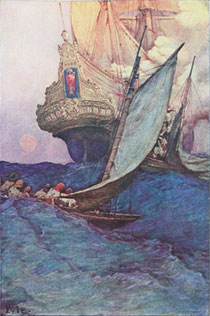
There is another aspect to our fascination with pirates. It is existential rather than political. It is about civilization and its limits, about our need for a sense of home versus a need to break those boundaries altogether. The sea has always played a big role in that dialectic. The sea is, potentially, an avenue for intercommunication and exchange among men. It is, in short, a vast shipping lane. But it is also an outer boundary. The land stops at the sea. The city stops at the sea. We human beings have conquered this earth, mostly and swiftly, but the sea is still unnatural territory for us, we aren\‘t as sure on its surfaces as we are on those harder surfaces more suited to bipeds.
The pirate takes that insecurity and runs with it. Indeed, the word pirate can ultimately be traced back to the ancient Greek word “peira,” which means trial, attempt, experiment. To have peira, to posses peira, is to have gone through an experience. If I try something, I get to know it. In fact, it is out of the collecting of peira that a person constructs the greater web of experience (ex-peira) that makes one person, one person, and another, another.
The pirate is, quite literally, taking a chance. In doing so, pirates reenact the basic process that everyone goes through in becoming a person. You start out with very little sense of the world, and you gradually gain experience and put it all together. Pirates are simply less complacent than the rest of us. For reasons specific to historical circumstance and the accident of birth, some people decide to take that ultimate chance and continue to push the boundary of peira, to become a peirate — a pirate. Such figures dive back into the chaos of the sea, the edges of civilization, the end of the world. That such a journey is wrapped in physical danger, violence, moral ambiguity, cruelty, and heroism is only natural. Things are messy at the limits. Sureness dissolves at the boundaries.



When western music was played to members of the Mafa people from Cameroon who have never been exposed to western music, movies, or art, they were able to recognize the emotions conveyed by the music, even though the Mafa don’t associate emotions with their own music.
Monastic fantastic
Nate
:
"Hans Christian Andersen made several picture books for the children and grandchildren of his friends. We know of approx a dozen picture books, all made after 1850. This picture book, which the poet created together with his friend Adolph Drewsen, is made for the one year old Astrid Stampe (1852-1930), the great granddaughter of Hans Christian Andersen's fatherly benefactor Jonas Collin."
Nate
:Fridge logic
Nate
:“sock barrel”: a collection of roughly identical jokes all about the same thing. Pick one, cut the rest.
“hang a lantern on it”: Instead of trying to hide a script/credibility problem, address it in full measure, so it can be dealt with and discarded. “How does she break into the base?” “Hang a lantern on it, how tough it is to get the codes, but that makes her twice as cool for pulling it off.” This is often a bit of sleight-of-hand, but hell, you’re probably using it to address some—
“fridge logic”: a logic problem in the script that the average viewer would only ask themselves about, say, an hour later when they’re at the fridge getting a snack during commercials. TV is a very tight little medium time-wise, with an enormous amount of hand-waving to begin with. Often a logic problem that seems to smack you in the face because you’ve had the time to read the script, reread it, give notes, break it down, etc. is going to fly by your average—and hopefully emotionally engaged—viewer.
“Well, how’d she get from Dallas to Houston.”
“Commuter flight.”
“Could she make the drive to the airport in time?”
“That’s fridge logic.”
Note that you’re not trying to be lazy here—you’re just dealing with the fact that every line of exposition is a line that isn’t active or particularly interesting, and you only get so many of those in 44 minutes before your show is now boring. Logically flawless, but boring.
Applied semiotics
Nate
:
The Easter drugstore aesthetic is not unlike Midwestern casual apparel circa 1987, filled with pastels, baby animals and references to Jesus. Fluffy bunnies and just-hatched chicks come as colouring books, pinwheels, picture frames, candles, barrettes and bobble-head figurines. Manufacturers clearly abide by a simple holiday marketing formula with two primary modes:
1. Turn symbols into candy;
2. Turn candy into symbols.
To satisfy the first, we’ve got chocolate praying hands (three inches high, with attached religious card), an enormous solid chocolate cross, candy cross bracelets, lollipops printed with “He Lives” and chewy candies shaped like sandals, called “Walking With Jesus” Gummy Treats.
The second category includes the usual holiday favourites: carrot-shaped bags of orange M&Ms, foam cartons full of malt-chocolate eggs, hollow chocolate bunnies and marshmallow Peeps in lurid colours. The cutie-pie marshmallows appear to be the most irresistible: Just Born, the company that produces Peeps, reports annual sales of $1.5 billion. There’s even a sugar-free version.
 Babel bubbles

Nate
: