 Com-moon-ion

[Aldrin] and Armstrong had only been on the lunar surface for a few minutes when Aldrin made the following public statement:
“This is the LM pilot. I’d like to take this opportunity to ask every person listening in, whoever and wherever they may be, to pause for a moment and contemplate the events of the past few hours and to give thanks in his or her own way.”
He then ended radio communication and there, on the silent surface of the moon, 250,000 miles from home, he read a verse from the Gospel of John, and he took communion. Here is his own account of what happened:
“In the radio blackout, I opened the little plastic packages which contained the bread and the wine. I poured the wine into the chalice our church had given me. In the one-sixth gravity of the moon, the wine slowly curled and gracefully came up the side of the cup. Then I read the Scripture, ‘I am the vine, you are the branches. Whosoever abides in me will bring forth much fruit. Apart from me you can do nothing.’ I had intended to read my communion passage back to earth, but at the last minute [they] had requested that I not do this. NASA was already embroiled in a legal battle with Madelyn Murray O’Hare, the celebrated opponent of religion, over the Apollo 8 crew reading from Genesis while orbiting the moon at Christmas. I agreed reluctantly. . . . I ate the tiny Host and swallowed the wine. I gave thanks for the intelligence and spirit that had brought two young pilots to the Sea of Tranquility. It was interesting for me to think: the very first liquid ever poured on the moon, and the very first food eaten there, were the communion elements.”
 “Dispatchwork” in Berlin


My apologies to time for all the world I overlook each second.
My apologies to past loves for thinking that the latest is the first.
Forgive me, distant wars, for bringing flowers home.
Forgive me, open wounds, for pricking my finger.
I apologize for my record of minuets to those who cry from the depths.
I apologize to those who wait in railway stations for being asleep today at five a.m.
—Wislawa Szymborska, trans. by Stanislaw Baranczak and Clare Cavanaugh, "Under One Small Star" (excerpt)

I know the Amish, and Wendell Berry and Eric Brende, and the minimites well enough to know that they believe we don’t need exploding technology to expand ourselves, at least in the proper directions. They are, after all, minimalists. They see most of the promises of freedoms from increased technology as illusionary. In their eyes, technology generates fake choices, meaningless options, or real choices that are really entrapments. This is an argument worth exploring because there is some truth in it. The technium is an autonomous system that tends to favor choices by humans that expand its own reach, which can feel like a type of entrapment. And many choices we make don’t matter.
But the evidence that the technium expands real choices is voluminous. Throughout history there is a one-way march from the farm to the bustling choices of the city. That steady migration is going on today at a shocking rate; More than two million people per day decide they prefer the options that modern technology life offers, so they flee the constrained choices in a picturesque and comforting village somewhere. They can’t all be bewitched. It would be a powerful spell to fool 50% of the people living on this planet.
Those million urban migrants per day have enrolled into the technium for the same reason you have (and you have if you are reading this): to increase your choices. To increase your chances of unleashing your full potential. Perhaps someday someone will invent a tool that is made just for your special combination of hidden talents. Or perhaps you will make your own tool. Most importantly, and unlike the Amish and minimites, you may invent a tool which will help unleash the fullest of someone else. Our call is not only to discover our fullest selves in the technium, but to expand the possibilities for others. We have a moral obligation to increase the amount of technology in the world in order to increase the number of possibilities for the most people. Greater technology will selfishly unleash us, but it will also unselfishly unleash others, our children and all to come.
Dan Wiesel and his wife, Alysa Binder, remember the guilt they felt after their Jack Russell terrier Zoe had to fly cross country in the cargo area of a plane when they moved from the San Francisco Bay area to Florida. “When she came out she just wasn’t herself,” Binder said. “We thought there had to be a better way.” The couple’s answer is Pet Airways, a new airline just for cats and dogs that the couple founded. The airline had its inaugural flights Tuesday from several airports, including BWI Marshall Airport.
There are no human passengers aboard Pet Airways flights, just animals, which are called “pawsengers…”
The airline is sold out for its first two months, Binder said. Pet Airways serves Baltimore, New York, Chicago, Denver and Los Angeles, but Binder said the company hopes to expand to 25 cities in a couple of years. Ticket prices average $250, Binder said. Other airlines charge $75 to $275 for pets, with prices varying depending on where the pets ride. In May, Southwest began allowing people to bring small pets on board for $75.
One airline expert said there is a niche for people who want to take their pets on vacation and other travels. But it is unclear if this airline is the answer.
It may be complicated for passengers to plan their flights with their pet’s flights, said Robert Mann, president of airline consulting firm R.W. Mann & Co. Inc.
“It’s an interesting concept,” Mann said. “There is a need for it. The key question is if this particular concept really meets that need. Time will tell, as it usually does.”
 Uyghur culture: muqam and more
Uyghur music embraces several distinct regional styles, product of the geography and complex history of the region, whose oasis kingdoms, separated by mountains and deserts, have been subject through the course of history to rule by many different outside forces. The musical traditions of the southern oasis towns of Khotan and Kashgar are more closely allied to the classical Central Asian traditions of Bukhara and Samarkand, while the music of the easternmost oasis town of Qumul has closer links to the music of Northwest China. Each of the region’s oasis towns have to this day maintained their own distinctive sound and repertoire, but they are linked by a common language and overarching culture, maintained by constant communication through trade and movement of peoples. Musically there is much to link these local traditions, in terms of instruments, genres, styles and contexts. The most prestigious and well-known genre of Uyghur music are the large-scale suites of sung, instrumental and dance music known as muqam. In addition to the muqam the Uyghurs maintain popular traditions of sung epic tales (dastan) and other forms of narrative song (qoshaq, leper, eytshish and maddhi name), suites of dance music (senem,) instrumental music, musical genres linked to the rituals of the Sufis, and a large repertoire of folk songs which commonly dwell on the suffering of life on earth and the torments of frustrated love. . . .
 Introducing Christy Tennant
The Culture Making Web site is almost exactly one year old, and today we begin what I hope will be a regular new feature of the site: introducing a guest editor who will stretch our cultural horizons in new directions. Christy Tennant is one of those alarmingly talented people you meet in New York, where she works at International Arts Movement and hosts a seriously entertaining and engaging podcast that has recently featured interviews with Billy Collins, Susan Isaacs, Nicholas Wolterstorff, and (as one untimely born) me.
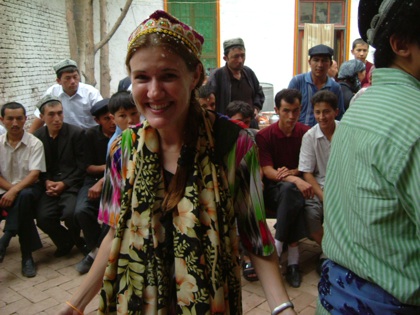
Christy will be joining Nate and me for the next month—longer if we can persuade her to stay around—contributing her keen eye for cultural developments near and far, such as her first post, based on her personal experience with the Uyghur people of western China. As this picture of Christy dancing at a Uyghur wedding shows, her horizons of possibility are wide. Welcome, Christy!
—Andy Crouch
One patient, who was so eloquent on the subject of music, had a great difficulty in walking alone, but was always able to walk perfectly if someone walked with her. Her own comments on this are of very great interest: ‘When you walk with me,’ she said, ‘I feel in myself your own power of walking. I partake of the power and freedom you have. I share your walking powers, your perceptions, your feelings, your existence. Without even knowing it, you make me a great gift.’ This patient felt this experience as very similar to, if not identical with, her experiences with music: ‘I partake of other people, as I partake of music…’
Child-proof
The endangerment of children—that persistent theme of our lives, arts, and literature over the past twenty years—resonates so strongly because, as parents, as members of preceding generations, we look at the poisoned legacy of modern industrial society and its ills, at the world of strife and radioactivity, climatological disaster, overpopulation, and commodification, and feel guilty. As the national feeling of guilt over the extermination of the Indians led to the creation of a kind of cult of the Indian, so our children have become cult objects to us, too precious to be risked. At the same time they have become fetishes, the objects of an unhealthy and diseased fixation. And once something is fetishized, capitalism steps in and finds a way to sell it.
What is the impact of the closing down of the Wilderness on the development of children’s imaginations? This is what I worry about the most. I grew up with a freedom, a liberty that now seems breathtaking and almost impossible. Recently, my younger daughter, after the usual struggle and exhilaration, learned to ride her bicycle. Her joy at her achievement was rapidly followed by a creeping sense of puzzlement and disappointment as it became clear to both of us that there was nowhere for her to ride it—nowhere that I was willing to let her go.


What everyone should have
Sister Bernadine Frieda, 91, spry and sharp, spends her days visiting the infirm with Sister Marie Kellner, 77, both of them onetime science teachers. Sister Marie, who left the classroom because of multiple sclerosis, reminds an astounded sister with Alzheimer’s that she was once a high school principal (“I was?!”) and sings “Peace Is Like a River” to the dying.
“We don’t let anyone go alone on the last journey,” Sister Marie said.
Seven priests moved here in old age, paying their own way, as does Father Shannon, who presides over funerals that are more about the celebratory “alleluia” than the glum “De Profundis.” But he has been with the sisters since he entered the priesthood, first as a professor at Nazareth College, founded by the order, and now as their chaplain. He shares with them the security of knowing he will not die among strangers who have nothing in common but age and infirmity.
“This is what our culture, our society, is starved for, to be rich in relationships,” Sister Mary Lou said. “This is what everyone should have.”


The Codex Sinaiticus, the oldest extant copy of the Bible, has been digitized by the Codex Sinaiticus Project, and can now be viewed online here. The manuscript contains the entire New Testament, and most of the Old Testament, all in Greek (the original language of the New Testament). The physical manuscript is divided unequally among four locations in Britain, Germany, Russia, and Egypt, so the online version marks the first time the Codex can be viewed in its entirety in 100 years, when the first part was taken from St. Catherine’s Monastery on Mount Sinai.
The Rosetta Project Language Archive includes a Greek Septuagint translation of the first three chapters of Genesis. This landmark Greek translation holds great historical significance, since it was the preferred translation of most Early Christian writers, including Paul, and is the text quoted throughout the New Testament.


This is must-read stuff, and not just for artists. It’s food for thought for any Christian wishing to make a meaningful contribution to their world.
?
Jennifer, professional soprano living in Madison, Wisconsin