
Nate
:
Nate
:
And yet, city life isn’t easy. The same London cafes that stimulated Ben Franklin also helped spread cholera; Picasso eventually bought an estate in quiet Provence. While the modern city might be a haven for playwrights, poets, and physicists, it’s also a deeply unnatural and overwhelming place.
Now scientists have begun to examine how the city affects the brain, and the results are chastening. Just being in an urban environment, they have found, impairs our basic mental processes. After spending a few minutes on a crowded city street, the brain is less able to hold things in memory, and suffers from reduced self-control. While it’s long been recognized that city life is exhausting—that’s why Picasso left Paris—this new research suggests that cities actually dull our thinking, sometimes dramatically so.
“The mind is a limited machine,“says Marc Berman, a psychologist at the University of Michigan and lead author of a new study that measured the cognitive deficits caused by a short urban walk. “And we’re beginning to understand the different ways that a city can exceed those limitations.”
One of the main forces at work is a stark lack of nature, which is surprisingly beneficial for the brain. Studies have demonstrated, for instance, that hospital patients recover more quickly when they can see trees from their windows, and that women living in public housing are better able to focus when their apartment overlooks a grassy courtyard. Even these fleeting glimpses of nature improve brain performance, it seems, because they provide a mental break from the urban roil.


Nate
: Good bad art
Nate
:
Literature | Why Orwell liked “good bad” art, according to a review of his collected essays: Such works “had the advantage of propagandizing for humble and obvious ideas rather than dangerous, overambitious ones. Good bad books are written by ‘natural novelists … who seem to attain sincerity partly because they are not inhibited by good taste.’ ” [Pop Matters]
 Six continents’ worth of static
Nate
:When all you want is Friends (or even its Arabic equivalent), prepare to weed through Italian soaps, Iranian talk shows, the Pentagon channel, Egyptian poetry, Russian porn, Mecca 24/7, Italian porn, state-run news, Kurdish divas, soccer, fútbol, American rap on Arab MTV, Bollywood revels, false prophets from Holland, German business commentary. When you finally come to Courteney Cox and Jennifer Aniston, they’re dubbed in Japanese.
I suppose the price you pay for living in a country that doesn’t produce too much TV for its own good is that you’re forced to learn about the rest of the world. This learning shouldn’t be confused with CIA World Factbook-learning. It’s more like what you’d get from a good intercontinental love affair. At the very least, watching the satellite means being subjected to the fact that this planet is crowded and teeming with desires for every kind of stardom. Amidst them all, our little languages and preferences are the tiniest of snowflakes falling in six continents’ worth of static.
 The new old cartography
Nate
:Geography | How the new cartography is like mapmaking in the Middle Ages: Today’s maps are “geographically accurate beyond the dreams of a medieval mind,” yet they’re still, perhaps more than ever, vehicles for representing the world’s geography as the mapmaker idiosyncratically interprets it — never mind getting from point A to point B. [Boston Globe]
 Allegro non sequitur
Nate
:Fighting time with marble
Nate
:Stone-cutters fighting time with marble, you foredefeated Challengers of oblivion Eat cynical earnings, knowing rock splits, records fall down, The square-limbed Roman letters Scale in the thaws, wear in the rain. The poet as well Builds his monument mockingly; For man will be blotted out, the blithe earth die, the brave sun Die blind and blacken to the heart: Yet stones have stood for a thousand years, and pained thoughts found The honey of peace in old poems.
Rich objects
Nate
: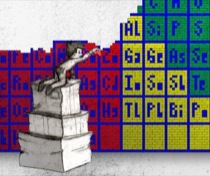
Science is fueled by passion, a passion that is often attached to the world of objects much as the artist is attached to his paints, the poet to her words. From my first days at the Massachusetts Institute of Technology in 1976, I saw this passion for objects everywhere. My students and colleagues told how they were drawn into science by the physics of sand castles, by playing with soap bubbles, by the mesmerizing power of a crystal radio.
Since this was the early days of computer culture, there was also talk of new objects. Some people identified with their computers, experiencing these machines as extensions of themselves. For them, computers were useful for thinking about larger questions, questions of determinism and free will, of mind and mechanism ...
Objects don’t nudge every child toward science, but for some, a rich object world is the best way to give science a chance. Given the opportunity, children will make intimate connections, connections they must construct on their own ...
If we attend to young scientists’ romance with objects, we are encouraged to make children comfortable with the idea that falling in love with things is part of what we expect of them. We are encouraged to introduce the periodic table as poetry and LEGOs as a form of art.
Sixty percent
Andy
:The beginning of a blood-curdling recession hardly seems like the time to ruminate about fantasy resources, I’ll grant you that. But, I want you to think about something. Really think about it.
If, tomorrow morning, you had 60% of the time and resources you needed to start making anything you wanted, what would it be? And, what would you do first? . . .
The reason I throw in that “60% of what you need,” is that it’s just enough to make the question interesting and ambitious. Give someone no resources, and they have no imagination. Give them all the resources and they break ground on a Hooters in their garage. But, give someone most of the resources they need, and you have a delightful real-world challenge to the creative imagination.

Nate
:
Nate
:When libraries shine
Nate
:The Boston Public Library is no different. New library cards are up 32.7 percent from July to November of 2008, compared with the same period in 2007. Visits are up 13 percent, from 1.4 million visits to 1.6 million. Checkouts of books, CDs, and DVDs are up 7.2 percent overall over the last fiscal year. More telling is that checkouts have soared between 27 percent and 37 percent at the Egleston Square, Fields Corner, Jamaica Plain, and Orient Heights branches.
New BPL president Amy Ryan said a baby story program at the Copley library has grown from fluctuating between 60 and 80 families to well over 100. Monthly visits to a free Internet homework tutoring service have doubled from 300 to 600. She said anecdotal reports indicate a spike in people using branch libraries to research new careers or returning to school. This is despite the BPL probably facing cuts, too.
“Libraries are unfortunately used to this,” Ryan said. “But the essential role of the library cannot be duplicated in anybody’s home, when you consider the combination of manuals, books, and librarian expertise,” Ryan said. “In down economic times, families aren’t going out to spend a lot of money on books and movies. This is when the branches can shine as a community gathering place and at a time when people are seeking answers to life improvement.”
Snark is what you make of it
But all that said, I want to go back to the point that this is a useless argument. Here’s my prediction: not one person in a thousand is going to be confronted with a statement whose core idea they agree with and say, Yep, that’s too snarky. They’ll either say along with Sternbergh that that’s good snark or (what amounts to the same thing) they’ll say it’s not snark at all but rather legitimate irony or sarcasm which the target of the criticism richly deserves. When faced with actual examples of critical language, almost everyone will approve of that critical languge if it’s directed against their (political, social, artistic, religious) enemies and disapprove of it if it’s directed against something or someone they approve of. Democrats will lament Republican snark, Republicans will lament Democratic snark, world without end. Why even bother having this conversation?
I’ll confine myself to this one statement: whether snark is ever a good thing or not depends on what you want to achieve. If you want to buld solidarity among people who already share a set of core convictions, or if you just want to blow off your own built-up steam, then snark might be a good thing. If you want to find ways to get people who disagree with each other to come to some mutual understanding, and perhaps even agreement . . . not so much.


[Crouch’s] analysis is sharp and hopeful at the same time. I have a feeling I am going to be giving away many copies of this book in the next few years.
?
David, urban architect
living in Kansas City, Missouri