Posts tagged photography
 Photographers at the wedding
Andy
:
[Wedding guests who double as amateur photographers] do not see themselves as intruding upon the event, but as absenting themselves from it in order to bestow the gift of . . . precious memories (which always requires the foreboding ellipsis). They sacrifice their ordinary presence at the mere wedding to become a selfless, invisible recording eye, as though they occupied some interstitial space between the sacred, but still physical one of the church and—what, exactly? The not-yet-embodied future? It strikes me that they think they are made angels by the camera, observers unobserved.
But there they were, still in their bodies, perfectly visible to everyone.
And who in the world were they? My wife told me later that she stopped the one on the side aisle by catching his eye, shaking her head, and fiercely mouthing the word No. Crestfallen, he retreated. The other one, however, a young woman, angled across the front of the church in front of the pulpit, went through the entrance to the sacristy, and emerged behind a carved wooden grate where she stationed herself for the next half-hour intermittently flashing away like an expert sniper at the bride and groom.

Nate
:

Nate
:
Nate
:The endlessly pliable photograph
Andy
:There was a time when photographs were synonymous with truth—when you could be sure that what you saw in a picture actually occurred. In today’s Photoshop world, all that has changed. Pictures are endlessly pliable. Photographs (and even videos) are now merely as good as words—approximations of reality at best, subtle (or outright) distortions of truth at worst. Is that Jane Fonda next to John Kerry at an antiwar rally? No, it isn’t; if you thought so, you’re a fool for trusting your own eyes.
Some photographers welcome the new skepticism toward images; it’s good that people are learning not to automatically believe what they see, they say. But many fear that we’re losing an important foothold on reality. Without trustworthy photographs, how will we ever know what in our world is real?
 The bridge to somewhere

Andy
:
Nate
:
Nate
:
Nate
:
Nate
:
Nate
: Adieu, Polaroids
Nate
:
Nate
:
Nate
:People of the screen, part deux
Andy
:The overthrow of the book would have happened long ago but for the great user asymmetry inherent in all media. It is easier to read a book than to write one; easier to listen to a song than to compose one; easier to attend a play than to produce one. But movies in particular suffer from this user asymmetry. The intensely collaborative work needed to coddle chemically treated film and paste together its strips into movies meant that it was vastly easier to watch a movie than to make one. A Hollywood blockbuster can take a million person-hours to produce and only two hours to consume. But now, cheap and universal tools of creation (megapixel phone cameras, Photoshop, iMovie) are quickly reducing the effort needed to create moving images. To the utter bafflement of the experts who confidently claimed that viewers would never rise from their reclining passivity, tens of millions of people have in recent years spent uncountable hours making movies of their own design. Having a ready and reachable audience of potential millions helps, as does the choice of multiple modes in which to create. Because of new consumer gadgets, community training, peer encouragement and fiendishly clever software, the ease of making video now approaches the ease of writing.
This is not how Hollywood makes films, of course. A blockbuster film is a gigantic creature custom-built by hand. Like a Siberian tiger, it demands our attention — but it is also very rare. In 2007, 600 feature films were released in the United States, or about 1,200 hours of moving images. As a percentage of the hundreds of millions of hours of moving images produced annually today, 1,200 hours is tiny. It is a rounding error.
We tend to think the tiger represents the animal kingdom, but in truth, a grasshopper is a truer statistical example of an animal. The handcrafted Hollywood film won’t go away, but if we want to see the future of motion pictures, we need to study the swarming food chain below — YouTube, indie films, TV serials and insect-scale lip-sync mashups — and not just the tiny apex of tigers. The bottom is where the action is, and where screen literacy originates.
Gravity and grace

Nate
:
Nate
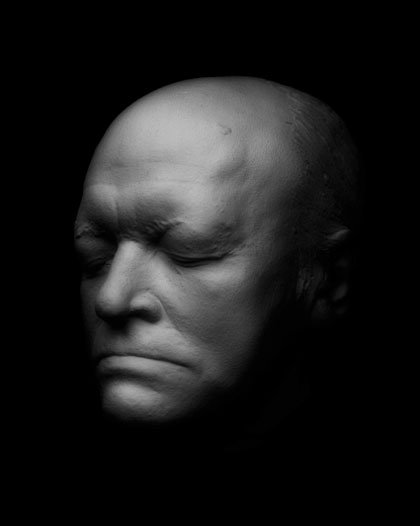
:William Blake, life mask
Nate
:
Nate
:
Nate
: