
Nate
:
 That’s progress for you
Nate
:
“In the 1970s, ‘80s and ‘90s, carmakers all offered super-high-efficiency cars,” says Eric Noble, president of the Car Lab, an auto industry research and consulting group. “Now that consumers are clamoring for them, those cars are pretty much all gone.”
For the 1992 model year, car buyers had the choice of 33 cars that had a combined city and highway EPA rating of at least 30 miles per gallon. For the current model year, there are 12. And though the 1990s had its share of gas guzzlers, it’s notable that the two-wheel-drive Ford Explorer from 1992 had better fuel efficiency (17 mpg) than the same model in 2008 (which gets 16).
With demand for efficiency surging, carmakers are racing to improve their lineups. General Motors Corp., which currently doesn’t have any cars that top 30 mpg combined, said last month that it would spend $500 million to produce a new compact car for 2011, the Cruze, that would reach 45 mpg on the highway. That’s about 13 mpg below the rating for its most fuel-efficient Geo Metro 14 years ago.
The humble magician
Andy
:Marilynne Robinson is in a category by herself, and that category is both fully staffed and up to any project. I hope this is gratuitous, but if you haven’t read the essays in The Death of Adam, neither sleep nor eat till you have remedied the oversight. Her first novel Housekeeping is what I think a book should be. And now writing in Home of the same people in the same time and place as in her Pulitzer Prize-winning novel Gilead, everything is different. These two books could not be less alike. And just because she can and perhaps must, Robinson has pages and pages of dialogue about theology here, people sitting on the porch as evening falls, discussing and dissecting the particulars. The reader slows his pace, he doesn’t want to miss a word. Theology as conversation. She’s pulled off the impossible. (I know whereof I speak.)
In all her work we have the writer as magician. She’s making a concoction of her own invention, and if she doesn’t know if it will turn the one who drinks it into a fairy princess or blow the place to smithereens, well, those are risks she is prepared to take on our behalf. Perhaps that hints at her distinctive. She has been the sort of reader in her life who knows the possibility of writing. She takes nothing lightly, but there is lilt and charm for all of that. She can be light precisely because she knows the stakes are high, because she has cared enough to take the measure of the thing. And, she has the requisite humility to say, “There are things worth believing.”
 Please sit on me
Andy
: Easy
Easy

Andy
: The new culture makers
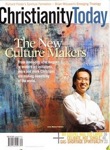
I couldn’t be happier with Christianity Today’s cover section in the September issue—a level of coverage that came as a great surprise to me. (I work for CT’s parent company but have no direct editorial responsibility for the magazine.) They not only generously excerpted my book, but wrote five terrific short stories about exemplary “culture makers” I suggested: people who are cultivators and creators in very different places and spheres of culture.
If you’re a regular you’ve probably already read the chapter that CT excerpted, but you might enjoy this brief interview with Derek Keefe and David Neff’s opening editorial. David captures one of my goals for the book very well:
Since 1951, the Christian discussion of culture has been uncomfortably squeezed into five boxes created by H. Richard Niebuhr’s magisterial Christ and Culture. Generations of pastors and scholars have analyzed their church traditions using Niebuhr’s categories: Is my denomination an example of “Christ against culture”? What should it be? “Christ and culture in paradox”? As someone who found the Niebuhrian categories a frustrating dead end, I was delighted to find that Andy managed to write about culture from a Christian perspective for about 200 pages before turning briefly to Niebuhr. Culture Making subverts and reorients the whole discussion.
I surely hope David is right . . . let a new, better, and more creative conversation begin.

Nate
:
Nate
:

In Bonn, Germany, I noticed a bookcase full of books in the public park where I run, with a young woman removing one book and returning another. These are used books that make up essentially a free voluntary lending library.
Would this cabinet last undamaged in a U.S. city one day? I doubt it. Similar things exist elsewhere — such as outdoor vending machines for DVD’s in Kyoto, Japan. Both of these indicate a certain level of mutual trust in the population and a certain level of civility; both reduce the transactions costs of daily living: easier access to books in one case, 24-hour DVD availability in the other.
Mutual trust is important in reducing transactions costs, and this aspect of culture has been viewed by economists as helping to determine some economic outcomes. (Although how different levels of trust arise has not been considered by the mostly macroeconomists who worry about this; it’s creating trust that seems to me to be the central issue.)
How many other examples like the books and the DVD’s are there in foreign countries that we don’t see at home?
When we say, “The Christian vision can transform our world,” something similar is happening. Is it really true that simply perceiving the radical comprehensiveness of the Christian worldview would “transform the world”? Or is there a middle step that is being skipped over all too lightly?
—Culture Making, p.62

Nate
:Failed writers
Nate
:His ambition to write may have prompted an exchange with T. S. Eliot, then in his late 50s, on the day they met in 1946, when Mr. Giroux, “just past 30,” as he recalled the moment in “The Oxford Book of Literary Anecdotes,” was an editor at Harcourt, Brace. “His most memorable remark of the day,” Mr. Giroux said, “occurred when I asked him if he agreed with the definition that most editors are failed writers, and he replied, ‘Perhaps, but so are most writers.’“
 Wooden whales

Nate
:Your neighbor must be everyone
Nate
:Lake County Sheriff Mark C. Curran Jr. sentenced himself today to a week in his own jail, saying he believes spending time behind bars will make him a better cop and a better person. “I believe that I can be a better sheriff by having a better understanding of jail operations from the perspective of an inmate in the Lake County Jail,” Curran said before being locked up. “I believe that I will receive significant introspection from staying in the jail with inmates for a week.”
Curran plans to live in a cell, eat jail food, mingle and talk with other inmates in common areas, while also attending numerous programs offered in the facility, including substance abuse counseling, parenting and educational classes, along with religious services. That immersion, he said, should give him more insight into everything from safety issues to what programs may be needed help inmates straighten out their lives and avoid future crimes.
“My experience in the jail will help me to better understand our existing programming, as well as any possible unmet needs that exist in our programming,’’ said Curran, a 45-year-old former prosecutor elected sheriff in 2006.
But Curran, a Roman Catholic, also frequently cited a spiritual desire to understand what inmates are going through and how their lives may be turned around. “In Lake County, we have embraced the scriptural mandate to love our neighbor. Your neighbor must be everyone if we are truly going to see peace on Earth,” he said. “In the eyes of society, I may be sheriff, but in God’s eyes, I am no better than anyone else.”
The power of the small
Andy
:Here are some of the themes I see at work in what is happening with Palin (and Obama for that matter).
1) Every human being is created in God’s image and is responsible for developing their unique capabilities in ways that glorify God.
2) True power resides in these God-imaged individuals whose power is released and becomes evident when they express their uniqueness.
3) Because humans are geographically distributed, this power can be found wherever humans are found. Bloom where you are planted!
These truths were taken by our founding fathers to be self-evident and are also evident in every page of biblical revelation.
In today’s fallen world we have forgotten these truths. We believe power resides in places and the people in those places. The media, politicians and the wealthy are the powerful, we are led to believe, and they reside in specific places: New York, LA, Chicago, Wall Street, and Hollywood, to name a few.
Today’s evangelical world has fallen into this trap and regularly develops strategies aimed at the powerful in powerful places. I remember a few years ago, George Barna identified the centers of cultural influence, concluding that the church did not rate very high. He shared a plan to work with large churches (also believed to be the center of power) in strategic cities (coinciding with the “world’s list” of strategic places) to recruit the brightest and the best next-generation evangelical leadership prospects to mentor them and help them enter the most powerful educational institutions (Harvard, Stanford, Yale) so they could enter the most powerful positions in the most powerful companies in the most powerful cities in the world.
I remember telling George that of the National Book Award winners I had interviewed, most were from small, out-of-the way places, and most hadn’t attended the best schools. They came out of nowhere, riding on the strength of their talent, internal sense of calling, and desire to express who they were in their work, starting where they were in some small farming community tucked away in some unknown village in the Midwest.
Regardless of your politics, this is surely the most important lesson from Sarah Palin’s debut as a national and global presence.


I can’t recall a time when I’ve had to read anything other than the Scriptures so slowly and deliberately—Culture Making was that thought provoking.
?
Ben, professor of management
living in Winneconne, Wisconsin