Culture Making is now archived. Enjoy five years of reflections on culture worth celebrating.
For more about the book and Andy Crouch, please visit andy-crouch.com.

Nate:
from "The 5 Best Toys of All Time," by Jonathan Liu, Wired.com's Geekdad, 31 January 2011

When I was a kid one of my favorite things to play with was Dirt. At some point I picked up an interest in cleanliness and I have to admit that I’m personally not such a fan of Dirt anymore—many parents (particularly indoor people like me) aren’t so fond if it either. But you can’t argue with success. Dirt has been around longer than any of the other toys on this list, and shows no signs of going away. There’s just no getting rid of it, so you might as well learn to live with it.

First off, playing with Dirt is actually good for you. It’s even sort of edible (in the way that Play-doh and crayons are edible). But some studies have shown that kids who play with Dirt have stronger immune systems than those who don’t. So even if it means doing some more laundry (Dirt is notorious for the stains it causes) it might be worth getting your kids some Dirt.

So what can you do with Dirt? Well, it’s great for digging and piling and making piles. We’ve got a number of outdoor toys in our backyard, but my kids spend most of their time outside just playing with Dirt. Use it with Stick as a large-format ephemeral art form. (didn’t I tell you how versatile Stick was?) Dirt makes a great play surface for toy trucks and cars. Need something a little gloopier? Just add water and—presto!—you’ve got Mud!

photo
Basket (Egadakua), pandanus leaves, shark's teeth, fiber, late 19th-early 20th century, Nauru, The Metropolitan Museum of Art, New York :: via the Met's Artwork of the Day feed
Nate:

Of all the creators and cultivators who have ever lived, Jesus was the most capable of shaping culture through his own talents and power—and yet the most culture-shaping event of his life is the result of his choice to abandon his talents and power. The resurrection shows us the pattern for culture-making in the image of God. Not power, but trust. Not independence, but dependence.

Culture Making, p.145

Nate

:
from "The Kawere Boys," by Matthew LaVoie, Voice of America African Music Treasures Blog, 12 November 2008 :: first posted here 12 November 2008
image

The Kawere Boys ‘Muma Ben’ (1974) mp3

Most of the songs in the Kawere repertoire seem to be praise songs for patrons who had invited the group to perform. These songs can be thought of as pre-internet age social networking. The singer usually starts by introducing himself, goes on to introduce the object of his praise, as well as the patron’s relatives, friends, and neighbors, before explaining the nature of his relationship to the patron in question. For example, in ‘Muma Ben’, the song starts with an introduction of ‘Muma Ben from Saye Konyango’, then introduces Muma Ben’s family, and ends with praise for the hospitality the singer received when he was invited to Muma Ben’s house. If you were to map out all of the relationships outlined in the Kawere Boys singles in our collection, and if you had a deep understanding of Luo culture, you could get a good idea of the social networks the Kawere Boys relied upon for their livelihood.

Not that long ago, a vast cultural infrastructure made it possible to travel the 300 miles from Boston to Philadelphia by horse. There were roads, wayside inns, stables, and turnpikes along which travelers could make a slow but steady journey from one city to the other. For more than a century, these cultural goods made interstate horse travel possible. But I dare say it would be impossible now.

Culture Making, p.28

Power without love is reckless and abusive, and love without power is sentimental and anemic. Power at its best is love implementing the demands of justice, and justice at its best is power correcting everything that stands against love.

—Martin Luther King, Jr., "Where Do We Go From Here?"

Nate:
from "The Goal of Predictions: 'Who Am I?'," by Elif Batuman, NYTimes.com, 29 December 2010 :: via My Life and Thoughts

There are two reasons for wanting to know the future: to help you decide between alternative courses of action, or because you just have to know.

As a writer, I’m more interested in the second reason, which seems to me to be implicated in most forms of prognostication.  Why do people get their DNA sequenced?  Partly in order to make better health decisions, but partly for aesthetic reasons.  We have always believed the secrets of human identity and human destiny to be inscribed on the body — etched in the palm, encoded in a “Habsburg lower lip,” or recorded on the Y chromosome. 

In prognostication, identity and destiny are inextricably linked. This is because we can only understand human identity as a narrative — and the meaning of a narrative depends on its ending. Without knowing what happens to us, we don’t know who we were all along. Hence the last line of “Oedipus Rex”: “Count no man happy till he dies, free of pain at last.”

While it is likely that you have heard at least one sermon on how to think in a Christian way about sex, and the requirements of church budgets make money an annual topic, chances are you have never a sermon on how to be stewards of cultural power.

Culture Making, p.226

Most of us, unless we are very careful historians, form our impression of the past by the books that are still in print and the music that is still performed, forgetting that while some cultural goods were best sellers then and are best sellers now, many others that were the talk of the town then are now completely forgotten, and some that we now consider classics were barely noticed at the time.

Culture Making, p.192

by Andy Crouch for Culture Making

Oh woman, you may keep the gold.
The child we seek doesn’t need our gold.
On love, on love alone he will build his kingdom.
His piercèd hand will hold no scepter.
His haloed head will wear no crown.
His might will not be built on your toil.
Swifter than lightning, he will soon walk among us.
He will bring us new life, and receive our death,
and the keys to his city
belong to the poor.

These words are sung by Melchior at the climax of Gian-Carlo Menotti’s operetta “Amahl and the Night Visitors,” which we listened to this Christmas morning. “Amahl” is a small gem of poetry and music that bears eloquent and imaginative witness to the journey of the Magi and the hope of Christmas, and it rarely fails to bring me to the brink of tears. Its emotional and narrative heart is centered on the one character who is not named in the title: the mother of Amahl, the crippled boy. Fiercely protective of her son, she can barely feed, let alone cure, him. His escape into flights of fancy has left her skeptical not just of his tall tales, but of hope itself—making her an unmistakably modern figure in this ancient rural setting. And yet her encounter with the extraordinary Night Visitors give this very ordinary mother hope that there is a new King and Kingdom coming into the world—even before the story’s miraculous conclusion.

Here is the amazing and sobering truth: in 1951, this was popular culture. Menotti composed “Amahl” for NBC, and it was broadcast live on Christmas Eve from Rockefeller Center, with a viewership (if Wikipedia is to believed) of perhaps 5 million. To be sure, even in 1951 an opera, no matter how accessible and affecting, was a stretch for TV. But still, in 1951, this was prime time stuff: Menotti’s graceful, modal melodies; the poetry of Melchior’s aria and the shepherds’ welcome; and an unguarded (if somewhat sentimental) meditation on what the coming of Christ into the world might mean for skeptical and wounded souls.

I am not generally a declinist, let alone a pessimist, about American culture. There was plenty of junk on NBC in 1951, and there is decent work being done on television today (or so I’m told by my discerning friends). But listening to “Amahl” this morning I was weighed down by the depressing sense that no one in any corner of American popular culture is creating that kind of accessible excellence any more. Consider also “West Side Story,” Bernstein and Sondheim’s masterpiece that premiered in 1957. Neither “Amahl” nor “West Side Story” were “high” culture—they were for ordinary Americans, presented in the media of middle-class American entertainment. But in a world that had not yet been fully colonized by consumerism’s race to the lowest common denominator, they could make demands on their audience, and offer corresponding rewards, that no one attempts today.

NBC quickly stopped broadcasting operas in prime time. And the age of publicly endorsed works of such transparent piety is also past. If we value works that reflect accessible excellence and imaginative faith, we will have to make them ourselves. But to make them we will first have to love them—and cultivate an audience for them. The decline of popular culture was the work of generations, each asking less of, and offering less to, their children than they had experienced themselves. Restoration, likewise, will take time. If you want to contribute to a flourishing culture and have children in the house this Christmas, you could do worse than introduce them to “Amahl.”
Revelation 21:2 is the last thing a careful reader of Genesis 1–11 would expect: in the remade world, the center of God’s creative delight is not a Garden, but a City. And a city is, by definition, a place where culture reaches critical mass—a place where culture eclipses the natural world as the most important feature we must make something of. Somehow the city, the embodiment of concentrated human culture, has been transformed from the site of sin and judgment to the ultimate expression of grace, a gift coming “down out of heaven from God.”

Culture Making, p.122

Nate:
from "The Joys and Perils of Overlapping Reading," by Nate Barksdale, Comment, 10 December 2010

For much of my post-college reading life, I‘ve been interested in the experience of shifting between texts, in particular the way that, for a short spell, the text I shift to inhabits the same mental space as the one I’ve just left, so that the second book feels like an increasingly improbable continuation of the previous narrative. Say you’re reading Great Expectations and just as your expectations begin to flag, you switch volumes and the scenery becomes more agreeable, the prose less stultifying, the seedy incidental characters more plausibly named, till at last you give in to reality and admit that you’ve abandoned Dickens for Graham Greene. Better yet, you can shift genres entirely. Sociological surveys may suddenly, with a little sleight of hand, contain sonnets.

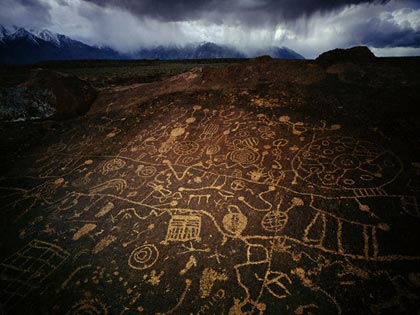
photo Petroglyphs
photo
from The History of Visual Communication :: via FFFFOUND! :: first posted here 6 November 2008

Nate

:

Nate

:
from "Metaphors of the Mind: Why Loneliness Feels Cold and Sins Feel Dirty," by Jonah Lehrer, Scientific American, 25 September 2008 :: via Arts & Letters Daily :: first posted here 6 October 2008

LEHRER: What are some other examples of how seemingly abstract thoughts, such as feeling excluded, can have physical manifestations?

ZHONG: Another example would be the relation between morality and physical cleanliness. In my early work “Washing Away Your Sins: Threatened Morality and Physical Cleansing” in collaboration with Katie Liljenquist [a professor of organizational behavior at Brigham Young University], we discussed how metaphors such as “dirty hands” or “clean records” may have a psychological basis such that people make sense of morality through physical cleanliness.

When people’s moral self image is threatened, as when they think about their own unethical past behaviors, people literally experience the need to engage in physical cleansing, as if the moral stain is literally physical dirt. We tested this idea in multiple studies and showed that when reminded of their past moral transgressions, people were more likely to think about cleansing-related words such as “wash” and “soap”, expressed stronger preference for cleansing products (for instance, a soap bar), and were also more likely to accept an antiseptic wipe as a free gift (rather than a pencil with equal value).

Further, physical cleansing may actually be effective in mentally getting rid of moral sins. In another study, in which participants who recalled unethical behaviors were either given a chance to cleanse their hands or not, we found that washing hands not only assuaged moral emotions such as guilt and regret but also reduced participants’ willingness to engage in prosocial behaviors such as volunteering Thus physical washing can actually wash away sins. Perhaps this effect is why most world religions practice some form of washing rituals to purify souls. We should be cautious, however, knowing that if our sins are so easily “washed away” we might not be as motivated to engage in actual compensatory behaviors to make up for our mistakes.

Nate:
Originally published as "The Stories of Scientists," by Nate Barksdale, Comment, Fall 2010, reprinted (with illustrations!) here

Foucault’s pendulum has fallen. On April 6, the steel cable snapped and sent it crashing onto the polished floor of the Musée des Artes et Metiers in Paris. The 28 kilogram brass weight ended its 159-year career—the dented bob is, a museum spokesperson affirmed, beyond repair—doing what it was meant to do: obeying the law of gravity. I have to admit I shed a tear (or at least the idea of a tear) for the fallen bit of scientific history, not because I’d visited the pendulum myself, or even read the 1988 Umberto Eco novel which takes its title and climax from the now-not-swinging orb. I have my own tangled history with pendulums—one stretching back, depending how you count it, decades, even centuries. It’s quite a bit of weight to bear, but a tale worth telling.

The quotations, images, and embedded media in this blog are the work of the credited authors, artists, and publications, and are employed in the spirit of fair use, commentary, and criticism. We always link to the original source of material we cite. If you think we’ve missed something, let us know. The inclusion of media on this site should not imply its owners’ endorsement (or for that matter awareness) of this book, blog, or the blog’s curators and commentators. Though we hope they’d like us.

This is must-read stuff, and not just for artists. It’s food for thought for any Christian wishing to make a meaningful contribution to their world.


?

Jennifer, professional soprano living in Madison, Wisconsin

horizons of the possible  cultural worlds  music  photography  art  technology and change  food and drink  europe  community  gardens and cities  cultivation and creation  asia  books  africa  language  children  literature  writing  painting  movies  video  cities  changing the world  family  gestures and postures  power  business  internet  medicine  poverty  grace  consumption  government  technology  education  color  reading  animals  india  architecture  money  poetry  maps  visual arts  performing arts  trends  transport  agriculture  3 12 120  design  disciplines  war  south america  travel  economics  transit  sculpture  tv  communication  film  science  work  advertising  psychology  churches  revelation  clothing  france  infrastructure  sport  england  home  unintended consequences  fashion  politics  failure  generations  bible  copying  street view  craft  women  humor  christmas  china  creativity  history  story  pop culture  water  california  museums  time  landscape  development  nature  remixes  play  discipline  creation  new york  computers  dance  kevin kelly  suburbs  middle east  furniture  least of nations  charity  naming  japan  primordial stories  parents  stories  stewardship  journalism  religion  russia  neighborhoods  germany  light  church  law  australia  love  cell phones  islam  traces of god  italy  names  drawing  games  media  mission  mexico  words  creation and cultivation  new jerusalem  statistics  shopping  typography  twitter  redemption  space  graffiti  buildings  change the world  pentecost and beyond  philanthropy  translation  libraries  heroes  entertainment  david taylor  data  tradition  safety  rob walker  cultivation  race  finance  cars  alphabets  engineering  sound  wilderness  lists  signs  military  death  beauty  visual art  marriage  risk  condemnation  critique  google  environmentalism  christianity  collage  south africa  television  taste  happiness  natural sciences  lamin sanneh  migration  environment  illustration  philosophy  noise  memes  19th century  reconciliation  ideas  prison  crime  innovation  service  modernity  recreation  pets  tools  metaphor  monasticism  heaven  friendship  leisure  irony  multiculturalism  canada  oceana  prayer  kenya  vision  john stackhouse  news  latin america  paper  stone  afghanistan  convergence  turkey  voice  babel  public space  future  wonder  animation  memory  nigeria  genesis  wealth  nostalgia  radio  vocation  donald miller  consumerism  criticism  walking  scripture  universities  jesus as culture maker  gospel  scale  haiti  ministry  communities  social sciences  toys