Posts tagged asia
 Fujimori Festival

Nate
:
 Slums are the answer
Nate
:
To be sure, there is something unseemly in privileged people rhapsodizing about such places. Prince Charles, for all his praise, does not appear poised to move to a shack in Dharavi. Identifying the positive aspects of poverty risks glorifying it or rationalizing it. Moreover, some of the qualities extolled by analysts are direct results of deprivation. Low resource consumption may be good for the earth, but it is not the residents’ choice. Most proponents of this thinking agree that it’s crucial to address the conflict between improving standards of living and preserving the benefits of shantytowns.
But given the reality that poverty exists and seems unlikely to disappear soon, squatter cities can also be seen as a remarkably successful response to adversity - more successful, in fact, than the alternatives governments have tried to devise over the years. They also represent the future. An estimated 1 billion people now live in them, a number that is projected to double by 2030. The global urban population recently exceeded the rural for the first time, and the majority of that growth has occurred in slums. According to Stewart Brand, founder of the Long Now Foundation and author of the forthcoming book “Whole Earth Discipline,” which covers these issues, “It’s a clear-eyed, direct view we’re calling for - neither romanticizing squatter cities or regarding them as a pestilence. These things are more solution than problem.”
 Cirque du sushi
Nate
:
Nate
:Every man a king
Nate
: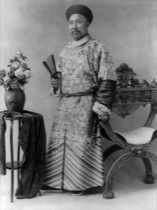
[T]here are railroad kings, copper kings, tobacco kings, etc. It is, however, manifestly improper and incongruous that the people should possess a higher title than their President, who is the head of the nation. To make it even, I would suggest that the title “President” be changed to “Emperor,” for the following reasons: First, it would not only do away with the impropriety of the chief magistrate of the nation assuming a name below that of some of his people, but it would place him on a level with the highest ruler of any nation on the face of the earth. I have often heard the remark that the President of the United States is no more than a common citizen, elected for four years, and that on the expiration of his term he reverts to his former humble status of a private citizen; that he has nothing in common with the dignified majesty of an Emperor; but were the highest official of the United States to be in future officially known as Emperor, all these depreciatory remarks would fall to the ground. There is no reason whatever why he should not be so styled, as, by virtue of his high office, he possesses almost as much power as the most aristocratic ruler of any nation. Secondly, it would clearly demonstrate the sovereign power of the people; a people who could make and unmake an Emperor, would certainly be highly respected. Thirdly, the United States sends ambassadors to Germany, Austria, Russia, etc. According to international law, ambassadors have what is called the representative character, that is, they represent their sovereign by whom they are delegated, and are entitled to the same honors to which their constituent would be entitled were he personally present. In a Republic where the head of the State is only a citizen and the sovereign is the people, it is only by a stretch of imagination that its ambassador can be said to represent the person of his sovereign. Now it would be much more in consonance with the dignified character of an American ambassador to be the representative of an Emperor than of a simple President. The name of Emperor may be distasteful to some, but may not a new meaning be given to it?
Nate
:When a modern Japanese family sits round the supper table eathing their bowls of Japanese-grown rice, they are not simply indulging a gastronomic preference for short-grain and slightly sticky Japonica rice over long-grain Indica rice from Thailand. They are eating and absorbing a tradition—in the sense of an invented and reinvented past. While the television beside the dining table pours out a stream of images of the here-and-now, of an urbanized, capitalist, and thoroughly internationalized Japan, each mouthful of rice offers communion with eternal and untainted Japanese values, with a rural world of simplicity and purity, inhabited by peasants tending tiny green farms in harmony with nature and ruled over by the emperor, descendant of the Sun Goddess, who plants and harvests rice himself each year in a special sacred plot. Simple peasant rice farmers are as marginal in contemporary Japan as hand-spinners are in India, but the small rice farm, like the swadeshi [homespun-style cloth] industry, lives on as a powerful symbol.
Africa and missionaries, pt. 2
Nate
:Majestic in a green chasuble, Father Ibemere delivered his homily strolling up and down the aisle. When it was time to distribute the eucharist, he bent down to give communion to a man he knew was too ill to stand.
After the Mass, however, one member of the congregation, Virginia Ballard, gestured toward the Nigerian priest and confided in Father Venters, “I can’t understand what he said, but he’s a sweet young man.”
Mrs. Ballard went on to praise Father Ibemere’s knowledge of the Bible, his capacity to remember the names of congregants, his willingness to teach the Americans about his home in Nigeria. “He is a holy man,” she concluded, “and we are honored to have him.”

Nate
:Glasses for the masses
Nate
:
Some 30,000 pairs of his spectacles have already been distributed in 15 countries, but to Silver that is very small beer. Within the next year the now-retired professor and his team plan to launch a trial in India which will, they hope, distribute 1 million pairs of glasses. The target, within a few years, is 100 million pairs annually. With the global need for basic sight-correction, by his own detailed research, estimated at more than half the world’s population, Silver sees no reason to stop at a billion.
If the scale of his ambition is dazzling, at the heart of his plan is an invention which is engagingly simple. Silver has devised a pair of glasses which rely on the principle that the fatter a lens the more powerful it becomes. Inside the device’s tough plastic lenses are two clear circular sacs filled with fluid, each of which is connected to a small syringe attached to either arm of the spectacles.
The wearer adjusts a dial on the syringe to add or reduce amount of fluid in the membrane, thus changing the power of the lens. When the wearer is happy with the strength of each lens the membrane is sealed by twisting a small screw, and the syringes removed. The principle is so simple, the team has discovered, that with very little guidance people are perfectly capable of creating glasses to their own prescription.
Nate
:
Architecture | Can you copyright an iconic building? That’s the issue raised by an expensively marbled clone of India’s Taj Majal built in Bangladesh by a wealthy filmmaker, who says he built it for Bangladeshis too poor to travel to see the real thing. Indian official: “You can’t just go out and copy historical monuments.” Bangladeshi: “Show me where it says that emulating a building like this can be illegal.” [Times of London]
Nate
:As part of the Japanese census, people were asked to keep a record of what they were doing in 15 minute intervals. The data was publicly released and Jonathan Soma took it and graphed the results so that you can see what many Japanese are up to during the course of a normal day.
“Sports: Women like swimming, but men eschew the water for productive sports, which is the most important Japanese invention.
Early to bed and early to rise… and early to bed: People start waking up at 5 AM, but are taking naps by 7:30 AM.”
Fascinating.

Nate
:
Nate
:Golden Gai, Tokyo

Nate
: The places we live
Nate
:One billion people live in slums. Their numbers are supposed to double over the next quarter-century. So: Who are those people — and what must their lives be like?
The Norwegian photojournalist Jonas Bendiksen has spent a good deal of time in Indian, Kenyan, Indonesian, and Venezuelan slums, and his website, The Places We Live, features dazzling 360-degree photos of homes and shanties, navigable and altogether immersive, along with audio recordings made by the inhabitants. Prepare yourself to gape, gasp, laugh, cry, and experience every emotion in between: In Mumbai, you’ll meet the Shilpiri family (15 people crammed into a tiny space through which floodwater and garbage regularly stream). In Nairobi, the head of the Dirango household takes great pride in his cramped abode, giving a tour that takes just seconds. “You have to visit somewhere before you judge,” he explains. Thanks, Mr. Bendiksen, for starting us on the journey.
 Nepal Horse Book

Nate
:
Nate
:Tree of life
Nate
:As a child growing up in India, I greeted the appearance of one particular vegetable on my plate with exaggerated distaste: tender seedpods from the moringa tree, locally known as “drumsticks.” Imagine my surprise when I heard a health worker from sub-Saharan Africa describe this backyard tree as a possible solution to malnutrition in tropical countries – he called it a “miracle tree,” no less.
Ounce for ounce, says Lamine Diakite, a Red Cross official from French Guinea in West Africa, moringa leaves contain more beta carotene than carrots, more calcium than milk, more iron than spinach, more Vitamin C than oranges, and more potassium than bananas. Its protein content is comparable to that of milk and eggs, and its leaves are still available for harvest at the end of the dry season, when other food may be scarce. Malnourished children gained weight when put on a timely dietary supplement made from the leaves, Mr. Diakite says. He passed around pouches of the green, hennalike powder at a recent international summit in Boston.
Until a decade ago, moringa was not widely known in Africa. Its leaves (boiled like spinach) were an occasional vegetable. Immigrant Indians prized the long, slender seedpods (stewed or cooked like green beans) as a delicacy. “But its nutritional value, newly ‘discovered,’ has been known for a long time,” says Lowell Fuglie, an international development administrator who has been instrumental in popularizing the moringa in Africa for the past 10 years. Laboratory analysis has corroborated traditional knowledge about the plant. It now awaits further validation by western science.
Nate
:
Nate
: