Culture Making is now archived. Enjoy five years of reflections on culture worth celebrating.
For more about the book and Andy Crouch, please visit andy-crouch.com.

excerpt Looks like work
Nate:
from "Lights! Camera! Inaction!," by Virginia Heffernan, The New York Times Magazine, 29 May 2009

Anyone who has followed fantasy football or an eBay auction at the office — and gotten away with it — knows that many of our everyday activities now look like work. Typing and scrolling and peering at a computer, you could be doing anything: e-mail, accounting, short-selling, browsing porn, buying uranium, getting divorced.

This odd accident of life online — the increasing visual homogeneity of our behaviors — may be a boon to procrastinators, hobbyists and multitaskers. But it has some victims. I don’t mean bosses concerned with productivity (who cares about them?). The crowd truly stymied by the merging of human activities are filmmakers. If fighting now looks like making up now looks like booking travel, as it does when people conduct their affairs online, how do film directors make human action both dramatic to viewers and roughly true to life?

Andy:

According to the conventional wisdom still taught in schools and repeated by many public intellectuals, Galileo bravely spoke truth (science) to power (the Church), and paid dearly for it, spending his dying days in prison. Except that it’s not true. Ronald L. Numbers’ Galileo Goes to Jail: And Other Myths About Science and Religion, just out from Harvard University Press, is only the most recent attempt to set the historical record straight on “myths”, including its Number Eight: That Galileo Was Imprisoned and Tortured for Advocating Copernicanism. Apparently Carl Sagan’s quip that Galileo was “in a Catholic dungeon threatened with torture” has all the academic rigor of the Indigo Girls song that begins “Galileo’s head was on the block.”

Consider: Galileo’s Dialogue Concerning the Two Chief World Systems, the source of controversy, previously had been read and approved by the Church’s censors; and Pope Urban VIII, who presided over the trial, was Galileo’s friend and admirer. Consider also: prior to the trial, Galileo stayed in the Tuscan embassy; during the trial, he was put up in a six-room apartment, complete with servant; following the trial, his “house arrest” consisted of being entertained at the palaces of the grand duke of Tuscany and the Archbishop of Siena. Galileo, apparently, was no ordinary heretic.

Forgery is about the way the present looks at the past. The best forgeries may imitate the style of a long dead artist, but to appeal to people at the moment that they’re being tricked, forgeries must also incorporate some of the aesthetic prejudices of the moment. When fakes work well, they give us a vision of the past that seems hauntingly up to date. And that’s one of the things that makes forgery so seductive.

—art historian Jonathan Lopez, interviewed by Errol Morris :: via kottke.org

Andy:

When people sit down together in a public place — a place where none of them is sovereign but each of them at home — and when those people pass the evening together, sipping drinks in which the spirit of place is stored and amplified, maybe smoking or taking snuff and in any case willingly exchanging the dubious benefits of longevity for the certain joys of friendship, they rehearse in their souls the original act of settlement, the act that set our species on the path of civilisation, and which endowed us with the order of neighbourhood and the rule of law.

When, however, people swig drinks without interest in their neighbours, except as equal members of the wild host of hunter-gatherers, when their sole concern is the intoxicating effect and when the drink itself is neither savoured nor understood, then are they rehearsing that time before civilisation, in which life was solitary, poor, nasty, brutish and short. Understandably, the first and natural effect of this way of drinking is an implacable belligerence towards the surrounding signs of settlement — an urge to smash and destroy, to replace the ordered world of house and street and public buildings, with a ruined wasteland where only the drunk is at home. Binge drinking may look like a communal act. In fact, it is an act of collective solitude, in which the god of modern puritans, the Self, reigns supreme.

photo
"In pictures: West African teddies," photographs and text by Glenna Gordon, BBC News, 20 May 2009
Nate:
Andy:
from "Student Leaders Reflect, 20 Years After Tiananmen," by Louisa Lim, NPR, 3 June 2009

Zhang, the former journalist who brought the students to the square, has taken a different path. Once, he preached for democracy; now he preaches for Jesus. Formerly No. 17 on Beijing’s most-wanted list, Zhang today is a pastor at a Chinese church in Fairfax, Va.

After the clampdown, Zhang spent two years in hiding, much of it in a remote mountain cabin near the frozen Russian border, where he lived off wildlife that he caught. He also spent a month in a Russian prison. It was at that time that he found God.

“I read the Bible and began to know God,” Zhang remembers. “I gained sustenance from it. People really needed God then. They needed a future. I couldn’t see the future with my bare eyes.”

Zhang finally escaped China through Hong Kong and sought asylum in the United States. These days, he throws himself into ministering his flock. He is planning to build a 16,000-square-foot church for his congregation, which currently numbers about 300.

What if you had to go to a church that had had no music since the early 1500s? It’s unimaginable. Yet the void you can’t imagine is there—[the] 500-year lack of visual arts in Protestant churches.

—Sandra Bowden, compiler of "Images of Faith"

Surprise Wedding Reception at Improv Everywhere, 2 June 2009 :: via Kottke.org
Nate:
Nate:

D: So the problem isn’t small-town Kansas—it’s a toxic mixture of small-town Kansas plus adolescence?

R: I think so. I like the small-town Kansas where we are now but, believe it or not, small-town Kansas is very heterogeneous. The town where we live now and where I grew up have a lot of significant differences in culture.

D: Tell me more…

R: Mainly it has to do with how people treat each other and how people approach problems. Here, problems are meant to be solved and people have a lot of respect for one another. We have “community conversations” when there’s something that impacts the whole town, and everyone who wants to speak can have their say. Where I grew up, on the other hand, people say all manner of things about other people, and if there’s a problem that affects the town everyone just complains to everyone else. The population even since I left has declined really sharply and everyone just says, “Oh, poor us, look at our dying town, who will save it?” Whereas here they formed an economic development commission and went out looking for new businesses to bring to the community. Some problems are similar, but by and large I think this is a positive place to grow up, and the graduating seniors we know well have said so too.

The other great example of small-town heterogeneity is to look at the counties to the north and south of us. To the north we have County A, where people routinely farm well into their 80’s, have active sex lives into their 90’s, and there has not been a teen pregnancy in almost 10 years. These are the ruddy-cheeked insanely healthy country folk you may have read about. To the south, then, we have County B, where everyone over 40 has diabetes, the obesity rate seems like it’s about 90%, STI’s are rampant and there are currently 8 pregnant girls in the high school. What’s the difference? I have been trying to figure this out. The medical care is exactly the same (it’s our group). The physical infrastructure is not that different. But culturally, people in County B have this victimizing, back-biting mentality.

D: It’s that stark a difference, huh? That’s astonishing.

R: It really and truly is.

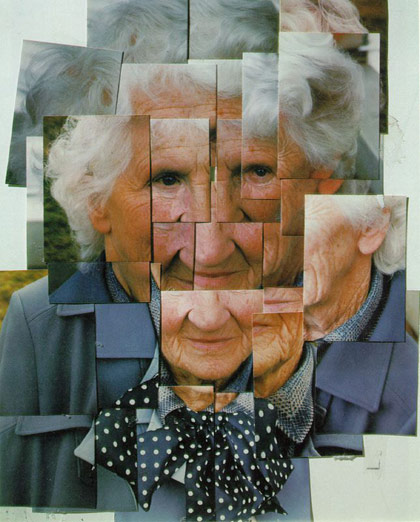
image
Mother I, Yorkshire Moors, August 1985 #1, photocollage by David Hockney
Nate:
excerpt Girls rock
Andy:

[When] our 10-year-old Jordan started to sound a little like the snotty teenagers she was watching on TV, Hannah Montana and Wizards were outlawed. Soon after, we were fortunate enough to be guests on the Cayamo [singer-songwriter cruise ship], and I made the family a mix of Cayamo artists for the drive down—Lyle Lovett, Patty Griffin, Kathleen Edwards, Over the Rhine, John Hiatt. But it was Brandi Carlile they kept wanting to hear. By the time we saw her concert, my girls knew most of the words. At Emma’s ninth birthday party (a lock-in at the Paste office) she cranked up “The Story” for her friends like it was the latest Miley Cyrus hit. The requests for Radio Disney stopped, and I overheard Jordan telling her friends she doesn’t think Cyrus is a very good singer anymore.

So when Brandi recently came within half a mile of our house last week to play a pair of intimate performances at Eddie’s Attic, I took them to the early show. It was the first real club concert for my kids. Eddie’s has a no-talking-during-the-performance rule, and my usually very loud children abided. . . . They mouthed all the words except when they couldn’t resist singing along. When Brandi started clapping, they clapped. When Brandi told the audience to stand, Emma stood up on her stool with her hands in the air.

Jordan wrote her first song a couple of days after the show. She won’t sing it to me yet, but the lyrics are great. She began guitar lessons earlier this year and is headed to girls rock camp this summer. Emma is saving up her money for a guitar now. When they think of a future rock star, the image is of a down-to-earth Carlile instead of a glammed-up Ashley Tisdale.

by Nate Barksdale for Culture Making

University of Colorado psychologist Geoffrey Cohen has done a couple of studies showing an easy way to help black students perform better on standardized tests. Simply having them spend 15 minutes writing about a value they held dear (family, music, sports, politics, friends, art), either right before the exam or just several times a semester, led to a jump in test scores compared to peers (majority culture students did not experience a similar boost).

Meanwhile, a study from Radbound University Nijmegen showed that students playing a computerized word game performed better if they took a step backward before each round than if they took a step to the side or no step at all. The physicality of adding distance to widen one’s view apparently triggers a mental analogue.

:: via VSL:Science, 27 and 28 May 2009

Finally, a joint Canadian–American study suggests the ways that exposure to brands can elicit certain types of improved performance: “Participants primed with Apple logos behave more creatively than IBM-primed and controls; Disney-primed participants behave more honestly than E!-primed and controls.”

:: via The Annals of Improbable Research

More delicate than the historians’ are the map-makers’ colors.

—Elizabeth Bishop, "The Map," The Complete Poems, 1927–1979

Nate:
from "The Real Time Web is a Beautiful Distraction," by Joshua-Michéle, Opposable Planets, 8 May 2009 :: via Kottke.org

The dominant revenue model of the web today—the ad that urges a click—embeds distraction into interface design. The more clicks you take—the more Google makes in ad revenue (distraction pays). This is not to say that social media doesn’t have extraordinary value—it does. It is at the heart the emerging social nervous system. Yet, the ability to pay attention, focus and strategically disconnect will be a winning discipline of the next generation of business leaders. As the zen phrase says, “eat when you eat” meaning, give each thing you do all of your attention.

Andy:
from "The Virtual Public Square," by Alan Jacobs, The New Atlantis, Spring 2009

[T]he Babylonian captivity of the Israelites produced social and, yes, technological developments that permanently altered Judaism—that, one might say, made Judaism as a way of life separate from the cult of the Temple in Jerusalem. For it was in that captivity that the synagogue developed—the place for reading and interpreting Torah—and along with it the scribal system by which the debates of the rabbis were recorded, organized, displayed, and passed down to future generations in what we now call the Talmud. And when the Israelites were given the opportunity to return from exile and rebuild the walls of Jerusalem and the Temple, many—among them some leading rabbis and their devoutest students—chose to stay in Babylon. They had come to prefer the new social structures they had made, and the new technologies formed to sustain those structures.

For those of us residing in the American Babylon, this sounds suspiciously like a parable; but it’s important to see that those who chose to stay behind were often neither frivolous nor culpably assimilated into Babylonian life. Moreover, wise historians doubt whether Judaism could have survived its ultimate diaspora were it not for the cultural forms originally built in that captivity.

The quotations, images, and embedded media in this blog are the work of the credited authors, artists, and publications, and are employed in the spirit of fair use, commentary, and criticism. We always link to the original source of material we cite. If you think we’ve missed something, let us know. The inclusion of media on this site should not imply its owners’ endorsement (or for that matter awareness) of this book, blog, or the blog’s curators and commentators. Though we hope they’d like us.

I can’t recall a time when I’ve had to read anything other than the Scriptures so slowly and deliberately—Culture Making was that thought provoking.


?

Ben, professor of management
living in Winneconne, Wisconsin

horizons of the possible  cultural worlds  music  photography  art  technology and change  food and drink  europe  community  gardens and cities  cultivation and creation  asia  books  africa  language  children  literature  writing  painting  movies  video  cities  family  changing the world  power  gestures and postures  internet  business  medicine  poverty  grace  consumption  government  technology  education  color  reading  animals  india  architecture  maps  money  poetry  visual arts  performing arts  trends  disciplines  transport  agriculture  3 12 120  design  south america  travel  war  economics  transit  sculpture  communication  tv  film  science  revelation  work  advertising  psychology  churches  clothing  france  infrastructure  sport  england  politics  home  unintended consequences  fashion  street view  failure  generations  bible  copying  china  creativity  history  story  craft  women  humor  christmas  pop culture  water  california  museums  time  landscape  development  nature  remixes  play  discipline  creation  new york  computers  dance  kevin kelly  suburbs  parents  furniture  middle east  least of nations  charity  naming  primordial stories  japan  stories  stewardship  journalism  religion  russia  neighborhoods  germany  light  church  games  media  mission  mexico  words  law  australia  love  cell phones  islam  traces of god  italy  names  drawing  translation  heroes  libraries  david taylor  entertainment  creation and cultivation  new jerusalem  statistics  shopping  typography  twitter  redemption  space  graffiti  buildings  change the world  pentecost and beyond  philanthropy  death  beauty  visual art  marriage  risk  data  tradition  safety  rob walker  cultivation  race  finance  cars  alphabets  engineering  sound  lists  wilderness  signs  military  prison  crime  innovation  service  modernity  condemnation  critique  google  environmentalism  christianity  collage  south africa  television  taste  happiness  natural sciences  lamin sanneh  environment  migration  philosophy  illustration  noise  memes  19th century  reconciliation  ideas  animation  memory  nigeria  genesis  wealth  nostalgia  recreation  pets  tools  metaphor  heaven  monasticism  friendship  leisure  irony  multiculturalism  canada  prayer  oceana  kenya  vision  john stackhouse  news  latin america  paper  stone  afghanistan  convergence  turkey  voice  babel  public space  future  wonder  visualcy  egypt  food  numbers  peru  walls  invention  small towns  illness  physics  israel  radio  vocation  consumerism  donald miller  criticism