Culture Making is now archived. Enjoy five years of reflections on culture worth celebrating.
For more about the book and Andy Crouch, please visit andy-crouch.com.

Nate:
from "A city dedicated to books and print," by Edwin Heathcole, Financial Times, 21 August 2009 :: thanks Adrianna!

The idea of a city of books evokes a fantastical vision: towers of tottering volumes, narrow alleys formed by canyons and stacks of dusty hardbacks, formal avenues between loaded shelves. Like something imagined by Calvino or Borges, it conjures up a city of wisdom and surprise, of endless narratives, meaning, knowledge and languages. What it does not evoke is an industrial estate bounded by a motorway and the heavily guarded edge of a demilitarised zone. Yet somehow, South Korea’s Paju Book City begins to reconcile these two extremes into one of the most unexpected and remarkable architectural endeavours.

Built on marshland, former flood plains and paddyfields 30km north-west of Seoul, Paju Book City is an attempt to create an ambitious new town based exclusively around publishing….

At the centre of the city stands a huge cultural complex, designed by Kim Byung-yoon, a combination of hotel (in which, it was pointed out to me, there are no TVs), restaurants, auditoriums and, on the roof, an urbane, elevated realm of seating, shops, libraries and galleries overlooking the sparkling waters of the river and the Simhak Mountain.

Nate:
from "Guilt and Atonement on the Path to Adulthood," by John Tierney, The New York TImes, 24 August 2009 :: via 3quarksdaily

Guilt in its many varieties — Puritan, Catholic, Jewish, etc. — has often gotten a bad rap, but psychologists keep finding evidence of its usefulness. Too little guilt clearly has a downside — most obviously in sociopaths who feel no remorse, but also in kindergartners who smack other children and snatch their toys. Children typically start to feel guilt in their second year of life, says Grazyna Kochanska, who has been tracking children’s development for two decades in her laboratory at the University of Iowa….

“Children respond with acute and intense tension and negative emotions when they are tempted to misbehave, or even anticipate violating norms and rules,” Dr. Kochanska said. “They remember, often subconsciously, how awful they have felt in the past.”

In Dr. Kochanska’s latest studies, published in the August issue of The Journal of Personality and Social Psychology, she and colleagues found that 2-year-olds who showed more chagrin during the broken-toy experiment went on to have fewer behavioral problems over the next five years. That was true even for the ones who scored low on tests measuring their ability to focus on tasks and suppress strong desires to act impulsively.

Frequently the [peacock] combines the lifting of his tail with the raising of his voice. He appears to receive through his feet some shock from the center of the earth, which travels upward through him and is released: Eee-ooo-ii! Eee-ooo-ii! To the melancholy this sound is melancholy and to the hysterical it is hysterical. To me it has always sound like a cheer for an invisible parade.

—Flannery O'Connor, "The King of the Birds"

photo
"Boston Road near Charlotte Street" (1979) from Faces in the Rubble" by David Gonzalez, The New York Times, 21 August 2009
Christy:
excerpt Tweet-worthy
Andy:
from "The Meaning of a Tweet," by Rebecca Larson, IVP - Strangely Dim, 25 August 2009

This idea [of concise communication] certainly isn’t new. How about the book of Proverbs? “When words are many, sin is not absent, / but he who holds his tongue is wise” (10:19). At seventy-eight characters, including spaces and punctuation, eminently tweetable. What about memorable speeches? We don’t remember the whole speech. But the short quotes are bite-sized, so they stick. “Ask not what your country can do for you. Ask what you can do for your country” (seventy-nine characters). Long? No. Meaningful? Yes. Or how about song lyrics? “I have run, I have crawled, I have scaled these city walls, only to be with you. But I still haven’t found what I’m looking for”—128 characters. Tweet it, baby.

This highly lauded poem by William Carlos Williams could be tweeted with 51 characters to spare:

so much depends
upon

a red wheel
barrow

glazed with rain
water

beside the white
chickens.

Or this Japanese Haiku:

old pond . . .
a frog leaps in
water’s sound

Simple. Beautiful. Tweet-worthy.

Promotional performance for a Belgian TV program, 29 March 2009
Christy:

Vitaphone newsreel, 1930; quotation from The Story of My Life, by Helen Keller, 1902 :: vis Boing Boing
Nate:
Nate:
from "Airships," by Javier Marías, translated by Margaret Jull Costa, Granta 107, Summer 2009 :: via The Morning News

We live in an age that tends to depersonalize even people and is, in principle, averse to anthropomorphism. Indeed, such a tendency is often criticized, erroneously and foolishly in my view, since that ‘rapprochement’ between the human and the non-human is quite natural and spontaneous, and far from being an attempt to deprive animals, plants and objects of their respective selves, it places them in the category of the ‘humanizable’, which is, for us, the highest and most respectable of categories.

I know people who talk to, question, spoil, threaten or even quarrel with their computers, saying things like: ‘Right now, you behave yourself,’ or thanking them for their help. There’s nothing wrong with that, it’s perfectly understandable. In fact, given how often we travel in planes, the odd thing about our relationship with them – those complex machines endowed with movement to which we surrender ourselves and that transport us through the air – is that it isn’t more ‘personal’, or more ‘animal’, or more ‘sailor-like’, if you prefer. Perhaps those who crew them haven’t known how to communicate this to us. I’ve never seen them pat a plane, as you might pat a horse to calm or reward it; I’ve never seen planes being groomed and cleaned and tidied, except very hurriedly and impatiently; I’ve never seen them loved as Conrad’s captain loved his sunken brig; I’ve never seen air hostesses – who spend a lot of time on-board – treat them with the respect and care, at once fatherly and comradely, enjoyed by ships.

image
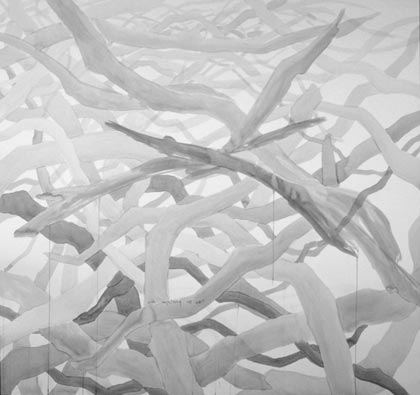
"With Expectancy We Wait," India ink 36" x 40", by Alison Stigora, 2008
Christy:
by Nate Barksdale for Culture Making

There’s a cheap/free good music convergence happening at Amazon.com’s mp3 store this week: Emmylou Harris’s splendid, splendid album “Wrecking Ball”, a brilliant sonic reinvention of songs by Gillian Welch, Lucinda Williams, Bob Dylan, Steve Earle, Neil Young, Jimi Hindrix, and Daniel Lanois, is on sale for just $2.99 for the full download.

And as if that weren’t enough, they’ve got a dozen or so world music sampler albums available for free download, including this eight-song compliation from the always-inspiring Soweto Gospel Choir. Did I mention it’s free?

image
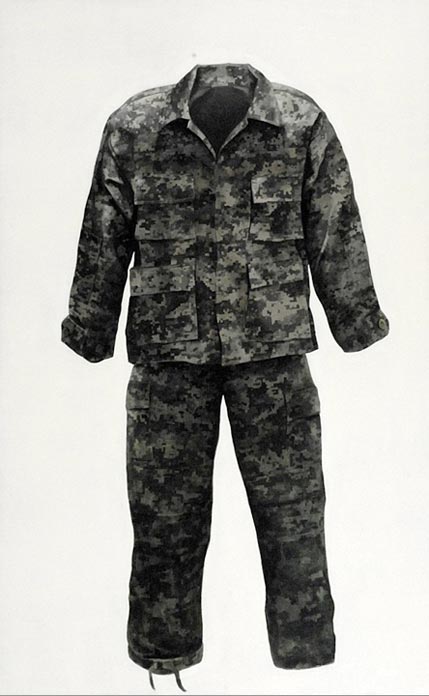
"Fatigue," oil on linen, 80" x 50" by Jay Walker, 2007
Christy:
Nate:
from "The lost art of reading," by David L. Ulin, The Los Angeles Times, 9 August 2009 :: via The Curator

Here we have the paradox, since in giving up control we somehow gain it, by being brought in contact with ourselves. “My experience,” William James once observed, “is what I agree to attend to” — a line Winifred Gallagher uses as the epigraph of “Rapt: Attention and the Focused Life” (Penguin Press: 244 pp., $25.95). In Gallagher’s analysis, attention is a lens through which to consider not just identity but desire. Who do we want to be, she asks, and how do we go about that process of becoming in a world of endless options, distractions, possibilities?

These are elementary questions, and for me, they cycle back to reading, to the focus it requires. When I was a kid, maybe 12 or 13, my grandmother used to get mad at me for attending family functions with a book. Back then, if I’d had the language for it, I might have argued that the world within the pages was more compelling than the world without; I was reading both to escape and to be engaged. All these years later, I find myself in a not-dissimilar position, in which reading has become an act of meditation, with all of meditation’s attendant difficulty and grace. I sit down. I try to make a place for silence. It’s harder than it used to be, but still, I read.

image
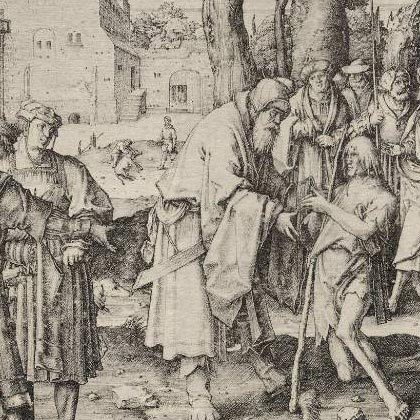
detail from "The Return of the Prodigal Son," engraving by Lucas van Leyden, c.1510 :: via Museum of Biblical Art
Christy:
video Les was More

"Les Paul & Mary Ford on Alistair Cooke's 'Omnibus,'" 23 October 1953 :: via Boing Boing
Nate:
Christy:
from "Biking 'Fastest Growing' Way To Get Around NYC," AP Article/WCBS, 15 August 2009

In a metropolis known for its aggressive traffic, noise and fumes, cyclists crisscross New York City on two wheels while dodging cars, trucks, cabs, pedestrians—and even other bikers tearing around with no hands on the bar.

Despite the dangers, biking is New York City’s “fastest growing mode of transportation,” says City Transportation Commissioner Janette Sadik-Khan, who herself bikes to work in lower Manhattan, about a mile from her Greenwich Village home.

The number of cyclists has jumped by 80 percent in the past decade—to 185,000 among the more than 8 million city denizens. City officials say they’ve worked to make the city more biker friendly. They note the hundreds of miles of marked bike paths created in recent years, safety awareness campaigns and handouts of free helmets to unprotected cyclists.

The quotations, images, and embedded media in this blog are the work of the credited authors, artists, and publications, and are employed in the spirit of fair use, commentary, and criticism. We always link to the original source of material we cite. If you think we’ve missed something, let us know. The inclusion of media on this site should not imply its owners’ endorsement (or for that matter awareness) of this book, blog, or the blog’s curators and commentators. Though we hope they’d like us.

horizons of the possible  cultural worlds  music  photography  art  technology and change  food and drink  europe  community  gardens and cities  cultivation and creation  books  asia  africa  language  children  literature  writing  painting  movies  video  cities  family  changing the world  gestures and postures  power  internet  business  medicine  government  technology  poverty  grace  consumption  education  color  reading  india  architecture  animals  poetry  maps  money  visual arts  performing arts  trends  design  disciplines  transport  agriculture  3 12 120  south america  travel  war  tv  communication  science  film  economics  transit  sculpture  advertising  psychology  churches  revelation  work  clothing  france  infrastructure  sport  england  home  unintended consequences  fashion  politics  street view  failure  generations  bible  copying  christmas  china  creativity  history  story  craft  women  humor  development  nature  pop culture  water  california  museums  time  landscape  computers  dance  kevin kelly  suburbs  remixes  play  discipline  creation  new york  primordial stories  japan  parents  furniture  middle east  least of nations  charity  naming  light  church  stories  stewardship  journalism  religion  russia  neighborhoods  germany  italy  names  drawing  games  media  mission  mexico  words  law  australia  love  cell phones  islam  traces of god  change the world  pentecost and beyond  philanthropy  translation  libraries  heroes  david taylor  entertainment  creation and cultivation  statistics  new jerusalem  shopping  typography  twitter  redemption  space  graffiti  buildings  alphabets  engineering  sound  wilderness  lists  signs  military  death  beauty  visual art  marriage  risk  data  tradition  safety  rob walker  cultivation  race  finance  cars  lamin sanneh  environment  migration  illustration  philosophy  noise  memes  19th century  ideas  reconciliation  crime  prison  innovation  service  modernity  condemnation  critique  google  environmentalism  collage  christianity  television  south africa  taste  happiness  natural sciences  paper  latin america  stone  afghanistan  convergence  voice  turkey  public space  babel  future  wonder  animation  memory  nigeria  genesis  wealth  nostalgia  recreation  pets  tools  metaphor  heaven  monasticism  friendship  leisure  irony  multiculturalism  canada  prayer  oceana  vision  kenya  john stackhouse  news  nations  sports  objects  colonialism  netherlands  disease  fiction  biology  glorious impossible  uk  gold  hip-hop  mentoring  parks  health  jewish