Culture Making is now archived. Enjoy five years of reflections on culture worth celebrating.
For more about the book and Andy Crouch, please visit andy-crouch.com.

Posts tagged writing

Nate

:
from "The Love of Reading," by Virginia Woolf, from her Essays, vol. 5, excerpted in The Guardian, 17 January 2009 :: via 3quarksdaily
image

Reading is a very complex art - the hastiest examination of our sensations as a reader will show us that much. And our duties as readers are many and various. But perhaps it may be said that our first duty to a book is that one should read it for the first time as if one were writing it.

One should begin by sitting in the dock with the criminal, not by mounting the bench to sit among the Judges. One should be an accomplice with the writer in his act, whether good or bad, of creation. For each of these books, however it may differ in kind and quality, is an attempt to make something. And our first duty as readers is to try and understand what the writer is making from the first word with which he builds his first sentence to the last with which he ends his book. We must not impose our design upon him; we must not try to make him conform his will to ours. We must allow Defoe to be Defoe and Jane Austen to be Jane Austen as freely as we allow the tiger to have his fur and the tortoise to have his shell. And this is very difficult. For it is one of the qualities of greatness that it brings Heaven and earth and human nature into conformity with its own vision.

I would write ads for deodorants or labels for catsup bottle, if I had to. The miracle of turning inklings into thoughts and thoughts into words and words into metal and print and ink never palls for me.

—John Updike, Paris Review interview (1967) :: via Daring Fireball

Nate

:
a Fed by Birds post, 17 January 2009
image

1,000 Postcards is a short radio piece by Rene Gutel, about how her father, a bus driver, finding his job sometimes dull, decided to write her a postcard every day while she was away at college. I like the fact that after a while the whole campus became fascinated by the postcards, and she found herself having to read that day’s instalment to student after envious student. Funny and sweet.

Andy

:

Texting is the cheapest and most popular mode of cellphone communication in most of the world, and last year text messages topped voice calls even in the U.S. The world’s three billion cellphones far surpass the Internet as a universal communications medium, and they are vital to business development in less-developed economies.

But companies that develop predictive text say they have created cellphone software for fewer than 80 of the world’s 6,912 languages cataloged by SIL International, a Dallas organization that works to preserve languages.

One key to using the languages is the availability of a technology called predictive text, which reduces the number of key taps necessary to create a word when using a limited keypad. Market research shows that text messaging soars after predictive text becomes available. . . .

In Hindi, a language with 11 vowels and 34 consonants that is spoken by 40% of the Indian population, texting “Namaste,” which means “hello,” can take 21 key presses. . . . Typing “Namaste” with predictive text takes just six key presses. Nuance Corp. of Burlington, Mass., which dominates the predictive-text market, says that in 2006 cellphone users in India with predictive text in their handsets averaged 70 messages a week; those without it averaged 18.

Nate

:
"Computer Beats Kerouac, Man," a NYTimes.com Ideas blog post, 8 December 2008 :: scroll video from WBUR

Literature | How would Jack Kerouac cope with Microsoft Word? Not very well, a blogger imagines, for “the birth of the computer has led, largely, to the death of the genuine stream of consciousness novel.” It “allows us to delete, shift sections around and continually edit, in the way that Kerouac, writing on his lengthy scrolls [for “On the Road”], could not.” [Guardian]

Nate

:
from "At the British Museum," by Peter Campbell, London Review of Books, 18 December 2008 :: via Polymeme
image

Held in the hand, a typical cuneiform tablet is about the same weight and shape as an early mobile phone. Hold it as though you were going to text someone and you hold it the way the scribe did; a proverb had it that ‘a good scribe follows the mouth.’ Motions of the stylus made the tiny triangular indentations of cuneiform characters in the clay. The actions would have been much quicker and more precise, but otherwise rather like the pecks you make at a phone keypad.

Some tablets are of course larger. Gilgamesh, thousands of words long, is an epic in 12 tablets more than a foot high, and inscriptions carved in rock are more expansive still. But it is the small tablets with tiny writing that are the most tantalising objects in Babylon, Myth and Reality (at the British Museum until 15 March). Can one, through them, get beyond archaeological evidence and inference, bypass the fevered imagination of William Blake’s and John Martin’s Bible illustrations and hear the voice of a Mesopotamian Pepys?

Well, not exactly, but the range and character of what is written down give some idea of the texture of everyday life in Nebuchadnezzar’s Babylon. The majority of tablets may be the equivalent of office files – letters, legal documents, contracts, mortgages, lists of goods – but there are also messages addressed to the gods, some of them expressing indignance that good behaviour has not been rewarded. Astronomical observations are detailed and medical texts full of diagnostic descriptions. There are records of refurbishments: the kings, who had responsibility not just for religious ceremonies but for the maintenance of temple structures, celebrated their building works.

Nate

:
a NYTimes.com ideas blog post, 9 December 2008

Journalism | While we’re on the subject of a New New Deal, an unemployed newsman says, how about resurrecting F.D.R.’s Federal Writers Project to tide over all the laid-off journalists displaced by the turmoil in their industry? They could chronicle “the ground-level impact of the Great Recession” or the transition to a green economy. And who knows? There might be a Steinbeck, Terkel or Ellison among them too. [New Republic]

Nate

:
Sayings of the Fathers (Verba Seniorum), Book XIV.v, recorded by St. Athanasius (4th century), translated from the Greek by Pelagius the Deacon and John the Subdeacon (6th century), and from the Latin by Helen Waddell in The Desert Fathers, 1936

They told of the abbot Silvanus that he had a disciple in Scete named Marcus, and that he was of great obedience, and also a writer of the ancient script: and the old man loved him because of his obedience. He had also another eleven disciples, who were aggrieved that he loved him more than them. And when the old men in the neighborhood heard that the abbot loved him more than the rest, they took it ill. So one day the came to him: and the abbot Silvanus took them with him and went out of his cell, and began to knock at the cells of his disciples, one by one, saying, “Brother, come, I have need of thee.” And not one of them obeyed him. He came to Marcus’ cell and knocked saying, “Marcus.” And when he heard the old man’s voice he came straight outside, and the old man sent him on some errand. Then the abbot Silvanus said to the old men, “Where are the other brethren?” And he went into Marcus’ cell, and found a quaternion of manuscript which he had that moment begun, and was making thereon the letter O. And on hearing the old man’s voice, he had not stayed to sweep the pen full circle so as to finish and close the letter that was under his hand. And the old men said, “Truly, abbot, him whom thou lovest we love also, for God loveth him.”

Nate

:

Literature | A new English translation of Hugo’s sprawling and digressive “Les Misérables” is 100,000 words longer than its best-known predecessor. So it draws attention to the translator’s mission of sticking to an author’s intent. Or in some cases not? In America, the 1863 “Confederate” edition, unlike a rival “Yankee” edition, “struck out all references to slavery.” [TLS]

Nate

:
from "Personal Space and Writing Novels in the Internet Era," by Jeff Vandermeer, Ecstatic Days, 13 September 2008; photo by juanpol/Flickr :: via LATimes.com Jacket Copy blog and Polymeme
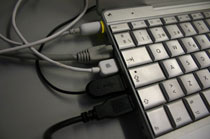
My Powerbook

Okay, I’ll admit it: work on my new novel, Finch, is going well because every morning my long-suffering yet often amused wife Ann hides the router box and my cell phone. I get up around 7am, I have my breakfast and watch something innocuous like BBC News or Frasier for about half an hour, and then get down to work. Around noon I take a break to get some lunch, then go back to it, usually at that point editing or organizing notes. Around 2:30 I call Ann on our landline and she tells me where the router box and the cell phone are (it has internet access on it) so I can finish up the afternoon with necessary emails and other work, before going to the gym.

The internet in its many forms is, for me, a harmful and insidious enemy of novel creation. A novel takes a great deal of uninterrupted thought, not to mention uninterrupted writing. A novel in gestation does not brook interference of this kind. This isn’t just a matter of procrastination or time-wasting. It directly affects quality and depth in my opinion. The sustained effort required by a novel should not include multi-tasking on other things, if you have the option.

Ten years ago this is not something I, or anyone else, would have had to worry about. In fact, I remember writing parts of one novel in an apartment that didn’t even have electricity. Or, heck, any furniture to speak of. I got up around dawn, went to my day job, and then came back and wrote until it got dark. Sometimes I’d go to a coffee shop so I could write longer.

The point is, some forms of modern technology are, in a certain context, dangerous. Sometimes in workshops, Ann and I will force students to write longhand just to cut them off from their laptops and all the stuff that comes flying up onto the screen. Some hate it. Some realize what they’ve been missing.

image
"Type Specimen: Blaktur," designed by Ken Barber for House Industries :: via Type Directors Club

Nate

:

Andy

:
from "A history of tables," by Kirstin Vander Giessen-Reitsma, catapult magazine, 12 September 2008

A photo is floating around our attic somewhere, probably in a Converse shoebox. In it, I am just barely fifteen years old, a sophomore in high school, wearing an oversized green sweatshirt, jeans, and perhaps the shoes that came in the box that now holds the photo. The setting is my school library. I am sitting at a table where I appear to be studying, but across from me is Rob, another fifteen-year-old sophomore. The look I’m giving the yearbook photographer is an exaggeration of innocence. Though our books are open, pens in hand, Rob has just finished giving me directions to his house for the party he plans to have while his parents are out of town.

At twenty-eight years old, nearly eight years in to my marriage to Rob, I can see this sly study hall meeting around a library table as a fulcrum on which much of my life story turns. I can also see tables—those ubiquitous pieces of furniture that invite gathering by their nature—as a key image for exploring where I’ve been and where I may be going.

Andy

:
from "Marilynne Robinson at Large Again," by Linda McCullough Moore, Books and Culture, 8 September 2008

Marilynne Robinson is in a category by herself, and that category is both fully staffed and up to any project. I hope this is gratuitous, but if you haven’t read the essays in The Death of Adam, neither sleep nor eat till you have remedied the oversight. Her first novel Housekeeping is what I think a book should be. And now writing in Home of the same people in the same time and place as in her Pulitzer Prize-winning novel Gilead, everything is different. These two books could not be less alike. And just because she can and perhaps must, Robinson has pages and pages of dialogue about theology here, people sitting on the porch as evening falls, discussing and dissecting the particulars. The reader slows his pace, he doesn’t want to miss a word. Theology as conversation. She’s pulled off the impossible. (I know whereof I speak.)

In all her work we have the writer as magician. She’s making a concoction of her own invention, and if she doesn’t know if it will turn the one who drinks it into a fairy princess or blow the place to smithereens, well, those are risks she is prepared to take on our behalf. Perhaps that hints at her distinctive. She has been the sort of reader in her life who knows the possibility of writing. She takes nothing lightly, but there is lilt and charm for all of that. She can be light precisely because she knows the stakes are high, because she has cared enough to take the measure of the thing. And, she has the requisite humility to say, “There are things worth believing.”

excerpt Failed writers

Nate

:
from "Robert Giroux, Publisher, Dies at 94," by Christopher Lehmann-Haupt, NYTimes.com, 5 September 2008

His ambition to write may have prompted an exchange with T. S. Eliot, then in his late 50s, on the day they met in 1946, when Mr. Giroux, “just past 30,” as he recalled the moment in “The Oxford Book of Literary Anecdotes,” was an editor at Harcourt, Brace. “His most memorable remark of the day,” Mr. Giroux said, “occurred when I asked him if he agreed with the definition that most editors are failed writers, and he replied, ‘Perhaps, but so are most writers.’“

by Andy Crouch for Culture Making

Today marks the launch of a new online magazine from the New York-based International Arts Movement, The Curator. As editor-in-chief Alissa Wilkinson writes, The Curator will seek “to encourage, promote, and uncover those artifacts of culture . . . that inspire and embody truth, goodness, and beauty.” Amen to that, sister—expect us to follow The Curator’s progress with great interest in the coming weeks and months, and no doubt to steal, er, I mean, excerpt and repost, some of its best material.

Alissa was one of the early readers and reviewers of Culture Making, and I’ve been grateful for her intelligent enthusiasm for the book, and more importantly for her discerning eye for signs of hope and opportunities to cultivate and create. Best wishes, Alissa and team!

"Dave Eggers makes his TED Prize wish: Once Upon a School" (2008), TED.com :: via GOOD Magazine

Nate

:

Andy

:
from "Letter from Beijing: Fun and Games," by Anthony Lane, The New Yorker, 1 September 2008

The morning of Friday, August 15th, was one of unaccustomed freshness in Beijing, and it brought forth two objects, both wreathed in legend but hitherto hard to spot. The first was a boiling ball of gases some ninety-three million miles away, known as the sun. . . .

I spoke with . . .  Jay Lyon, of Canada, after he had held his nerve and taken two matches, one on the heels of the other, on the Archery Field. His first victim had been Xue Hai Feng, of China, who was ranked No. 18 at the games, twenty-nine places above Lyon, so it was quite a scalp, and he had then seen off Brady Ellison, of the United States. What was boosting him that day? “Sweet little e-mail from my mom. She said, no matter what, the sun’s still going to come up tomorrow.” Mrs. Lyon was clearly not in Beijing, where the chances of that were around fifty-fifty. “And, if I don’t do well, she’s going to kick my ass,” he added, lovingly. The other mystery weapon in Lyon’s quiver was Phil Towle, a performance coach back in the States, whose online messages had been an inspiration. “He’s also been a psychologist for Metallica,” Ryan said, as if to justify the gentleman. I had to steady myself against a passing volunteer. Metallica has a psychologist? What, exactly, is it repressing in its sylvan melodies?

Nate

:
from "Joseph Mitchell's true facts," by Garth Risk Hallberg, More Intelligent Life, 25 August 2008

This summer marks the 100th birthday of the late Joseph Mitchell, who helped to redefine the art of journalism. In 1938, when Mitchell wrote his first profile for the New Yorker, the notion of the reporter as stylist was still a novelty. By 1992, when the omnibus ”Up in the Old Hotel” hit bestseller lists, it was ubiquitous. The recent republication of Mitchell’s finest collection, ”The Bottom of the Harbor”, brings back into focus innovations that have faded into familiarity or fallen into neglect. It couldn’t have come at a better time. Our current crop of reporter-stylists would do well to study the qualities that make this book remarkable.

Chief among these is patience. Contemporary magazine journalism often seems torn between ratifying conventional wisdom and railing against it. The twin temptations of sensationalism and contrarianism hover over online discourse, in particular. Not that technology is solely to blame; as a newspaperman in the 1930s, covering the Hauptmann murder trial and interviewing George Bernard Shaw for the Herald Tribune and the World-Telegram, respectively, Mitchell was near the centre of the media circuses of his day. Once the New Yorker freed him from deadline pressure, however, Mitchell conserved his attention for (and lavished it on) subjects he felt it might dignify.

It turns out just about anything is fascinating if you look at it hard enough. What Mitchell chose to look at, in his increasingly lengthy “profiles”, were the remnants of Old New York that were disappearing beneath the city’s relentless growth: waterfront rooming-houses (“Old Mr Flood”), petty criminals (“King of the Gypsys”), Epicurean ritual (“All You Can Eat for Five Bucks”) and, in “The Bottom of the Harbor, the maritime life of a city most people forget is an archipelago.

Nate

:
from "Why I Live Where I Live" (1980), collected in Signposts in a Strange Land: Essays, by Walker Percy, 2000

A Chinese curse condemns one to live in interesting and eventful times. The best thing about Covington is that it is in a certain sense out of place and time but not too far out and therefore just the place for a Chinese scholar who asks nothing more than being left alone. One can sniff the ozone from the pine trees, visit the local bars, eat crawfish, and drink Dixie beer and feel as good as it is possible to feel in this awfully interesting century. And now and then, drive across the lake to New Orleans, still an entrancing city, eat trout amandine at Galatoire’s, drive home to my pleasant, uninteresting place, try to figure out how the world got into such a fix, shrug, take a drink, and listen to the frogs tune up.