Culture Making is now archived. Enjoy five years of reflections on culture worth celebrating.
For more about the book and Andy Crouch, please visit andy-crouch.com.

Posts tagged language

Christy:
From "Nine Ideas About Languages," by Harvey A. Daniels, in "Language: Introductory Readings," Virginia Clark, Paul Eschholz, Alfred Rosa, and Beth Lee Simon, Eds., 7th Ed., 2008 (Bedford/St. Martin's)

In spite of the commonsense notions of parents, they do not “teach” their children to talk. Children learn to talk, using the language of their parents, siblings, friends, and others as sources and examples—and by using other speakers as testing devices for their own emerging ideas about language. When we acknowledge the complexity of adult speech, with its ability to generate an unlimited number of new, meaningful utterances, it is clear that this skill cannot be the end result of simple instruction. Parents do not explain to their children, for example, that adjectives generally precede the noun in English, nor do they lecture them on the rules governing formation of the past participle. While parents do correct some kinds of mistakes on a piecemeal basis, discovering the underlying rules which make up the language is the child’s job.

From what we know, children appear to learn language partly by imitation but even more by hypothesis-testing. Consider a child who is just beginning to form past tenses. In the earliest efforts, the child is likely to produce such incorrect and unheard forms as I goed to the store or I seed a dog, along with other conventional uses of the past tense: I walked to Grandma’s. This process reveals that the child has learned the basic, general rule about the formation of the past tense—you add -ed to the verb—but has not yet mastered the other rules, the exceptions and irregularities. The production of forms that the child has never heard suggests that imitation is not central in language learning and that the child’s main strategy is hypothesizing—deducing from the language she hears an idea about the underlying rule, and then trying it out.

excerpt Tweet-worthy
Andy:
from "The Meaning of a Tweet," by Rebecca Larson, IVP - Strangely Dim, 25 August 2009

This idea [of concise communication] certainly isn’t new. How about the book of Proverbs? “When words are many, sin is not absent, / but he who holds his tongue is wise” (10:19). At seventy-eight characters, including spaces and punctuation, eminently tweetable. What about memorable speeches? We don’t remember the whole speech. But the short quotes are bite-sized, so they stick. “Ask not what your country can do for you. Ask what you can do for your country” (seventy-nine characters). Long? No. Meaningful? Yes. Or how about song lyrics? “I have run, I have crawled, I have scaled these city walls, only to be with you. But I still haven’t found what I’m looking for”—128 characters. Tweet it, baby.

This highly lauded poem by William Carlos Williams could be tweeted with 51 characters to spare:

so much depends
upon

a red wheel
barrow

glazed with rain
water

beside the white
chickens.

Or this Japanese Haiku:

old pond . . .
a frog leaps in
water’s sound

Simple. Beautiful. Tweet-worthy.

Vitaphone newsreel, 1930; quotation from The Story of My Life, by Helen Keller, 1902 :: vis Boing Boing
Nate:
image
from the "Shettima Kagu Qur'an," Early Nigerian Qur'anic Manuscripts :: thanks Andrew!
Nate:
photo
photo by Johanna Brugman and Bonny Sands, from "Classifying 'Clicks' In African Languages To Clear Up 100-year-old Mystery," ScienceDaily, 18 July 2009 :: additional click info from Wikipedia
Nate:

Flannery: A Life of Flannery O'Connor author Brad Gooch, interviewed by Michael Silverblatt on KCRW's Bookworm. Additional links from Black Market Kidneys
Nate:
Nate:
a Kottke.org post, 17 April 2009

When western music was played to members of the Mafa people from Cameroon who have never been exposed to western music, movies, or art, they were able to recognize the emotions conveyed by the music, even though the Mafa don’t associate emotions with their own music.

excerpt Babel undone

Nate

:

So the LORD scattered them from there over all the earth, and they stopped building the city. That is why it was called Babel —because there the LORD confused the language of the whole world. From there the LORD scattered them over the face of the whole earth.

English–Albanian–Arabic–Bulgarian–Catalan–Chinese–Croatian–Czech–Danish–Dutch–Estonian–Filipino–Finnish–French–Galician–German–Greek–Hebrew–Hindi–Hungarian–Indonesian–Italian–Japanese–Korean–Latvian–Lithuanian–Maltese–Norwegian–Polish–Portuguese–Romanian–Russian–Serbian–Slovak–Slovenian–Spanish–Swedish–Thai–Turkish–Ukrainian–Vietnamese–English

Then stop developing city and region. Yes, more than one world language. Reverse direction in this area.

by Nate Barksdale for Culture Making
image

Yesterday Comment Magazine has posted an interview Gideon Strauss conducted with me over email a few weeks back, about my role as a curator for Culture-Making.com and, inevitably, my love of Swahili dictionaries. It’s part of their new “Comforts and Delights” feature; a few times a year I’ll be weighing in there with my thoughts about interesting cultural artifacts.

image
from "The directed graph of stereotypical incomprehensibility," by Mark Liberman, Language Log, 15 January 2009 :: via Strange Maps

Nate

:

Nate

:
from "McCulture," by Aviya Kushner, The Wilson Quarterly, Winter 2009 :: via NYTimes.com Ideas Blog

“So many writers nowadays come from different cultures, and I wonder if that compensates for the lack of interest in other cultures,” says ­Moscow-­born novelist Olga Grushin, author of The Dream Life of Sukhanov (2006), who writes in English and now lives near Washington, D.C. “In a way, if Americans will not go to other cultures, then other cultures will have to come here and speak about themselves.”

But from the first translation of the Bible onward, what Grushin describes was always the translator’s role: to go to another culture and bring back what matters. It was sort of like immigration with a ­built-­in return trip. A good translator must create and inhabit a place that does not fully exist—a land between languages—because it is impossible to reproduce another language exactly. A translator must bring over what is most important, as accurately as ­possible.

A bilingual writer, on the other hand, might omit the dirty laundry, inside jokes, or other intimate markers of a culture, such as a scandalous reference to a prime minister’s ­sexual ­harassment travails that matter only to the small number of residents of his country, or a joke on, say, Chairman Mao’s appearance. A novelist is more interested in story than in accuracy, but most translators think about exactness, and try to honor it, in their ­way.

Now, sadly, we have forgotten what it is to live between languages, to have translators who inhabit the space between tongues. We prefer to read of a Bosnian immigrant in New York instead of a Bosnian man in Sarajevo, written by a Bosnian. This way, at least we can recognize New ­York.

Nate

:
from "Speaking in Tongues," by Zadie Smith, The New York Review of Books, 26 February 2009

For reasons that are obscure to me, those qualities we cherish in our artists we condemn in our politicians. In our artists we look for the many-colored voice, the multiple sensibility. The apogee of this is, of course, Shakespeare: even more than for his wordplay we cherish him for his lack of allegiance. Our Shakespeare sees always both sides of a thing, he is black and white, male and female—he is everyman. The giant lacunae in his biography are merely a convenience; if any new facts of religious or political affiliation were ever to arise we would dismiss them in our hearts anyway.

Nate

:
from Moon Tiger, by Penelope Lively (1987), pp.40–41

Today language abandoned me. I could not find the word for a simple object—a commonplace familiar furnishing. For an instant, I stared into a void. Language tethers us to the world; without it we spin like atoms. Later, I made an inventory of the room—a naming of parts: bed, chair, table, picture, vase, cupboard, window, curtain. Curtain. And I breathed again.

We open our mouths and out flow words whose ancestries we do not even know. We are walking lexicons. In a single sentence of idle chatter we preserve Latin, Anglo-Saxon, Norse; we carry a museum inside our heads, each day we commemorate peoples of whom we have never heard. More than that, we speak volumes—our language is the language of everything we have not read. Shakespeare and the Authorized Version surface in supermarkets, on buses, chatter on radio and television. I find this miraculous. I never cease to wonder at it. That words are more durable than anything, that they blow with the wind, hibernate and reawaken, shelter parasitic on the most unlikely hosts, survive and survive and survive.

Andy

:

Texting is the cheapest and most popular mode of cellphone communication in most of the world, and last year text messages topped voice calls even in the U.S. The world’s three billion cellphones far surpass the Internet as a universal communications medium, and they are vital to business development in less-developed economies.

But companies that develop predictive text say they have created cellphone software for fewer than 80 of the world’s 6,912 languages cataloged by SIL International, a Dallas organization that works to preserve languages.

One key to using the languages is the availability of a technology called predictive text, which reduces the number of key taps necessary to create a word when using a limited keypad. Market research shows that text messaging soars after predictive text becomes available. . . .

In Hindi, a language with 11 vowels and 34 consonants that is spoken by 40% of the Indian population, texting “Namaste,” which means “hello,” can take 21 key presses. . . . Typing “Namaste” with predictive text takes just six key presses. Nuance Corp. of Burlington, Mass., which dominates the predictive-text market, says that in 2006 cellphone users in India with predictive text in their handsets averaged 70 messages a week; those without it averaged 18.

Nate

:

Added excitement comes from the bilingual reworking of the libretto. When Maria sings I Feel Pretty it comes out as: “Hoy me siento/Tan Hermosa/Tan preciosa que puedo volar/Y no hay diosa, en el mundo, que me va a alcanzar.”

Lin-Manuel Miranda, creator of the recent hit musical In The Heights, which focuses on a poor neighbourhood of Manhattan’s Washington Heights faced with gentrification, was recruited to rewrite the lyrics. The Sharks sing in Spanish, with English surtitles, while the delinquent Jets sing in English.

Laurents was given the idea of a bi-lingual show after his companion, Tom Hatcher, who died two years ago, saw an all-Spanish staging of the musical in Colombia in which the Sharks – the Capulets of Shakespeare’s play – were transformed into heroes, the Jets into villains.

Laurents intends to make the new version darker and more threatening than previous stagings, certainly more so than the film, of which he is disparaging. “I thought the whole thing was terrible. Day-Glo costumes and fake accents!” he told the Washington Post.

Nate

:
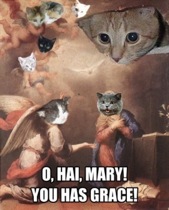
Luke 1:46–56, LOLCat Bible Translation Project :: thanks Christine!
image

Mary sed “Ceiling Cat is laik a big deal, Mai I is happy about Ceiling Cat… bcz he kepted me in maind an now evribodi knowz i can haz cheezburgr. Thank u Ceiling Cat, u iz cool. U iz niec to evribodi. Xcept peeplz who doant dizrv it LOL. U haz pwned teh r00lrz whiel stil bein niec to teh n00bz. U givd cookies to teh hungri whiel u tolded teh rich “Niec trai.” U wuz niec to Israel an to all Abraham’s famili liek u promist.”

Nate

:
from Bend Sinister, by Vladimir Nabokov, 1947 :: via The excitement of verbal adventure

It was as if someone, having seen a certain oak tree (further called Individual T) growing in a certain land casting its own unique shadow on the green and brown ground, had proceeded to erect in his garden a prodigiously intricate piece of machinery which in itself was as unlike that or any other tree as the translator’s inspiration and language were unlike those of the original author, but which, by means of ingenious combinations of parts, light effects, breeze-engendering engines, would, when completed, cast a show exactly similar to that of Individual T—the same outline, changing in the same manner, with the same double and single spots of sun rippling in the same position, at the same hour of the day.

Andy

:

I’m interested in how reading on the page differs from reading on screens; in how different kinds of screens enable different kinds of knowledge; in the strategies and tools we employ for information gathering, for information ordering, and for information evaluating. I think a lot about linear and non-linear forms of organizing mental experience, and the technologies that make such organization easier or harder. I wonder about whether we’re really losing serendipity, as so many people say. I’m fascinated by the various speeds at which technologies move and by our ability (or, sometimes, inability) to match those speeds. I wonder what libraries are for and what they will be for.

Nate

:

"Qongoqothwane (The Click Song)," by Miriam Makeba (1979)

Nate

: