 My pleasant uninteresting place
Nate
:
A Chinese curse condemns one to live in interesting and eventful times. The best thing about Covington is that it is in a certain sense out of place and time but not too far out and therefore just the place for a Chinese scholar who asks nothing more than being left alone. One can sniff the ozone from the pine trees, visit the local bars, eat crawfish, and drink Dixie beer and feel as good as it is possible to feel in this awfully interesting century. And now and then, drive across the lake to New Orleans, still an entrancing city, eat trout amandine at Galatoire’s, drive home to my pleasant, uninteresting place, try to figure out how the world got into such a fix, shrug, take a drink, and listen to the frogs tune up.

Nate
:
 Chain mosques
Nate
:
Taking a page from the evangelical mega-churches that have popped up around the country, Muslims have begun setting up multi-site “mosque chains” to accommodate increasingly large religious services, Mallika Rao reports for the Religion News Service. Often branded as more progressive than other mosques, some of the organizations have begun offering gymnasiums, adult education classes, and even mixed-gender prayer areas. The strategy seems to be paying off, both financially and organizationally. Abeer Abdulla, a media specialist for the Islamic Society of Central Florida in Orlando, told Rao, “because of how streamlined we are, you can get off the highway from anywhere and find a mosque that is well-maintained, well-structured and that will always be open.”
(Thanks, Pew Forum.)
Doctored photographs are the least of our worries. If you want to trick someone with a photograph, there are lots of easy ways to do it. You don’t need Photoshop. You don’t need sophisticated digital photo-manipulation. You don’t need a computer. All you need to do is change the caption.
—Errol Morris, documentary filmmaker, NYTimes.com
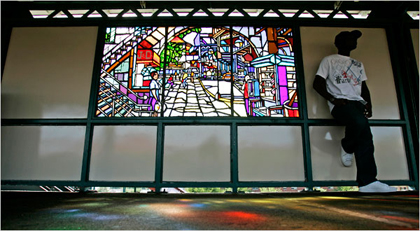
 The El, by Daniel Hauben
Nate
: Culture Making on . . . GodTube!
At the International Christian Retail Show I had the chance to sit down with Kelly Ewing of GodTube, the all-Christian-all-the-time online video powerhouse. (Which posture toward culture described in Culture Making does GodTube represent? As they say in college math textbooks, I’ll leave that as an exercise for the reader.) I enjoyed the interview very much, and we covered some interesting territory. It’s 15 minutes long, an eternity in online video time, but there’s some good stuff here. Thanks, Kelly and GodTube!
A year of… books
Nate
:A collection of books, compiled by Rex, by people who spent a year doing something and then wrote a book about it. Topics include competitive eating, not shopping, and reading the OED.

Nate
:Unix, five hundred years on
Nate
:Very few infrastructure details begin with the idea that they will last 1,000 years. Strange as it sounds it is very likely that some basic software running inside computers today will be running in computers 500 years from now. We see that conservation in cells, where very primitive metabolic cycles present in archaic cells are still operating in cells today. All the fancy “recent” improvements run upon them. One could imagine that in 5 centuries, parts of unix will be found operating in servers. But it is clear that no one would be more surprised than the creators of unix. Most creations, including software, are written in less than optimal conditions. Creators always have the idea that they will go back later to fix the many known imperfections. Of course they are never fixed because the shipped rev is “good enough” — and so the temporary good enough becomes a permanent good enough.
When critique becomes a posture, we end up strangely passive, waiting for culture to deliver us some new item to talk about. Critique as a posture, while an improvement over condemnation as a posture, can leave us strangely unable simply to enjoy cultural goods, preoccupied with our interrogation of their “worldview” and “presuppositions.”
—Culture Making, p.93
Not in my intellectual back yard
Nate
:We hear a lot about the “tragedy of the commons”: if a valuable asset (a grazing field, say) is held in common, each individual will try to exploit as much of it as possible. Villagers will send all their cows out to graze at the same time, and soon the field will be useless. When there’s no ownership, the pursuit of individual self-interest can make everyone worse off. But Heller shows that having too much ownership creates its own problems. If too many people own individual parts of a valuable asset, it’s easy to end up with gridlock, since any one person can simply veto the use of the asset.
The commons leads to overuse and destruction; the anticommons leads to underuse and waste. In the cultural sphere, ever tighter restrictions on copyright and fair use limit artists’ abilities to sample and build on older works of art. In biotechnology, the explosion of patenting over the past twenty-five years—particularly efforts to patent things like gene fragments—may be retarding drug development, by making it hard to create a new drug without licensing myriad previous patents. Even divided land ownership can have unforeseen consequences. Wind power, for instance, could reliably supply up to twenty per cent of America’s energy needs—but only if new transmission lines were built, allowing the efficient movement of power from the places where it’s generated to the places where it’s consumed. Don’t count on that happening anytime soon. Most of the land that the grid would pass through is owned by individuals, and nobody wants power lines running through his back yard.
Nate
:In a recent California Supreme Court case (Bernard vs. Foley), the court decided that friends who care for their elderly or infirm counterparts cannot take gifts or bequests without some special proof that they didn’t unduly influence their friends into making the donation. Perversely, if you take care of your friends when they most need you, you may be disqualifying yourself from accepting their largess.
For a while, lower courts found a way around this awkward burden in the case of “pre-existing” friendships, creating a special exemption from the “custodial care provisions” that the Supreme Court recently interpreted. But the Supreme Court simply thought the pre-existing friendship exemption carved by the lower courts could not be justified by the statutory language.
In my work on friendship and the law, I took the modest position that the lower courts had the right instinct — and that it would be a good thing if friends didn’t have to worry about disqualifying themselves from accepting gifts and bequests merely by trying to care for their infirm counterpart. It is good to see that the Commission, after having read my case, is supportive of the Legislature changing the rules.
There’s a lot to say about why we don’t want the law getting too involved in our friendships. But this is a simple way to help protect friends and encourage the care they can provide for one another — and more cheaply than Medicare, to boot.
 Taggers abhor a vacuum

Nate
:DIY country, DIY university
Nate
:Slightly larger than England and Wales, Somaliland has enjoyed relative peace and prosperity and has held democratic elections, with a presidential vote scheduled for next year.
In a move to lure refugees home, the administration has introduced tax waivers on new investments to fuel more growth.
Despite its poverty, Somaliland and the region offer investment opportunities for those brave enough to return.
Half of Somaliland’s cabinet and lawmakers are former refugees who came back mainly from Europe and America. Former refugees have also become small-factory owners or created businesses, for example, in telecommunications.
Ibrahim has even bigger dreams: he wants to fashion future leaders. “We don’t have leaders in our country but we have managers. Our aim is to produce visionary leaders in future who can bring back hope and amalgamate our people. There is a huge appetite for such leadership and we hope to be the source,” he said.
20yrs experience needed
Nate
:What I went to last night was not the full-blown Passion play - that won’t happen until 2010 (they’re working on it now). I attended instead a play called JEREMIAS, written by the Jewish pacifist Stefan Zweig in 1933, which featured a relatively modest cast of 500, ranging in age from 3 to 80. The criterion for being in a play is that you should be born in Oberammergau or have lived there for 20 years. The current director is Christian Stückl, a local man who directed his first Passion at the tender age of 28 (making him the youngest director in the long history of the play). Stückl told us that, in the 2000 Passion, a group of Muslim inhabitants of the town asked if they could be included: they’d by that time fulfilled the 20 year residency criterion. After enormous discussion during which the Muslim folk elucidated the parallels between the Koran and the Bible, they were included.

This is must-read stuff, and not just for artists. It’s food for thought for any Christian wishing to make a meaningful contribution to their world.
?
Jennifer, professional soprano living in Madison, Wisconsin