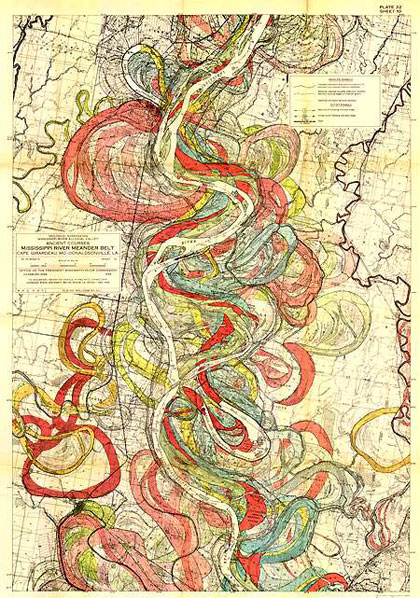
My latest essay for Comment is online now: an illustrated meditation on the history and execution movie subtitles (their color, their language, their grammatical tricks) and why I find them so, well, fascinating. Read it here.
Salvaje de Corazon
La Familia is a notorious drug cartel founded in 2006 in Michoacan, Mexico, and is known for its brutal slayings of detractors.
Mexican authorities have issued a report on the group, which includes the finding that Eldredge’s 2001 book, ”Wild at Heart,” is required reading for gang members. Spanish translations of the book have been discoverd in La Familia residences by police authorities conducting raids, McClatchy Newspapers reports.
Eldredge leads Ransomed Heart, a Springs ministry dedicated to helping men regain their masculinity and become adventurers in life. In “Wild at Heart,” he writes approvingly of men’s innate love of weapons, combat and hunting.
Subtractive creations
Love and language
If I didn’t actually believe in my responsibility to tell Americans the truth about Turkey, nevertheless I did feel it was somehow wasteful to study Russian literature instead of Turkish literature. I had repeatedly been told in linguistics classes that all languages were universally complex, to a biologically determined degree. Didn’t that mean that all languages were, objectively speaking, equally interesting? And I already knew Turkish; it had happened without any work, like a gift, and here I was tossing it away to break my head on a bunch of declensions that came effortlessly to anyone who happened to grow up in Russia.
Today, this strikes me as terrible reasoning. I now understand that love is a rare and valuable thing, and you don’t get to choose its object. You just go around getting hung up on the all the least convenient things—and if the only obstacle in your way is a little extra work, then that’s the wonderful gift right there.
Anyone who does not see the vanity of the world is very vain himself.
And so who does not see it, apart from the young who are preoccupied with bustle, distractions, and plans for the future?
But take away their distractions and you will see them wither from boredom.
Then they feel their hollowness without understanding it, because it is indeed depressing to be in a state of unbearable sadness as soon as you are reduced to contemplating yourself, and without distraction from doing so.
—Pascal, Penseés 70 (tr. Honor Levi)
The daily grind
Of course, there are trade-offs. Bimbo is not as good as a bolillo. A machine-made tortilla is not anything like a homemade tortilla – it’s not even in the same universe.
Mexican women that I have talked to are very explicit about this trade-off. They know it doesn’t taste as good; they don’t care. Because if they want to have time, if they want to work, if they want to send their kids to school, then taste is less important than having that bit of extra money, and moving into the middle class. They have very self-consciously made this decision. In the last ten years, the number of women working in Mexico has gone up from about thirty-three percent to nearly fifty percent. One reason for that—it’s not the only reason, but it is a very important reason—is that we’ve had a revolution in the processing of maize for tortillas.
Being bored is a precious thing
The brilliance of the iPad is that it’s the anytime-anywhere computer. On the subway. In the hall waiting for the elevator. In a car on the way to the airport. Any free moment becomes a potential iPad moment.
The iPhone can do roughly the same thing, but not exactly. Who wants to watch a movie in bed on an iPhone?
So why is this a problem? It sounds like I was super-productive. Every extra minute, I was either producing or consuming.
But something — more than just sleep, though that’s critical too — is lost in the busyness. Something too valuable to lose.
Boredom.
Being bored is a precious thing, a state of mind we should pursue. Once boredom sets in, our minds begin to wander, looking for something exciting, something interesting to land on. And that’s where creativity arises.
My best ideas come to me when I am unproductive. When I am running but not listening to my iPod. When I am sitting, doing nothing, waiting for someone. When I am lying in bed as my mind wanders before falling to sleep. These “wasted” moments, moments not filled with anything in particular, are vital.
They are the moments in which we, often unconsciously, organize our minds, make sense of our lives, and connect the dots. They’re the moments in which we talk to ourselves. And listen.
To lose those moments, to replace them with tasks and efficiency, is a mistake. What’s worse is that we don’t just lose them. We actively throw them away.

My latest essay for Comment is online now: an illustrated meditation on the history and execution movie subtitles (their color, their language, their grammatical tricks) and why I find them so, well, fascinating. Read it here.
Fasting for the mind
A student pursuing a degree in the humanities can expect to run through 1,000 books before graduation day. A wealthy family in England in 1250 might have owned three books: a Bible, a collection of prayers, and a life of the saints—this modestly sized library nevertheless costing as much as a cottage. The painstaking craftsmanship of a pre-Gutenberg Bible was evidence of a society that could not afford to make room for an unlimited range of works but also welcomed restriction as the basis for proper engagement with a set of ideas.
The need to diet, which we know so well in relation to food, and which runs so contrary to our natural impulses, should be brought to bear on what we now have to relearn in relation to knowledge, people, and ideas. Our minds, no less than our bodies, require periods of fasting.
Absolutely zero effort
The [Glee iPhone app] uses a special, gentle version of auto-tune, the recording effect that rounds off your notes to the nearest correct pitch. (Most pop singers today are, in fact, routinely auto-tuned during the recording process.) You’re also given generous reverb and other effects; it’s the high-tech version of singing in the shower.
But the app also somehow multiplies you, duplicates your own vocal line and assigns your clones to other notes. Now you’re singing in lush four-part harmony with yourself, with absolutely zero effort. If you can carry a tune, you can turn off the processing and go it alone.
The result — professional backup band, you processed to sound gorgeous and perfect — is exhilarating, no matter how rotten a singer you are. It’s pop-star fantasy fulfillment for a buck, and everyone who tries it goes nuts. . . .
What both apps teach you along the way is that to sound like a pop star, technical singing talent is not necessarily a prerequisite. (This is especially apparent when, ahem, you isolate Taylor Swift’s vocal track in her app.) With these apps, you now have the same support structure the pros do. You get all the benefits of state-of-the-art vocal processing — and even a taste of the public adoration — that comes with being a star.

2010 will mark several significant milestones in the globalization of Christianity. It is the hundredth anniversary of the Edinburgh Missionary Conference, in many ways the high-water mark of Euro-American Protestant missions. It is also the year that the Lausanne Movement, whose initial congress in 1974 solidified the worldwide evangelical movement, holds its third Congress, this time in Cape Town, South Africa.
Lausanne’s Cape Town 2010 Congress will be dramatically different from either Edinburgh 1910 or Lausanne 1974. At Edinburgh there were no representatives at all of non-Western Christianity (Catholics and Eastern Orthodox churches were not present). Lausanne 1974 had an influential representation from what was then called the “Third World,” but they were decidedly in the minority. In Cape Town in 2010, the majority of the 4,500 delegates will be from the “majority world.” And the majority of those delegates will be paying their own way rather than relying on Western financial support. It’s a remarkable moment and worth celebrating.
Only a few hundred US citizens will be able to attend Cape Town 2010. For the rest of us, the Lausanne Movement is convening twelve conversations in twelve cities about major issues facing the global church. It’s an in-person version of the Global Conversation series I helped to launch at Christianity Today. I had the privilege of joining the conversation in Chicago in March, and on Wednesday 16 June I’ll be on the panel for the Orlando conversation. I’m not worthy to untie the sandals of my fellow panelists, who range from Catalyst director Brad Lomenick to Jesse Miranda from the National Hispanic Christian Leadership Conference.
You’ll have to be in Orlando to join that conversation, but tomorrow night (Thursday 10 June) the Global Conversation arrives at Saddleback Church in southern California, and it will be webcast live at 7 p.m. PDT. You can watch it here.
— Andy Crouch