 Trips that make a difference
Andy
:
[Some doubt] whether it’s even possible to achieve the goals of a real encounter with poverty in a week to 10 days. According to Crouch it is—if the trips are radically different. He suggests three ingredients for trips to have an impact:
1. Make trips a part of a lasting, organization-level partnership: Many youth groups feel they have to go someplace new each year to interest participants. Visiting the same place year after year allows the Americans to begin building more of an understanding of local context and needs, and increases the likelihood that the “help” they offer is actually helpful.
2. Properly set expectations: The more a trip is described as a learning experience rather than an opportunity for an unskilled teenager to “help”, the more likely the trip is to have an impact.
3. Small is beautiful: if personal contact is the sine qua non of such trips, they have to be small enough to allow actual personal contact between Americans and their counterparts.
Still, Crouch doubts that one trip can make a difference:
“The trips only make sense if they are part of a comprehensive program of changing people’s attitudes and behaviors. Evidence is shockingly clear that a single trip has no impact. No matter how well you do a trip, especially when you’re talking about teenagers, they are at such a high-velocity developmental stage that I don’t think any single experience is going to have an ‘impact.’ . . . The organizations that have thought about this the most and are doing the best job are making these trips part of a much longer engagement with the issues. For instance, there’s one organization that requires a year-long commitment and the trip occurs in the middle—they meet just as often after the trip as they do preparing for it. . . . The grooves in our culture are too deep for us to escape without that level of commitment.”
The right number to watch
Andy
:Generations of Americans have been trained to follow the Dow Jones Industrial Average for a quick snapshot of how the economy is performing or is expected to perform. There’s a lot that’s ill-advised about that habit, but, most importantly, attending to the ups and downs in the Dow won’t tell you much about the current financial crisis. Ours is a crisis of credit: Financial firms are unwilling to lend to each other (at all-but-exorbitant rates) for fear that borrowing firms may fail or that they themselves may need the cash to fend off their own crisis.
Whereas the hourly fortunes of the Dow or any stock index are, at best, indirect reflections of this reluctance to lend, the TED Spread measures credit conditions directly. Bloomberg tracks the TED Spread here. What sounds like second-rate Nutella is actually the difference between the interest rate banks charge each other on three-month loans and the interest rate on three-month U.S. Treasury bills.
Consumption v. confession
Nate
:The biggest barrier between Catholics and the confessional, however, may be the real effort it requires. Unloading your transgressions on the Internet takes a few computer clicks—you can do it on your coffee break. But done right, Catholic confession demands a rigorous examination of conscience and real contrition, to say nothing of the prayers you may be assigned for penance and the thinking a priest may ask you to do about the ways you’ve let yourself and God down. No wonder we are more comfortable with the Eucharist service, which demands only that we line up like consumers and accept something for free. Dorothy Day wrote of having to “rack your brain for even the beginnings of sin.” That’s work.

Nate
: The afterlife of Gordon Gekko
Nate
:Gekko’s character was written to create an engaging, charming, but deceitful and brutal being. I have nevertheless run into quite a number of younger people, who upon discovering that I co-wrote the film, wax rhapsodic about it . . . but often for the wrong reasons.
A typical example would be a business executive or a younger studio development person spouting something that goes like this: “The movie changed my life. Once I saw it I knew that I wanted to get into such and such business. I wanted to be like Gordon Gekko.”
The flattery is disarming and ego-stoking, but then neurons fire and alarm bells go off. “You have succeeded with this movie, but you’ve also failed. You gave these people hope to become greater asses than they may already be.”
If even the divine Creator paints on a limited canvas, then this is much more true for us. We can only introduce so many products, write so many laws, paint so many pictures. The best creativity involves discarding that which is less than best, making room for the cultural goods that are the very best we can do with the world that has been given to us.
—Culture Making, p.107

Nate
: NY Department of Bridges

Nate
:Nate
:I feel sometimes as if I were a child who opens its eyes on the world once and sees amazing things it will never know any names for and then has to close its eyes again. I know this is all mere apparition compared to what awaits us, but it is only lovelier for that. There is a human beauty to it. And I can’t believe that, when we have all been changed and put on incorruptibility, we will forget our fantastic condition of mortality and impermanence, the great bright dream of procreating and perishing that meant the whole world to us. In eternity this world will be Troy, I believe, and all that has passed here will be the epic of the universe, the ballad they sing in the streets. Because I don’t imagine any reality putting this one in the shade entirely, and I think piety forbids me to try.
 Glamour and grace
Nate
:Andy
:To its proponents, the A-11 [offense] represents the logical and inevitable evolution of a game that is becoming faster and more spread out at all levels. The alignment diminishes, or eliminates, the need for a traditional offensive line, where players can weigh 300 pounds even in high school. And, coaches say, it reduces injury because it involves glancing blows more than smash-mouth collisions.
To its detractors, the A-11 is a gimmick that cleverly but unfairly takes advantage of a loophole in the rules. To these critics, the offense places an inequitable burden on defenses to determine who is eligible for passes and makes the sport nearly impossible to referee.
Whatever one thinks of the offense, it complies with the current statutes of the National Federation of State High School Associations. And it is as entertaining to watch as it is radical in design.
“My wife says it looks like basketball on grass,” said Coach Johnny Poynter, who has installed the A-11 at Trimble High in Bedford, Ky., fearing injuries would leave his team unable to finish the season in a more conventional offense.

Nate
:Musilanguage
Nate
:According to evolutionary musicology, “Musilanguage” is a proto-linguistic form of communication somewhere in between, on the one hand, emotive grunting/cooing/moaning/what-have-you, and then on the other, semantically/ symbolically appropriate but sonically arbitrary sounds that convey meaning (i.e. words). As most things are when it comes down to it, this particular concept is about gettin’ busy.
In “Descent of Man,” Darwin describes “true musical cadences” used by “some early progenitor of man” to woo the opposite sex (or to get totally whack with the same one). This “musilanguage” — a term coined by neurologist Steven Brown — would ostensibly evolve into language and music, respectively.
The Icelandic post-rock four-piece Sigur Rós is well-known for switching up the emotive and the referential. A made-up language Vonlenska (“Hopelandic” in English), which emulates the cadences of Icelandic without actually meaning anything, peppers their songs up to the current album, Með suð í eyrum við spilum endalaust (“With a Buzz in Our Ears we Play Endlessly”). Now on tour in Europe, Japan, Canada and the US, the band’s bassist confessed in an interview with Pitchfork media, however, that all the hullaballoo about the nature of their lyrics and linguistic hijinks was, and is, rather hype. For example the title of a track on the last album, “Gobbledigook”, was not so much a comment on how they express themselves, but rather a misspelling of the Icelandic “Gobbldigob”, a word for the clippity-clop of horses’ hooves.
The contents of the City will be more akin to our present cultural patterns than is usually acknowledged in discussions of the afterlife. Isaiah pictures the Holy City as a center of commerce, a place that receives the vessels, goods, and currency of commercial activity. . . . Isaiah is, in contemporary jargon, interested in the future of “corporate structures” and “cultural patterns.” And his vision leads him to what are for many of us very surprising observations about the future destiny of many items of “pagan culture.” He sees these items as being gathered into the Holy City to be put to good use there.
—Richard Mouw, When the Kings Come Marching In, p.20
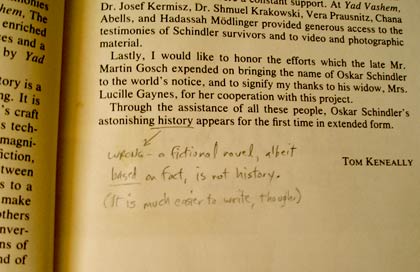
WRONG—
Nate
:


I’m loving your book. Parts of it are making me jump out of my skin. Molting, I think it’s called.
?
Alf, composer and musician
living in New York City