 Cheaper than a bottle of wine
Nate
:
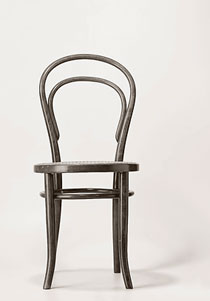
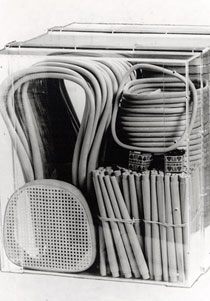
It consists of six pieces of wood - two circles, two sticks and a couple of arches - held together by 10 screws and two nuts. Together they make the wooden chair known as Thonet Model No.14, which although no one has ever actually done the math, is thought to have seated more people than any other chair in history.
The No.14 was the result of years of technical experiments by its inventor, the 19th-century German-born cabinetmaker Michael Thonet. His ambition was characteristically bold. Thonet wanted to produce the first mass-manufactured chair, which would be sold at an affordable price (three florins, slightly less than a bottle of wine).

Nate
: From gardening to gaming
Nate
:One day Miyamoto was tending his garden. He was in awe at the process of planting, growing and harvesting and the general admiration of the beauty that can arise out of the garden. This is when the crazy idea of making some sort of garden-influenced game came to mind. As cheesy and boring as it may sound, he did not end up with a design reminiscent of literally watching grass grow on your TV screen. The end result was Pikmin, a title where the player plants and harvests little flower creatures. You play as Captain Olimar whose job is to keep all the Pikmin alive, safe from the large bugs and animals that inhabit the planet. Quite a far cry from the shoot-to-kill mentality, eh?
A few years after bringing an evolved sense of gardening to gaming, Miyamoto oversaw the advent of Wii Fit, a new interactive way to bring health into the fold of non-traditional gaming. So instead of playing a version of creation on screen, the player would literally be working out, which in and of itself isn’t new or innovative, but bringing it into the fold of interactive games is more than admirable. Even the joy of playing music is made simpler, a-la Guitar Hero or Rock Band, in Wii Music - a simpler way to enjoy the beauty of making music than even the aforementioned blockbusters.
 Call + Response
Nate
:Image vs. presence
Nate
:
“I mean,” Hockney continued, “I’ve observed his progress, though at times that was by no means easy, and for the longest time I felt that his position on the photographing of his work”—a flat prohibition, as it happens (which is one of the principal reasons he was so much less well known among the public at large)—“was pretty preposterous, and somewhat fetishistic.” Irwin for his part accounted for that absolutist injunction by arguing that a photograph could capture everything that the work was not about (which is to say its image) and nothing that it was about (which is to say its presence), so why bother?
Hockney paused and took a drag on a cigarette before going on to confound me entirely: “The thing is,” he now said, “with time I’ve come to see that Irwin was right about that ban on photographing his work; I wish I’d imposed a similar ban regarding my own from the outset.” (This from an artist whose work was more photographed and more ubiquitously visible in the world than that of just about anybody else, with the possible exception of Andy Warhol!) “I mean, no one can come upon one of my paintings in a museum, say, and simply see it; instead they see the poster in their college dorm or the dentist’s office or the jacket on the book they are reading, all sorts of second-rate mediations getting in the way of experiencing the work as if from scratch.”
 Child, by Mattia Marchi

Nate
:Is there a way to change the world without falling into one of the many traps laid for would-be world changers? If so, it will require us to learn the one thing the language of “changing the world” usually lacks: humility, defined not so much as bashfulness about our own abilities as awed and quiet confidence in God’s ability.
—Culture Making, p.201
The mind is also a landscape
Nate
:Walking, ideally, is a state in which the mind, the body, and the world are aligned, as though they were three characters finally in conversation together, three notes suddenly making a chord. Walking allows us to be in our bodies and in the world without being made busy by them. It leaves us free to think without being wholly lost in our thoughts….
The rhythm of walking generates a kind of rhythm of thinking, and the passage through a landscape echoes or stimulates the passage through a series of thoughts. This creates an odd consonance between internal and external passage, one that suggests that the mind is also a landscape that was there all along, as though thinking were traveling rather than making.

Nate
:Architecture as anthill madness
Nate
:
The Tower of Babel is a vision of architecture as anthill madness. As the British Museum’s exhibition Babylon: Myth and Reality reveals, Brueghel is not the only artist driven to imagine this fabulous building. Towers of Babel proliferate in this show, be they painted with miniaturist precision or exploding in apocalyptic doom; there’s even one made of shoes, in a 2001 painting by Michael Lassel. Martin van Heemskerk’s, however, is square, in keeping with old sources he studied, but his attempt to visualise what the tower was “really” like does not stop him showing its top smashed apart by divine lightning. In an anonymous Dutch painting—one of a series that riff on Brueghel—the city that surrounds the tower is on fire, the summit of the hubristic edifice menaced by an eerie light coming through the storm clouds. Perhaps the strangest is by Athanasius Kircher, a 17th-century scholar whose light, airy spiral looks prophetically modern, like a blueprint for a skyscraper.
 Golden Gai, Tokyo

Nate
:In tune with the times
Nate
:Equal temperament, Duffin says, suited the conditions of the 20th century. It jibed with capitalism because it enabled manufacturers to mass produce pianos, which all now had the same tuning, and which, since the piano was the chosen instrument of the middle class, determined the tuning of other instruments. It also was “democratic,” a politically correct system in which all keys were created equal. Finally, it was “scientific,” if by that we mean that it brought the inexplicable (the comma) within the domain of mathematics and under the sway of a single, universal, rational system.
But is ET suitable to the conditions of the 21st century? Duffin was motivated to write his book because he thinks the compromises of ET do harmonic damage, especially to major thirds, “the invisible elephant in our musical system today,” he says. “Nobody notices how awful the major thirds are.” I confess I am one of those nobodies who doesn’t have the ear to notice. But I’m intrigued by Duffin’s book for another reason.
By stressing the unnaturalness and the historical contingency of our music system, Duffin forces us to consider the place of Western music in world history, and how it relates to that of other cultures. Bach, Mozart and Beethoven may be great, but they are not great in any absolute sense because they are servants to tuning systems of their particular time and place.
Nate
:
To those that have acquired the taste, nsenene is the object of undiluted greed for many Ugandans of all ages. A favourite joke is to tease a husband about finding himself on the receiving end of his pregnant wife’s tantrums if she asks for nsenene in the middle of the night, moreover on the wrong month.
During the month of Musenene, everyone was sure to get a mini harvest and neighbours would freely (maybe grudgingly too) share their catch.
Well, the romantic story of nsenene of old is no more. Today most of the grasshoppers that make the long trip from the Abyssinian heights end up at commercial harvesting rigs set up by ambitious greedy capitalists who have monopolized the catching of nsenene.
Weeks before the first insects are expected, building sites with top floors are booked and leased for the sole purpose of catching the most nsenene possible. The ‘combine harvesters’ consist of rows of huge barrels fitted with shiny new iron sheets and crudely wired light bulbs. The fluorescent lights bounce off the iron sheets, at once attracting and blinding the insects. When they hit the iron sheets the nsenene slide all the way down to the bottom of the barrel, literally. Security guards are hired to keep watch, and sometimes live electric cables are wired around the area to deter thieves. This way the monopolists lag home tonnes and tonnes of nsenene, and close out the ordinary people who used to get free ‘manna’ from heaven.
Nate
: Crazy in the same way?
Nate
:
Does the nature of psychotic delusions change over the centuries? Or are “crazy” people crazy in the same ways regardless of where and when they lived and died?
Slovenian researchers analyzed more than 120 years’ worth of patient reports from the Ljubljana mental hospital, and their findings suggest that psychotic delusions are profoundly shaped by contemporary society, with the technology of the day—be it the telegraph or the television—playing a prominent role. The researchers also found that the “persecution delusion” (a paranoid narrative in which the subject feels hounded by evildoers) is a relatively modern phenomenon: a reaction to the possibility of nuclear war and to Cold War conspiracy flicks like The Manchurian Candidate. In this sense, schizophrenic delusions are a twisted mirror to the world we live in.

I’m loving your book. Parts of it are making me jump out of my skin. Molting, I think it’s called.
?
Alf, composer and musician
living in New York City