Culture Making is now archived. Enjoy five years of reflections on culture worth celebrating.
For more about the book and Andy Crouch, please visit andy-crouch.com.

image
Chak De! India (DVD Menu), Yash Raj Films, 2007 :: via Netflix
Nate:
photo
"Wedding Preparations, Davao City, Philippines," photo by Ryan Anson, The New Breed of Documentary Photographers, 2 October 2009
Nate:
Nate:
from "The Importance of Being Unimportant," by Shane McAdams, The Brooklyn Rail, September 2009 :: via kottke.org

[Dave] Hickey’s essay “Frivolity and Unction” is an assault against “puritanical,” non-profit interests in the 1990s that aimed to sanctify the practice of artmaking, leaving it immune to real critical appraisal. He says in the essay that art would benefit from being considered a “bad, silly and frivolous thing to do,” for, if we could admit that art was frivolous, it could fail, and thus, by contrast, be allowed to succeed in ways sacred objects aren’t. The essay is a staple of art criticism courses and is usually met with fierce resistance, as it ruffles most people’s sense of what’s proper too much to actually listen to what Hickey is saying. By “silly, bad and frivolous,” he means art should be unimportant enough to be criticized. Ascribing general terms like “silly” and “frivolous” might seem belittling, but they should be distinguished from more active and specific terms about how art directly communicates, such as “unmoving” or “ineffective.” “Art” can be unimportant and still allow for the experience of a work of art to be life-changing. I value the memories I have of listening to baseball games on my grandparents’ porch, but Baseball, as a concept, remains entirely unimportant. Such concepts as baseball, art, and Hickey’s example of rock and roll, are wholly unimportant except for the experiences they foster and the history to which they contribute.

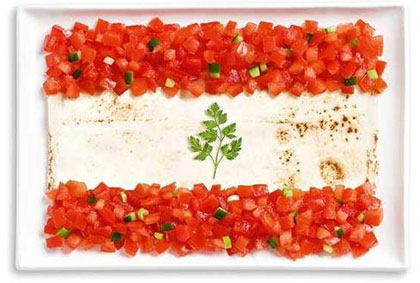
photo Food flags
photo
"Lebanon (lavash, fattoush, and a herb sprig)," by WHYBIN for the Sydney International Food Festival 2009, blogged at The Kitchn, 29 September 2009 :: via GOOD
Nate:
Christy:
from "When Words Become Endangered," by Anne Keisman, National Wildlife Magazine, October/November 2009

The revised book could be viewed as another example of adults contributing to the growing disconnection between children and the natural world—a trend that was identified by a study conducted a few years ago by two zoologists at Cambridge University. Reporting in the journal Science, the researchers revealed that a typical 8-year-old could name 78 percent of the 150 characters in the popular video game Pokémon, but could identify less than half of the common British plants and animals in pictures.

Which brings us to one final irony: The concept of the Pokémon universe stems from the hobby of insect collecting, a popular pastime of the game’s inventor when he was a child in Japan.

Andy:
from "The Music of Eternity," by David B. Hart, First Things, 5 October 2009

The symphony’s first movement—Feierlich, misterioso—announces in its opening bars, with their dark string oscillations and mournful horn melody, that this is sad music, twilight music, coming at the end of things; even the first great crescendo to which the opening builds is oddly elegiac, and yields to a lighter, more canorous, but still wistful middle section, which then in turn dissolves into a movingly melancholy D major theme.  The second movement is the scherzo, though whether music as drivingly propulsive as this initially is should still be called a scherzo is open to debate (is there such a thing as a “sublime scherzo”?).  Whatever the case, it is powerful music, moved along on driving string figures, which bracket an interlude of extraordinary sweetness, and it leads beautifully—almost by exhausting itself—into the adagio.  That final movement, with its opening, ascendingly chromatic theme—the Abschied theme—and its meltingly lyrical secondary themes, and its hugely dissonant climax, and then its final, artfully fragmentary descent into silence, is full of sorrow and rebellion and resignation and, finally, perfect peace.

There are some pieces of music that, by their nature, should remain unfinished.  No fourth movement that Bruckner could have composed this side of death would have fulfilled the deeper design that unfolded throughout all his work.  That last adagio is already so otherworldly, and so overflowing with a sweet hunger for God, and so deep a longing for the timeless within time, that only eternity could bring it to its proper completion.  And there are some artists who, by all rights, should write themselves into eternity.  Bach is obviously the most perfect example, leaving that final great fugue on B-A-C-H in Die Kunst der Fuge abruptly unfinished; one senses that it had to be taken beyond time in order to be made perfect.  But Bruckner too was an artist who required more of his art than time could supply.

by Andy Crouch for Culture Making

My friend Adam McHugh, whose first (very good) book is about to be published, wrote me asking if I had any advice. He was going through the roller coaster of excitement, nervousness, anxiety, and eagerness of a first-time author. It’s a common experience (and not just for authors), and with his permission I thought I’d share what I wrote in reply.

Well, first of all, congratulations! Enjoy opening the first box of books—it’s pretty fun.

It is good to keep in mind Mark Twain’s admittedly harsh dictum, “Most books come into the world with all the fanfare of a stillborn child.” The truth is that unlike, say, your wedding day, there will be a great and utter lack of excitement about your book the day it is published. And the day after. And most days after that. Believe me. My book has done well, perhaps embarrassingly so, and the truth is it just is not that big a deal. Considering that “doing well” in these latter days means that maybe 25,000 people read a book over the course of its first year—that would be 0.1% 0.01% of the American population—it’s not surprising that it just doesn’t rise to the level of a big event for anyone except the author. (The foregoing does not apply, at least not entirely, if you are Bill Clinton, Dan Brown, or Donald Miller. But you are not, so no worries!)

What Absolutely Does Not Matter and Should Be Ignored If At All Possible is the Amazon rank of your book. It means nothing. (There are whole Web pages documenting this.) If your book is doing well enough for the Amazon rank to provide any meaningful information (say, less than 250 or so) you will know that anyway, because people will be calling to say they saw you on Oprah. If it is among the vast majority of books, including very good, solidly selling, important, and influential books, the number will fluctuate maddeningly and inscrutably, providing you with periodic endorphin rushes that will get you hooked but will tell you nothing about the success, let alone the worth, of the book. So I recommend never checking it. But of course you will. At least know that you’re basically just feeding your endorphin needs, nothing else.

What will be a big deal, hopefully, over the coming months, are individual letters, emails, conversations and even (we hope!) reviews from grateful readers. This is what makes it worth doing, in my opinion—the amazing chance to meet people for whom your words were genuinely, even dramatically, helpful. And then further down the road, to hear stories about people who actually created something or started something or persevered in something because you wrote the book. But of course by definition, all these truly worthwhile outcomes will happen months or years from the date of publication. We authors play a long game, which is a very good thing.

The other big deal will be the opportunities, whether few or many, that come to speak to groups and find that for some strange reason, they actually listen to you now that you have published a book, even though you are basically saying the same things you said before you published a book and basically have the same gifts and limitations you did before you published a book. It is a truly mysterious thing, and in many ways a bit absurd, but you will find yourself with an additional quantum of cultural power. I knew about this in the abstract when I wrote Culture Making (the importance of concrete cultural artifacts rather than disembodied ideas) but I must confess I still find myself surprised at how true it is.

So, as with all events that confer additional power and also expose insecurities and fears, this is mostly an opportunity to deepen your own prayer life, entrusting both the elation (assuming there is any—see first few paragraphs above) and the deflation to God. I have found John Wesley’s Covenant Prayer to be incredibly useful in turbulent times like these.

Oh, one other thing: I highly recommend never responding to critical comments (in reviews, blog posts, comment threads, etc.) online. I have done so a handful of times and regretted it every time. You are very unlikely to be able to respond to criticism in a constructive way in the heat of the online moment, and once the moment has passed you will realize it is faintly ridiculous to respond to things that were written after half a moment’s thought and most likely not even based on the slightest serious engagement with what you have written. You’ve had the great privilege of being able to spend a great deal of time shaping and polishing your ideas, then interacting with editors and early readers to refine them further. Why throw that all away with a hastily (and probably angrily/nervously/defensively/imprudently) composed reply? And furthermore, a hastily composed reply that, unlike your carefully written book, will be instantly accessible via a Google search for your name for ever and ever? I highly recommend simply taking online criticism as a chance to pray John Wesley’s Covenant Prayer again.

I hope these thoughts are in some way helpful! Godspeed and I hope to see you somewhere in person soon!
photo
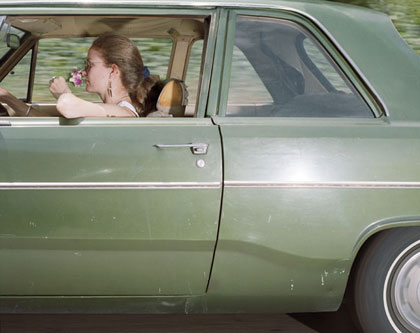
"Woman taking her time rambling south at 63 mph on the Hollywood Freeway near the Vine Street exit in Los Angeles on a Saturday afternoon in 1991," from the series Vector Portraits, by Andrew Bush, at M+B Gallery, Los Angeles, 12 September–15 October :: via We can shoot too
Nate:

from "The Middle's Patricia Heaton," interviewed by Christy Tennant, IAM Conversations, 1 October 2009
Christy:
Andy:
from "A Public-Service Game Changer," by D. Michael Lindsay, On Leadership, WashingtonPost.com, 2 October 2009

Because the White House Fellowship draws younger leaders from many different fields—including business, the military, nonprofits, law, and academia, it provides one of the few professional settings where leaders from very different fields regularly work together and build collegial relations. This cross-pollination of leaders makes a huge difference over the long term. For instance, consider the program’s impact on fellows’ attitudes toward parts of the federal government.

We see that fellows with no military experience express significantly greater confidence in the military after spending a year with a classmate who has a military background, and for each additional class member with a military background, the non-military fellow’s level of confidence rises. Levels of support for the military can rise from 54% to 81% among fellows, depending on how many classmates with military backgrounds were in a class. Most significant, that positive attitude toward the military remains over the course of the leader’s life, whether that Fellowship contact happened last year or four decades ago.

image
"Austin, Texas," oil on canvas, 5x6', by Christa Palazzolo :: via FFFFOUND!
Nate:
Andy:
from "Ingenious and Demanding," by Ada Louise Huxtable, WSJ.com, 30 September 2009

Ms. Acedo [the housekeeper who must clean Rem Koolhaas’s Lemoîne house in Bordeaux, France] is a star, a woman of determination, ingenuity and forthright opinions who can match anything the house throws at her. As the film starts, she stands on the platform surrounded by her pails, mops, brooms, rags and vacuum cleaner while it rises slowly to the strains of a romantic Strauss melody. (Actually, she does not use the platform, preferring the arduous stair route ever since she got stuck between floors and a technician had to crawl through the books to reach the controls.)

She even succeeds in confounding the notoriously self-possessed architect, in his recorded 10-minute response to the film. One sequence shows her aggressive cleaning of one of the house’s most offputting features, a punitive spiral stair consisting only of toe holds in a round concrete void open to the rain, unfazed by the seeming impossibility of dragging a vacuum up it. Mr. Koolhaas is momentarily flummoxed by the irreconcilability of his architecture and her cleaning methods.

But only momentarily. He quickly redefines the subject as the collision of two systems—“the platonic conception of cleaning and the platonic idea of architecture”—which I take to be the consideration of each on an elevated abstract plane of theoretical existence. Anyone who has ever done any cleaning knows that is not where it lives.

Let us concede the point: It is clear that the job is being pursued with familiar and archaic methods and devices that seem surreally unrelated to the task at hand, revealing how out of sync the vision—no matter how beautifully executed—and the result can be.

Nate:
from "The lost art of handwriting," by Umberto Eco, The Guardian, 21 September 2009 :: via 3quarksdaily

My parents’ handwriting was slightly slanted because they held the sheet at an angle, and their letters were, at least by today’s standards, minor works of art. At the time, some – probably those with poor hand- writing – said that fine writing was the art of fools. It’s obvious that fine handwriting does not necessarily mean fine intelligence. But it was pleasing to read notes or documents written as they should be. My generation was schooled in good handwriting, and we spent the first months of elementary school learning to make the strokes of letters. The exercise was later held to be obtuse and repressive but it taught us to keep our wrists steady as we used our pens to form letters rounded and plump on one side and finely drawn on the other. Well, not always – because the inkwells, with which we soiled our desks, notebooks, fingers and clothing, would often produce a foul sludge that stuck to the pen and took 10 minutes of mucky contortions to clean.

photo
"HIV," 22cm, from the sculpture series Glass Microbiology, by Luke Jerram Smithfield Gallery, London, 22 September–9 October 2009 :: via Freakonomics Blog
Nate:
image
from "Recent Works - Joo Kim," Azusa Pacific University, 7 September–2 October 2009 :: image courtesy of the artist and Azusa Pacific University Department of Art
Andy:

The quotations, images, and embedded media in this blog are the work of the credited authors, artists, and publications, and are employed in the spirit of fair use, commentary, and criticism. We always link to the original source of material we cite. If you think we’ve missed something, let us know. The inclusion of media on this site should not imply its owners’ endorsement (or for that matter awareness) of this book, blog, or the blog’s curators and commentators. Though we hope they’d like us.

[Crouch’s] analysis is sharp and hopeful at the same time. I have a feeling I am going to be giving away many copies of this book in the next few years.


?

David, urban architect
living in Kansas City, Missouri

horizons of the possible  cultural worlds  music  photography  art  technology and change  food and drink  europe  community  gardens and cities  cultivation and creation  asia  books  africa  language  children  literature  writing  painting  movies  video  cities  changing the world  family  gestures and postures  power  business  internet  medicine  grace  consumption  government  technology  poverty  education  color  reading  animals  india  architecture  poetry  maps  money  visual arts  performing arts  trends  transport  agriculture  3 12 120  design  disciplines  south america  travel  war  transit  sculpture  tv  communication  film  science  economics  work  advertising  psychology  churches  revelation  infrastructure  sport  england  clothing  france  home  unintended consequences  fashion  politics  generations  bible  copying  street view  failure  women  humor  christmas  china  creativity  history  story  craft  california  museums  time  landscape  development  nature  pop culture  water  discipline  creation  new york  computers  dance  kevin kelly  suburbs  remixes  play  least of nations  charity  naming  primordial stories  japan  parents  furniture  middle east  journalism  religion  russia  neighborhoods  germany  light  church  stories  stewardship  law  love  australia  cell phones  islam  traces of god  italy  names  drawing  games  media  mission  mexico  words  shopping  typography  twitter  redemption  space  graffiti  buildings  change the world  pentecost and beyond  philanthropy  translation  heroes  libraries  david taylor  entertainment  creation and cultivation  new jerusalem  statistics  cultivation  race  finance  cars  alphabets  engineering  sound  wilderness  lists  signs  military  death  beauty  visual art  marriage  risk  data  tradition  safety  rob walker  critique  google  environmentalism  christianity  collage  south africa  television  taste  happiness  natural sciences  lamin sanneh  migration  environment  philosophy  illustration  noise  memes  19th century  reconciliation  ideas  prison  crime  innovation  service  modernity  condemnation  leisure  irony  multiculturalism  canada  prayer  oceana  kenya  vision  john stackhouse  news  latin america  paper  stone  afghanistan  convergence  turkey  voice  babel  public space  future  wonder  animation  memory  nigeria  genesis  wealth  nostalgia  pets  recreation  tools  metaphor  heaven  monasticism  friendship  walking  scripture  jesus as culture maker  universities  gospel  scale  haiti  ministry  communities  toys  social sciences  bodies  plastic  quotes  breakfast  nations