Posts tagged reading
 Huzzah for Alan Jacobs
Andy
:
I’m interested in how reading on the page differs from reading on screens; in how different kinds of screens enable different kinds of knowledge; in the strategies and tools we employ for information gathering, for information ordering, and for information evaluating. I think a lot about linear and non-linear forms of organizing mental experience, and the technologies that make such organization easier or harder. I wonder about whether we’re really losing serendipity, as so many people say. I’m fascinated by the various speeds at which technologies move and by our ability (or, sometimes, inability) to match those speeds. I wonder what libraries are for and what they will be for.
Nate
:
In a ritual repeated nearly every weekend for the past decade here in Colombia’s war-weary Caribbean hinterland, Luis Soriano gathered his two donkeys, Alfa and Beto, in front of his home on a recent Saturday afternoon. Sweating already under the unforgiving sun, he strapped pouches with the word “Biblioburro” painted in blue letters to the donkeys’ backs and loaded them with an eclectic cargo of books destined for people living in the small villages beyond. His choices included “Anaconda,” the animal fable by the Uruguayan writer Horacio Quiroga that evokes Kipling’s “Jungle Book”; some Time-Life picture books (on Scandinavia, Japan and the Antilles); and the Dictionary of the Royal Academy of the Spanish Language.
“I started out with 70 books, and now I have a collection of more than 4,800,” said Mr. Soriano, 36, a primary school teacher who lives in a small house here with his wife and three children, with books piled to the ceilings. “This began as a necessity; then it became an obligation; and after that a custom,” he explained, squinting at the hills undulating into the horizon. “Now,” he said, “it is an institution.”
A whimsical riff on the bookmobile, Mr. Soriano’s Biblioburro is a small institution: one man and two donkeys. He created it out of the simple belief that the act of taking books to people who do not have them can somehow improve this impoverished region, and perhaps Colombia.
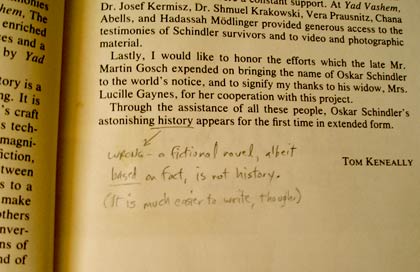
 WRONG—
Nate
:
Andy
:The inclination to read a huge Victorian novel, the capacity to untangle a metaphor in a line of verse, the desire to study and emulate a distant historical figure, the urge to ponder a concept such as Heidegger’s ontic-ontological difference over and over and around and around until it breaks through as a transformative insight — those dispositions melt away with every 100 hours of browsing, blogging, IMing, Twittering, and Facebooking. The shape and tempo of online texts differ so much from academic texts that e-learning initiatives in college classrooms can’t bridge them. Screen reading is a mind-set, and we should accept its variance from academic thinking. [Jakob] Nielsen concisely outlines the difference: “I continue to believe in the linear, author-driven narrative for educational purposes. I just don’t believe the Web is optimal for delivering this experience. Instead, let’s praise old narrative forms like books and sitting around a flickering campfire — or its modern-day counterpart, the PowerPoint projector,” he says. “We should accept that the Web is too fast-paced for big-picture learning. No problem; we have other media, and each has its strengths. At the same time, the Web is perfect for narrow, just-in-time learning of information nuggets — so long as the learner already has the conceptual framework in place to make sense of the facts.”
So let’s restrain the digitizing of all liberal-arts classrooms. More than that, given the tidal wave of technology in young people’s lives, let’s frame a number of classrooms and courses as slow-reading (and slow-writing) spaces. Digital technology has become an imperial force, and it should meet more antagonists. Educators must keep a portion of the undergraduate experience disconnected, unplugged, and logged off.
Nate
:When I think about it, my ability to “read deeply and without distraction” is not impaired at all when it comes to 9,000 word articles in Harper’s or The Atlantic on, say, trends in urban crime, thick with policy analysis and statistics, or for that matter, “Is Google Making us Stupid?” It’s just when I try to read Proust, or heaven forbid, JR by William Gaddis—a novel that I greatly anticipated reading, but which quickly became a coaster for the glass of water on my bedside table.
A more important question, I think, is why our brains now seem to better tolerate nonfiction. Regarding Proust in particular, Carr’s argument is, for me, especially ironic: The way that I have found to actually read those long complex sentences is, in fact, to skim them—to ride along on the surface from one detailed, beautiful image of village life to another, without trying to unpack them too literally or rationally.
Room to Read
Nate
:For our readers who are unfamiliar with Room to Read, can you explain what it is?
We do three things: We build schools. We establish multilingual libraries and fill them with thousands of books. And we provide long term scholarships for girls because girls are often left out of the education system. Basically, we’re a group that is committed to reaching 10 million kids across the world with the life-long gift of education. In education lies the key to self sufficiency—and the best long term ticket out of poverty.
What does a $20 Donation do for Room to Read?
This is a perfect price point. Twenty dollars is sufficient to sponsor a girl’s scholarship for one month. We can also print 20 local-language children books in languages that have never really had children’s books before. It’s one of the reasons there’s such an illiteracy problem in the developing world—there’s just no children’s book industry.