<?xml version="1.0" encoding="utf-8"?>
<feed xmlns="http://www.w3.org/2005/Atom" xml:lang="en">

    <title type="text">Culture Making Articles items tagged turkey</title>
    <subtitle type="text">Culture Making Articles:Writing on Christianity and culture from Andy Crouch</subtitle>
    <link rel="alternate" type="text/html" href="http://culture-makers.com/" />
    <link rel="self" type="application/atom+xml" href="https://culture-making.com/tag/atom" />
    <updated>2025-01-03T22:54:05Z</updated>
    <rights>Copyright (c) 2025, Andy Crouch</rights>
    <generator uri="http://www.pmachine.com/" version="7.5.15">ExpressionEngine</generator>
    <id>tag:culture-makers.com,2025:01:02</id>

    <entry>
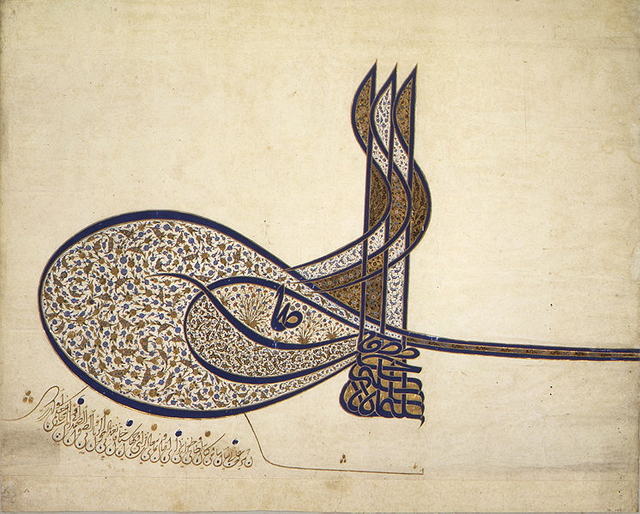
      <title>Süleyman the Magnificent’s magnificent signature</title>
      <link rel="alternate" type="text/html" href="https://culture-making.com/post/sueleyman_the_magnificents_magnificent_signature" />
      <id>tag:culture-makers.com,2025:author/1.2011</id>
      <published>2025-01-02T22:53:00Z</published>
      <updated>2025-01-03T22:54:05Z</updated>
      <author>
            <name>Andy Crouch</name>
            <email>andy@culture-making.com</email>
            
      </author>

      <content type="html"><![CDATA[


					<b>Nate: </b><em>?When a new Ottoman emperor ascended to the throne, his court calligrapher would create an elaborate signature (called a tughra) for him, to be affixed henceforth to royal documents, coins, etc. Once or twice I've come across <a href="http://en.wikipedia.org/wiki/Süleyman_the_Magnificent">Süleyman the Magnificent</a>'s tughra and was always stopped short: what a fitting, dashing, swaggering mark for the man who rebuilt the walls of Jerusalem, and marched his armies all the way to the gates of Vienna. What I didn't realize is how stylized and similar all the Ottoman emperors' tughras are—unless you're skilled at parsing Arabic calligraphy, they <a href="http://en.wikipedia.org/wiki/File:Tughra_of_Selim_III.JPG">mostly</a> <a href="http://upload.wikimedia.org/wikipedia/commons/4/4d/Tugra_Mahmuds_II.png">look</a> the <a href="http://upload.wikimedia.org/wikipedia/commons/d/d3/Abdul_Hameed_II_Sign.svg">same</a>. What I'd assumed were the most distinct elements of Süleyman's mark—those three bold upstrokes with pennants flying—are common to all.?</em><br />
		
		<a href="http://en.wikipedia.org/wiki/Tughra"><img src="http://www.culture-making.com/media/tughra.jpg" alt="image" /></a><hr />
<div class="author" style="font-size: -1">image from <a href="http://en.wikipedia.org/wiki/Tughra">Tughra</a>, Wikipedia.</div>		


      ]]></content>
    </entry>    <entry>
      <title>Love and language</title>
      <link rel="alternate" type="text/html" href="https://culture-making.com/post/love_and_language" />
      <id>tag:culture-makers.com,2025:author/1.1932</id>
      <published>2025-01-02T22:53:00Z</published>
      <updated>2025-01-03T22:54:05Z</updated>
      <author>
            <name>Andy Crouch</name>
            <email>andy@culture-making.com</email>
            
      </author>

      <content type="html"><![CDATA[


					<b>Nate: </b><em>?I just finished Elif Batuman's delightful, erudite, and hopelessly funny memoir of her love of Russian literature as lived out through seven at-times-harrowing years of comp lit grad school. Elif is a college acquaintance and <a href="http://www.elifbatuman.net/2009/01/13/beards-and-other-outerwear/">sometime correspondent</a> of mine, so it's always a double treat to see her writing out in the wider world.?</em><br />
		
		<p>If I didn&#8217;t actually believe in my responsibility to tell Americans the truth about Turkey, nevertheless I did feel it was somehow wasteful to study Russian literature instead of Turkish literature. I had repeatedly been told in linguistics classes that all languages were universally complex, to a biologically determined degree. Didn&#8217;t that mean that all languages were, objectively speaking, equally interesting? And I already <i>knew</i> Turkish; it had happened without any work, like a gift, and here I was tossing it away to break my head on a bunch of declensions that came effortlessly to anyone who happened to grow up in Russia.</p><p>Today, this strikes me as terrible reasoning. I now understand that love is a rare and valuable thing, and you don&#8217;t get to choose its object. You just go around getting hung up on the all the least convenient things—and if the only obstacle in your way is a little extra work, then <i>that&#8217;s</i> the wonderful gift right there.</p><hr />
<div class="author" style="font-size: -1">from <i><a href="http://www.amazon.com/Possessed-Adventures-Russian-Books-People/dp/0374532184/cmcom-20">The Possessed: Adventures with Russian Books and the People Who Read Them</a></i>, by Elif Batuman, 2010, p.88</div>		


      ]]></content>
    </entry>    <entry>
      <title>Two things you’ve never considered drinking before, but may want to now</title>
      <link rel="alternate" type="text/html" href="https://culture-making.com/post/two_things_youve_never_considered_drinking_before_but_may_want_to_now1" />
      <id>tag:culture-makers.com,2025:author/1.1629</id>
      <published>2025-01-02T22:53:00Z</published>
      <updated>2025-01-03T22:54:05Z</updated>
      <author>
            <name>Andy Crouch</name>
            <email>andy@culture-making.com</email>
            
      </author>

      <content type="html"><![CDATA[


					<b>Nate: </b><em>?Of course all these lists of "50 best things" are, even at their best, arbitrary and hyperbolic. But they're also fun—clearly scratching some itch in the collective mind of reader and writer. In the case of food/travel lists like this one, they really can be a treat.?</em><br />
		
		<p><b>20. Best place to buy: Olive oil<br/>Turkish embassy electrical supplies, London</b></p>
<p>The most unlikely olive oil vendor in the world? At his electrical supply shop in London&#8217;s Clerkenwell, Mehmet Murat sells wonderful, intensely fruity oil from his family&#8217;s olive groves in Cyprus and south-west Turkey. Now he imports more than a 1,000 litres per year. His lemon-flavoured oil is good enough to drink on its own.</p><p>76 Compton Street, London  EC1, 020 7251 4721,<a href="http://www.planet mem.com">www.planet mem.com</a></p>
<p><b>26. Best place to eat: Filipino cuisine<br/>Lighthouse Restaurant, Cebu, Philippines</b></p><p>&#8220;The Lighthouse in Cebu in the Philippines is my favourite restaurant. We always eat bulalo (beef stew), banana heart salad, adobo (marinaded meat), baked oysters, pancit noodles, lechon de leche (suckling pig) and, to drink, green mango juice – my daughter is addicted to it! The staff are so friendly and welcoming. The chef has been there for more than 20 years, so the food is very consistent.&#8221;</p><p>Gaisano Country Mall, Banilad, Cebu city, Philippines, 0063 32 231 2478</p><hr />
<div class="author" style="font-size: -1">from "<a href="http://www.guardian.co.uk/lifeandstyle/2009/sep/13/best-foods-in-the-world">The 50 best foods in the world and where to eat them</a>," by Killian Fox, <a href="http://www.guardian.co.uk/lifeandstyle/2009/sep/13/best-foods-in-the-world"><i>The Observer</i></a>, 13 September 2009 :: via <a href="http://kottke.org/09/09/wheres-the-worlds-best-food">kottke.org</a></div>		


      ]]></content>
    </entry>    <entry>
      <title>On the migration of books</title>
      <link rel="alternate" type="text/html" href="https://culture-making.com/post/on_the_migration_of_books" />
      <id>tag:culture-makers.com,2025:author/1.1111</id>
      <published>2025-01-02T22:53:00Z</published>
      <updated>2025-01-03T22:54:05Z</updated>
      <author>
            <name>Andy Crouch</name>
            <email>andy@culture-making.com</email>
            
      </author>

      <content type="html"><![CDATA[


					<b><p>Nate</p>: </b><em>?This lovely opening to the Turkish Nobel laureate's memoir of a lifetime of reading calls to mind the dialogue from C.S. Lewis's <i><a href="http://books.google.com/books?id=fg8XtMnARZ8C&pg=PA123&dq=c.s.+lewis+%22library+in+heaven%22&ei=cYU9SauWE5TUlQSRxKzBBA">God in the Dock</a></i>, about how our libraries in heaven will likely only contain the books we've given away or lent. But such books they'll be!?</em><br />
		
		<p>At the heart of my library is my father&#8217;s library. When I was seventeen or eighteen and began to devote most of my time to reading, I devoured the volumes my father kept in our sitting room as well as the ones I found in Istanbul&#8217;s bookshops. These were the days when, if I read a book from my father&#8217;s library and liked it, I would take it into my room and place it among my own books. My father, who was pleased to see his son reading, was also glad to see some of his books migrating to my library, and whenever he saw one of his old books on my bookshelf, he would tease me by saying, &#8220;Aha, I see this volume has been promoted to the upper echelons!&#8221;</p><hr />
<div class="author" style="font-size: -1">from "<a href="http://www.nybooks.com/articles/22182">My Turkish Library</a>," by Orhan Pamuk, <a href="http://www.nybooks.com/articles/22182"><i>The New York Review of Books</i></a>, 18 December 2008</div>		


      ]]></content>
    </entry>    <entry>
      <title>Worship first, then farm</title>
      <link rel="alternate" type="text/html" href="https://culture-making.com/post/worship_first_then_farm" />
      <id>tag:culture-makers.com,2025:author/1.1024</id>
      <published>2025-01-02T22:53:00Z</published>
      <updated>2025-01-03T22:54:05Z</updated>
      <author>
            <name>Andy Crouch</name>
            <email>andy@culture-making.com</email>
            
      </author>

      <content type="html"><![CDATA[


					<b><p>Nate</p>: </b><em>?Religion, rather than agriculture, may have been the catalyst for the formation of early neolithic societies, about 11,000 years ago.?</em><br />
		
		<div style="float:right; padding:15px 5px 5px 5px"><img src="http://culture-making.com/media/gobeklitepe_nov08_388_210.jpg" alt="image"></div><p>To Schmidt and others, these new findings suggest a novel theory of civilization. Scholars have long believed that only after people learned to farm and live in settled communities did they have the time, organization and resources to construct temples and support complicated social structures. But Schmidt argues it was the other way around: the extensive, coordinated effort to build the monoliths literally laid the groundwork for the development of complex societies.</p>
<p>The immensity of the undertaking at Gobekli Tepe reinforces that view. Schmidt says the monuments could not have been built by ragged bands of hunter-gatherers. To carve, erect and bury rings of seven-ton stone pillars would have required hundreds of workers, all needing to be fed and housed. Hence the eventual emergence of settled communities in the area around 10,000 years ago. “This shows sociocultural changes come first, agriculture comes later,” says Stanford University archaeologist Ian Hodder, who excavated Catalhoyuk, a prehistoric settlement 300 miles from Gobekli Tepe. “You can make a good case this area is the real origin of complex Neolithic societies.”
</p><hr />
<div class="author" style="font-size: -1">from "<a href="http://www.smithsonianmag.com/history-archaeology/gobekli-tepe.html?c=y&page=2">Gobekli Tepe: The World’s First Temple?</a>," by Andrew Curry, <a href="http://www.smithsonianmag.com/history-archaeology/gobekli-tepe.html?c=y&page=2"><i>Smithsonian</i></a>, November 2008 :: via <a href="http://ideas.blogs.nytimes.com/2008/11/08/the-worlds-oldest-temple/">NYTimes.com Ideas blog</a></div>		


      ]]></content>
    </entry>

</feed>