<?xml version="1.0" encoding="utf-8"?>
<feed xmlns="http://www.w3.org/2005/Atom" xml:lang="en">

    <title type="text">Culture Making Articles items tagged names</title>
    <subtitle type="text">Culture Making Articles:Writing on Christianity and culture from Andy Crouch</subtitle>
    <link rel="alternate" type="text/html" href="http://culture-makers.com/" />
    <link rel="self" type="application/atom+xml" href="https://culture-making.com/tag/atom" />
    <updated>2025-01-03T22:54:05Z</updated>
    <rights>Copyright (c) 2025, Andy Crouch</rights>
    <generator uri="http://www.pmachine.com/" version="7.5.15">ExpressionEngine</generator>
    <id>tag:culture-makers.com,2025:01:02</id>

    <entry>
      <title>“What’s your name?”</title>
      <link rel="alternate" type="text/html" href="https://culture-making.com/post/whats_your_name" />
      <id>tag:culture-makers.com,2025:author/1.1760</id>
      <published>2025-01-02T22:53:00Z</published>
      <updated>2025-01-03T22:54:05Z</updated>
      <author>
            <name>Andy Crouch</name>
            <email>andy@culture-making.com</email>
            
      </author>

      <content type="html"><![CDATA[


					<b>Nate: </b><em>?This is from a follow-up to Michael Luo's November 30 <a href="http://www.nytimes.com/2009/12/01/us/01race.html?_r=1">article</a> about the racial disparity in unemployment among college graduates. In recent weeks I've been watching the Roots miniseries for the first time, and thinking a lot about naming in particular. The multiple scenes where Kunta Kinte <a href="a href="http://www.youtube.com/watch?v=ByhFz5e5Tno&feature=player_embedded">struggles to keep his own name and identity</a> make the sometimes-more-subtle question of who gets called what when and by whom impossible to ignore and, in the light of both past and present, troubling (if fascinating) to consider.?</em><br />
		
		<p>Nevertheless, the strategy of hiding race — in particular changing names — can be soul-piercing. It prompted one African-American reader of the article to write that he was reminded of the searing scene in the groundbreaking TV miniseries “Roots” when the runaway slave Kunta Kinte is whipped until he declares that his name is Toby, the name given to him by his master.</p><p>Black job seekers said the purpose of hiding racial markers extended beyond simply getting in the door for an interview. It was also part of making sure they appeared palatable to hiring managers once race was seen. Activism in black organizations, even majoring in African-American studies can be signals to employers. Removing such details is all part of what Ms. Orr described as “calming down on the blackness.”</p><p>In “Covering: the Hidden Assault on Our Civil Rights,” Kenji Yoshino, a law professor at New York University, wrote about this phenomenon not just among blacks but also other minority groups. “My notion of covering is really about the idea that people can have stigmatized identities that either they can’t or won’t hide but nevertheless experience a huge amount of pressure to downplay those identities,” he said. Mr. Yoshino says that progress in hiring has meant that “the line originally was between whites and nonwhites, favoring whites; now it’s whites and nonwhites who are willing to act white.”</p><hr />
<div class="author" style="font-size: -1">from "<a href="http://www.nytimes.com/2009/12/06/weekinreview/06Luo.html">‘Whitening’ the Résumé</a>," by Michael Luo, <a href="http://www.nytimes.com/2009/12/06/weekinreview/06Luo.html"><i>The New York Times</i></a>, 5 December 2009</div>		


      ]]></content>
    </entry>    <entry>
      <title>A better stocking striper</title>
      <link rel="alternate" type="text/html" href="https://culture-making.com/post/a_better_stocking_striper" />
      <id>tag:culture-makers.com,2025:author/1.1759</id>
      <published>2025-01-02T22:53:00Z</published>
      <updated>2025-01-03T22:54:05Z</updated>
      <author>
            <name>Andy Crouch</name>
            <email>andy@culture-making.com</email>
            
      </author>

      <content type="html"><![CDATA[


					<b>Nate: </b><em>?This week I've been haphazardly exploring unsurprisingly nifty <a href="http://www.google.com/patents">Google patents</a> database. Surprise discoveries included a <a href="http://www.google.com/patents?id=x4d5AAAAEBAJ&pg=PA2&dq=hamilton+blumberg&source=gbs_selected_pages&cad=1#v=onepage&q=hamilton%20blumberg&f=false">talking alarm system</a> invented by my great-great-uncle in 1927. The patent shown here, though, I found particularly pleasing, mostly due to the patentee's names. Lamprey & Bugbee write, "Our invention relates to knitting-machines adapted to the production of striped goods, and, as here shown, it is particularly applicable to circular rib-knitting machines. It is the object of our invention to provide improved means for automatically operating and controlling the operations of two yarns of different colors in such manner that a tubular fabric can be produced having alternate stripes of different colors and of any desired width repeated to the end of the tube without stopping the machine to change the yarns to throw one color out of action and another into action."?</em><br />
		
		<a href="http://www.google.com/patents?id=HGJlAAAAEBAJ&pg=PA3&source=gbs_selected_pages&cad=1#v=onepage&q=&f=false"><img src="http://culture-making.com/media/Untitled-1.jpg" alt="image" /></a><hr />
<div class="author" style="font-size: -1">from "<a href="http://www.google.com/patents?id=HGJlAAAAEBAJ&pg=PA3&source=gbs_selected_pages&cad=1#v=onepage&q=&f=false">Patent No. 383,817: Knitting-Machine</a>," by Benjamin B. Lamprey and Almon C. Bugbee, 29 May 1888</div>		


      ]]></content>
    </entry>    <entry>
      <title>The private languages of Lego</title>
      <link rel="alternate" type="text/html" href="https://culture-making.com/post/the_private_languages_of_lego" />
      <id>tag:culture-makers.com,2025:author/1.1716</id>
      <published>2025-01-02T22:53:00Z</published>
      <updated>2025-01-03T22:54:05Z</updated>
      <author>
            <name>Andy Crouch</name>
            <email>andy@culture-making.com</email>
            
      </author>

      <content type="html"><![CDATA[


					<b>Nate: </b><em>?I recall having a strong sense of Lego nomenclature as well, though I'm hazy on the details. I should go out to the storage bins in the garage to root around and see if the touch of plastic can retrieve any specific terms. Meanwhile, Language Log's Geoff Pullum <a href="http://languagelog.ldc.upenn.edu/nll/?p=1874">sums up</a> this delightful article well: "It's about the deep-seatedness of children's need to have names for all the things they deal with — and the lack of any necessity for there to be pre-existing names in the language they happen to have learned."?</em><br />
		
		<div style="float:right; padding:15px 5px 5px 5px"><a href="http://www.themorningnews.org/archives/opinions/a_common_nomenclature_for_lego_families.php"><img src="http://culture-making.com/media/legochart.jpg" alt="image"></a></div>
<p>Then, when another seven-year-old came round for tea after school one day, I overheard the two of them, busy in the spaceship construction yard that used to be our living room, get into a linguistic thicket.</p><p>“Can you see any clippy bits?” my son asked his friend. The friend was flummoxed. “Do you mean handy bits?” he asked, pointing.</p>
<p>“Yes,” replied my boy. “Clippy bits.”</p>
<p>Of course! This language of Lego isn’t just something our family has invented; every Lego-building family must have its own vocabulary. And the words they use (mostly invented by the children, not the adults) are likely to be different every time. But how different? And what sort of words?</p><hr />
<div class="author" style="font-size: -1">from "<a href="http://www.themorningnews.org/archives/opinions/a_common_nomenclature_for_lego_families.php">A Common Nomenclature for Lego Families</a>," by Giles Turnbull, <a href="http://www.themorningnews.org/archives/opinions/a_common_nomenclature_for_lego_families.php">The Morning News</a>, 4 November 2009 :: via <a href="http://www.languagehat.com/archives/003679.php">languagehat.com</a></div>		


      ]]></content>
    </entry>    <entry>
      <title>Name that tune</title>
      <link rel="alternate" type="text/html" href="https://culture-making.com/post/name_that_tune" />
      <id>tag:culture-makers.com,2025:author/1.1693</id>
      <published>2025-01-02T22:53:00Z</published>
      <updated>2025-01-03T22:54:05Z</updated>
      <author>
            <name>Andy Crouch</name>
            <email>andy@culture-making.com</email>
            
      </author>

      <content type="html"><![CDATA[


			<p align="center"><object classid="clsid:d27cdb6e-ae6d-11cf-96b8-444553540000" codebase="http://download.macromedia.com/pub/shockwave/cabs/flash/swflash.cab#version=9,0,0,0" width="420" height="420" id="umapper_embed">
  <param name="FlashVars" value="kmlPath=http://umapper.s3.amazonaws.com/maps/kml/45536.kml"/>
  <param name="allowScriptAccess" value="always"/>
  <param name="allowFullScreen" value="true"/>
  <param name="movie" value="http://umapper.s3.amazonaws.com/templates/swf/embed.swf"/>
  <param name="quality" value="high"/>
&nbsp; <embed src="http://umapper.s3.amazonaws.com/templates/swf/embed.swf" FlashVars="kmlPath=http://umapper.s3.amazonaws.com/maps/kml/45536.kml" allowScriptAccess="always" allowFullScreen="true" quality="high" width="420" height="420" name="umapper_embed" type="application/x-shockwave-flash" pluginspage="http://www.macromedia.com/go/getflashplayer"/>
</object></p><br />
<b>Nate: </b><em>?Use the map controls to zoom on this extremely tall timeline; the creators took the <a href="http://waxy.org/2008/05/the_whitburn_project/">Billboard Top 5</a> charts from every year since 1890, found the full lyrics, and extracted all the first names. For the most part, the names that show up have little to do with the <a href="http://www.ssa.gov/OACT/babynames/">popular baby names</a> of a given year. I'm a little surprised how few of the songs I could name from the names: a couple from the 80s and 90s, and several more from the Beatles years, but that's about it.?</em><br /><hr />
<span style="font-size: -1">"<a href="http://www.verysmallarray.com/?p=901">Popular Names in Popular Music</a>," by <a href="http://www.verysmallarray.com/?p=901">very small array</a>, 20 October 2009</span>


      ]]></content>
    </entry>    <entry>
      <title>Fridge logic</title>
      <link rel="alternate" type="text/html" href="https://culture-making.com/post/fridge_logic" />
      <id>tag:culture-makers.com,2025:author/1.1375</id>
      <published>2025-01-02T22:53:00Z</published>
      <updated>2025-01-03T22:54:05Z</updated>
      <author>
            <name>Andy Crouch</name>
            <email>andy@culture-making.com</email>
            
      </author>

      <content type="html"><![CDATA[


					<b><p>Nate</p>: </b><em>?From a collection of tv-writer jargon. The good bit: it's cool to learn the names for all the specific dramatic and comedic turns that typical plots take. The bad news: once you start recognizing them in the wild, you can never really go back. Rob Long's brief and very funny podcast <a href="http://www.kcrw.com/etc/programs/ma">Martini Shot</a> is another excellent source for this kind of stuff (as well as reflections on Hollywood, entertainment, and the writing life, by which he means the doing-anything-but-writing life).?</em><br />
		
		<p><b>&#8220;sock barrel&#8221;</b>: a collection of roughly identical jokes all about the same thing.&nbsp; Pick one, cut the rest.</p><p><b>&#8220;hang a lantern on it&#8221;</b>: Instead of trying to hide a script/credibility problem, address it in full measure, so it can be dealt with and discarded. &#8220;How does she break into the base?&#8221; &#8220;Hang a lantern on it, how tough it is to get the codes, but that makes her twice as cool for pulling it off.&#8221; This is often a bit of sleight-of-hand, but hell, you&#8217;re probably using it to address some&#8212;</p><p><b>&#8220;fridge logic&#8221;</b>: a logic problem in the script that the average viewer would only ask themselves about, say, an hour later when they&#8217;re at the fridge getting a snack during commercials. TV is a very tight little medium time-wise, with an enormous amount of hand-waving to begin with. Often a logic problem that seems to smack you in the face because you&#8217;ve had the time to read the script, reread it, give notes, break it down, etc. is going to fly by your average&#8212;and hopefully emotionally engaged&#8212;viewer.</p><p>&#8220;Well, how&#8217;d she get from Dallas to Houston.&#8221;<br>&#8220;Commuter flight.&#8221;<br>&#8220;Could she make the drive to the airport in time?&#8221;<br>&#8220;That&#8217;s fridge logic.&#8221;</p><p>Note that you&#8217;re not trying to be lazy here&#8212;you&#8217;re just dealing with the fact that every line of exposition is a line that isn&#8217;t active or particularly interesting, and you only get so many of those in 44 minutes before your show is now boring. Logically flawless, but boring.</p><hr />
<div class="author" style="font-size: -1">from "<a href="http://kfmonkey.blogspot.com/2005/04/writing-jargon-preservation-4.html">Writing: Jargon Preservation 4</a>," by Rogers, <a href="http://kfmonkey.blogspot.com/2005/04/writing-jargon-preservation-4.html">Kung Fu Monkey</a>, 28 April 2005 :: via <a href="http://schott.blogs.nytimes.com/2009/03/28/elsewhere-movie-jargon-preservation/">Schott's Vocab</a></div>		


      ]]></content>
    </entry>    <entry>
      <title>Every man a king</title>
      <link rel="alternate" type="text/html" href="https://culture-making.com/post/every_man_a_king" />
      <id>tag:culture-makers.com,2025:author/1.1239</id>
      <published>2025-01-02T22:53:00Z</published>
      <updated>2025-01-03T22:54:05Z</updated>
      <author>
            <name>Andy Crouch</name>
            <email>andy@culture-making.com</email>
            
      </author>

      <content type="html"><![CDATA[


					<b><p>Nate</p>: </b><em>?After studying at an Anglican university in Hong Kong and then becoming the first East Asian to be admitted as a barrister in England, <a href="http://en.wikipedia.org/wiki/Wu_Tingfang">Wu Tingfang</a> served as the Qing Dynasty's minister to the United States, Spain, and Peru around the turn of the last century. His 1914 book comparing American and Chinese cultures is a fascinating, moving, and at times amusing read; it was written in part to counter the era's entrenched discrimination against Chinese immigrants. I particularly enjoyed his bafflement at the Americans' boast of calling their president, simply, "Mr."; he argues (in a playful but serious manner) for a more exalted title.?</em><br />
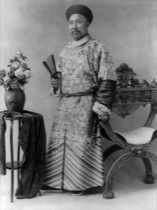
		
		<div style="float:right; padding:15px 5px 5px 5px"><img src="http://culture-making.com/media/450px-Wu_Tingfang1_210.jpg" alt="image"></div><p>[T]here are railroad kings, copper kings, tobacco kings, etc. It is, however, manifestly improper and incongruous that the people should possess a higher title than their President, who is the head of the nation. To make it even, I would suggest that the title “President” be changed to “Emperor,” for the following reasons: First, it would not only do away with the impropriety of the chief magistrate of the nation assuming a name below that of some of his people, but it would place him on a level with the highest ruler of any nation on the face of the earth. I have often heard the remark that the President of the United States is no more than a common citizen, elected for four years, and that on the expiration of his term he reverts to his former humble status of a private citizen; that he has nothing in common with the dignified majesty of an Emperor; but were the highest official of the United States to be in future officially known as Emperor, all these depreciatory remarks would fall to the ground. There is no reason whatever why he should not be so styled, as, by virtue of his high office, he possesses almost as much power as the most aristocratic ruler of any nation. Secondly, it would clearly demonstrate the sovereign power of the people; a people who could make and unmake an Emperor, would certainly be highly respected. Thirdly, the United States sends ambassadors to Germany, Austria, Russia, etc. According to international law, ambassadors have what is called the representative character, that is, they represent their sovereign by whom they are delegated, and are entitled to the same honors to which their constituent would be entitled were he personally present. In a Republic where the head of the State is only a citizen and the sovereign is the people, it is only by a stretch of imagination that its ambassador can be said to represent the person of his sovereign. Now it would be much more in consonance with the dignified character of an American ambassador to be the representative of an Emperor than of a simple President. The name of Emperor may be distasteful to some, but may not a new meaning be given to it?</p><hr />
<div class="author" style="font-size: -1">from <i><a href="http://books.google.com/books?id=VTcTAAAAYAAJ&printsec=frontcover&dq=america+through+the+spectacles&ei=U9N0SfLhHobWlQTa9ZG6Dg#">America, Through the Spectacles of an Oriental Diplomat</a></i>," by Wu Tingfang (1914)</div>		


      ]]></content>
    </entry>    <entry>
      <title>The encyclopedia of life</title>
      <link rel="alternate" type="text/html" href="https://culture-making.com/post/the_encyclopedia_of_life" />
      <id>tag:culture-makers.com,2025:author/1.772</id>
      <published>2025-01-02T22:53:00Z</published>
      <updated>2025-01-03T22:54:05Z</updated>
      <author>
            <name>Andy Crouch</name>
            <email>andy@culture-making.com</email>
            
      </author>

      <content type="html"><![CDATA[


					<b><p>Andy</p>: </b><em>?As Stephen Webb observes in this short but substantive commentary, "the status of taxonomy is pretty low. . . . Why be content to describe the world when you can develop theories to explain it and, better yet, change it?" Yet being able to name and order the world is one of our distinctively human qualities. The Encyclopedia of Life is an invitation to cultivation, and to contemplation.?</em><br />
		
		<p>Far from being an ancient myth with no contemporary relevance, the story of Adam’s task has inspired and shaped human endeavor throughout the centuries. Modern science got its start in the golden age of exploration, when collectors began cataloging exotic plants and animals in the hope of restoring Adam’s complete knowledge of the world. Some sixteenth-century scholars, like Benito Montano (1527–1598), gave Hebrew names to the places Columbus discovered, because they assumed that the Bible must contain all the words we need to understand the New World. Others realized that there were more things to know and to be named than they ever imagined. Francis Bacon exhorted gentlemen of means to build gardens “with rooms to stable in all rare beasts and to cage in all rare birds . . . so you may have in small compass a model of the universal nature made private.” Adam’s sin, Christians believed, not only expelled the first couple from the Garden. Plants and animals too had been dispersed, but now scholars could imagine a return to paradise by achieving universal knowledge.</p><p>If God were to bring all the animals before man today, the line would be too long. This scene could only take place on the computer, which is exactly what the new <em>Encyclopedia of Life</em> proposes. This remarkable project aims to gather descriptions of every species known to science on a single website. Harvard biologist Edward O. Wilson has been the driving force behind the <em>Encyclopedia</em>, and his enthusiasm for it is unbounded. “It’s going to have everything known on it,” he said, “and everything new is going to be added as we go along.” Nearly two million species are known, but scientists estimate that ten times that many are yet to be discovered. Most of these unknown species are bacteria, fungi, and insects. We can name them because we know, or want to know, everything about them.</p><hr />
<div class="author" style="font-size: -1">from "<a href="http://www.firstthings.com/onthesquare/?p=1154">Completing Adam’s Task</a>," by Stephen H. Webb, <a href="http://www.firstthings.com/onthesquare/">FIRST THINGS: On the Square</a>, 27 August 2008 :: via <a href="http://ayjay.tumblr.com/">Alan Jacobs</a></div>		


      ]]></content>
    </entry>    <entry>
      <title>Who’s a good dog?</title>
      <link rel="alternate" type="text/html" href="https://culture-making.com/post/whos_a_good_dog" />
      <id>tag:culture-makers.com,2025:author/1.590</id>
      <published>2025-01-02T22:53:00Z</published>
      <updated>2025-01-03T22:54:05Z</updated>
      <author>
            <name>Andy Crouch</name>
            <email>andy@culture-making.com</email>
            
      </author>

      <content type="html"><![CDATA[


					<b><p>Nate</p>: </b><em>?This was the top graphical item on today's LA Times website. A little disturbing that something so fluffy is the main news. But it's undeniably fascinating ... and, of course, undeniably cultural.?</em><br />
		
		<p>The most common dogs in L.A. County (by number of registrations)</p>
<p>1. Chihuahua named Princess (1,262)
2. Chihuahua named Chiquita (1,138)
3. German Shepherd named Lucky (862)
4. Chihuahua named Lucky (819)
5. German Shepherd named Max (784)</p><hr />
<div class="author" style="font-size: -1">from <a href="http://projects.latimes.com/dogs/">LA's Top Dogs</a>, <a href="http://latimes.com/"><i>Los Angeles Times</i></a>, 31 Aug 2008</div>		


      ]]></content>
    </entry>    <entry>
      <title>You can call me Al</title>
      <link rel="alternate" type="text/html" href="https://culture-making.com/post/you_can_call_me_al" />
      <id>tag:culture-makers.com,2025:author/1.477</id>
      <published>2025-01-02T22:53:00Z</published>
      <updated>2025-01-03T22:54:05Z</updated>
      <author>
            <name>Andy Crouch</name>
            <email>andy@culture-making.com</email>
            
      </author>

      <content type="html"><![CDATA[


					<b><p>Nate</p>: </b><em>?I wonder how well these new parental nicknames will age? Also ... it's not clear from the article whether there's any racial diversity in their interview pool, or whether everyone's white. African American and many Latino/a cultures have long had a much more fluid sense of names, nicknames, diminutives, etc. so I doubt they'd be as surprised by this new "trend".?</em><br />
		
		<p>The change in the way these children address their parents probably stems from baby boomers’ less authoritarian child-raising practices. Technology is a factor, too, given the offhand style that people use in instant messages and cellphone texts. The Internet has made people comfortable using names that are not their own  - in particular, the frequent use of screen names online has made naming a bit more elastic, said Cleveland Evans, a psychology professor at Bellevue University in Nebraska who is a former president of the American Name Society, a group that studies the cultural significance of names. Screen names, he said, “might have made people freer to think of the same person addressed by multiple names, and that’s what nicknaming is.”
</p><hr />
<div class="author" style="font-size: -1">from "<a href="http://www.boston.com/news/local/articles/2008/06/28/not_your_fathers_nicknames_when_teens_talk_to_parents/">Not your father's nicknames when teens talk to parents</a>," by Ellen Freeman Roth, <a href="http://www.boston.com/bostonglobe/"><i>The Boston Globe</i></a>, 28 June 2008</div>		


      ]]></content>
    </entry>

</feed>