Nate
: ?So I made this myself, but since this is apparently LOLCat and Narnia week on this blog, why not combine themes??
]]>
Nate
: ?So I made this myself, but since this is apparently LOLCat and Narnia week on this blog, why not combine themes??Nate
: ?Wait, the dogs in New Yorker cartoons aren't just dogs that have gotten smart by reading the New Yorker??Internet | The meaning of LOLcats, explained by a Psychology Today editor: “Just as the dogs in the New Yorker cartoons don’t represent actual dogs, these cats don’t represent cats at all, but people. By using cats, icanhascheezburger can access themes more tragic and poignant than it could using people.” [Salon]
]]>Nate
: ?So: what exactly are the cultural meanings and implications of the collective internet effort to paraphrase the entire Bible in the language of LOLCats? Bad taste bordering on sacrilege? A mockery of the care and exceeding effort of the many people working to make the Bible available to every person in their mother tongue? Or something that in its way might actually border on the reverent? Certainly we see the collective efforts of lots of people contemplating the meaning of verse after verse, even if only at first to look for hilarious potential misspellings and mysterious cheezburger refrains.?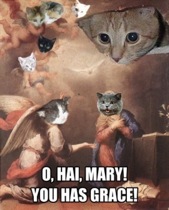
Mary sed “Ceiling Cat is laik a big deal, Mai I is happy about Ceiling Cat… bcz he kepted me in maind an now evribodi knowz i can haz cheezburgr. Thank u Ceiling Cat, u iz cool. U iz niec to evribodi. Xcept peeplz who doant dizrv it LOL. U haz pwned teh r00lrz whiel stil bein niec to teh n00bz. U givd cookies to teh hungri whiel u tolded teh rich “Niec trai.” U wuz niec to Israel an to all Abraham’s famili liek u promist.”
Andy
: ?Tom Wolfe's 2006 Jefferson Lecture, typically for Wolfe, is insanely wide-ranging and brilliantly provocative, and arguably also lacks a finally convincing plot. But it's fascinating reading on the subject of culture and its ineradicable and irreducible role in shaping human beings. (Paragraph breaks added below to make Wolfe's peroration a bit more intelligible.)?Until there was speech, the human beast could have no religion, and consequently no God. In the beginning was the Word. Speech gave the beast its first ability to ask questions, and undoubtedly one of the first expressed his sudden but insatiable anxiety as to how he got here and what this agonizing struggle called life is all about. To this day, the beast needs, can’t live without, some explanation as the basis of whatever status he may think he possesses. For that reason, extraordinary individuals have been able to change history with their words alone, without the assistance of followers, money, or politicians. Their names are Jesus, John Calvin, Mohammed, Marx, Freud—and Darwin.
And this, rather than any theory, is what makes Darwin the monumental figure that he is. The human beast does not require that the explanation offer hope. He will believe whatever is convincing. Jesus offered great hope: The last shall be first and the meek shall inherit the earth. Calvin offered less. Mohammed, more and less. Marx, even more than Jesus: The meek will take over the earth now! Freud offered more sex. Darwin offered nothing at all. Each, however, has left an enduring influence. Jesus is the underpinning of both Marxism and political correctness in American universities. There was a 72-year field experiment in Marxism, which failed badly. But Marx’s idea of one class dominating another may remain with us forever. In medical terms, Freud is now considered a quack. But his notion of sex as an energy like the steam in a boiler, which must be released in an orderly fashion or the boiler will blow up, remains with us, too. At this very moment, as we gather here in the Warner Theatre, you can be sure that there are literally millions of loin spasms and hip-joint convulsions that are taking place at this very instant throughout the world that would not be occurring were it not for the power of the words of Sigmund Freud.
Today, Charles Darwin still reigns, but his most fervent followers, American neuroscientists, are deeply concerned about this irritating matter of culture, the product of speech. Led by the British neuroscientist Richard Dawkins, they currently propose that culture is the product of “memes” or “culturegens”, which operate like genes and produce culture. There is a problem, however. Genes exist, but memes don’t. The concept of memes is like the concept of Jack Frost ten centuries ago. Jack Frost was believed to be an actual, living, albeit invisible, creature who went about in the winter freezing fingertips and making the ground too hard to plow.
Noam Chomsky has presented another problem. He maintains that there is no sign that speech evolved from any form of life lower than man. It’s not that there is a missing link, he says. It’s that there is absolutely nothing in any other animal to link up with.
Nate
: ?A nice parable of unintended consequences.?In the 2004 movie “The Butterfly Effect” - we watched it so you don’t have to - Ashton Kutcher travels back in time, altering his troubled childhood in order to influence the present, though with dismal results. In 1990’s “Havana,” Robert Redford, a math-wise gambler, tells Lena Olin, “A butterfly can flutter its wings over a flower in China and cause a hurricane in the Caribbean. They can even calculate the odds.”
Such borrowings of Lorenz’s idea might seem authoritative to unsuspecting viewers, but they share one major problem: They get his insight precisely backwards. The larger meaning of the butterfly effect is not that we can readily track such connections, but that we can’t.