<?xml version="1.0" encoding="utf-8"?>
<feed xmlns="http://www.w3.org/2005/Atom" xml:lang="en">

    <title type="text">Culture Making Articles items tagged manufacturing</title>
    <subtitle type="text">Culture Making Articles:Writing on Christianity and culture from Andy Crouch</subtitle>
    <link rel="alternate" type="text/html" href="http://culture-makers.com/" />
    <link rel="self" type="application/atom+xml" href="https://culture-making.com/tag/atom" />
    <updated>2025-01-03T22:54:05Z</updated>
    <rights>Copyright (c) 2025, Andy Crouch</rights>
    <generator uri="http://www.pmachine.com/" version="7.5.15">ExpressionEngine</generator>
    <id>tag:culture-makers.com,2025:01:02</id>

    <entry>
      <title>Cheaper than a bottle of coke</title>
      <link rel="alternate" type="text/html" href="https://culture-making.com/post/cheaper_than_a_bottle_of_coke" />
      <id>tag:culture-makers.com,2025:author/1.1048</id>
      <published>2025-01-02T22:53:00Z</published>
      <updated>2025-01-03T22:54:05Z</updated>
      <author>
            <name>Andy Crouch</name>
            <email>andy@culture-making.com</email>
            
      </author>

      <content type="html"><![CDATA[


					<b><p>Nate</p>: </b><em>?"The world's most popular chair"—this one with murkier, more recent origins than the venerable Thonet Model No.14. Still, when Bruce Cockburn sings about his visit to a Mozambique village, "They stuck me in the only chair they had / while the cooked cassava and a luckless hen," there's no doubt which sort of seat he's talking about.?</em><br />
		
		<div style="float:right; padding:15px 5px 5px 5px"><img src="http://culture-making.com/media/Plastic-Chair_210.jpg" alt="image"></div><p>Maybe you’re sitting on one right now. It has a high back with slats, or arches, or a fan of leaf blades, or some intricate tracery. Its legs are wide and splayed, not solid. The plastic in the seat is three-sixteenths of an inch thick. It’s probably white, though possibly green. Maybe you like how handy it is, how you can stack it or leave it outdoors and not worry about it. Maybe you’re pleased that it cost less than a bottle of shampoo.</p><p>No matter what you’re doing, millions of other people around the world are likely sitting right now on a single-piece, jointless, all-plastic, all-weather, inexpensive, molded stacking chair. It may be the most popular chair in history.</p><p>That dawned on me recently after I started noticing The Chair in news photographs from global trouble spots. In a town on the West Bank, an indignant Yasser Arafat holds a broken chair damaged by an Israeli military operation. In Nigeria, contestants in a Miss World pageant are seated demurely on plastic chairs just before riots break out, killing some 200 people. In Baghdad, U.S. administrator L. Paul Bremer III, during a ceremony honoring Iraqi recruits, sits on a white plastic chair as if on a throne&#8230;.</p><p>The plastic chairs in all those places were essentially alike, as far as I could tell, and seemed to be a natural part of the scene, whatever it was. It occurred to me that this humble piece of furniture, criticized by some people as hopelessly tacky, was an item of truly international, even universal, utility. What other product in recent history has been so widely, so to speak, embraced? And how had it found niches in so many different societies and at so many different levels, from posh resorts to dirt courtyards? How did it gain a global foothold?</p><hr />
<div class="author" style="font-size: -1">from "<a href="http://www.smithsonianmag.com/people-places/seat.html?c=y&page=1">Everybody Take A Seat</a>," by Mariana Gosnell, <a href="http://www.smithsonianmag.com/people-places/seat.html?c=y&page=1"><i>Smithsonian</i></a>, July 2004 :: image via <a href="http://neetaexports.tradeindia.com/Exporters_Suppliers/Exporter12938.186559/Plastic-Chair.html">Neeta Exports</a> :: first posted here 17 November 2008</div>		


      ]]></content>
    </entry>    <entry>
      <title>Making of a chair</title>
      <link rel="alternate" type="text/html" href="https://culture-making.com/post/making_of_a_chair" />
      <id>tag:culture-makers.com,2025:author/1.1146</id>
      <published>2025-01-02T22:53:00Z</published>
      <updated>2025-01-03T22:54:05Z</updated>
      <author>
            <name>Andy Crouch</name>
            <email>andy@culture-making.com</email>
            
      </author>

      <content type="html"><![CDATA[


			<p align="center"><embed src="http://services.brightcove.com/services/viewer/federated_f8/1316333565" bgcolor="#FFFFFF" flashVars="videoId=1586418314&amp;playerId=1316333565&amp;viewerSecureGatewayURL=https://console.brightcove.com/services/amfgateway&amp;servicesURL=http://services.brightcove.com/services&amp;cdnURL=http://admin.brightcove.com&amp;domain=embed&amp;autoStart=false&amp;" base="http://admin.brightcove.com" name="flashObj" width="420" height="356" seamlesstabbing="false" type="application/x-shockwave-flash" swLiveConnect="true" pluginspage="http://www.macromedia.com/shockwave/download/index.cgi?P1_Prod_Version=ShockwaveFlash"></embed>
</p><br />
<b><p>Andy</p>: </b><em>?This (longish) video on the making of Eames fiberglass chairs circa 1970 is striking for its juxtaposition of tools and techniques that range from the quintessentially modern to the surprisingly old-fashioned (to the alarming—I don't think you're supposed to handle fiberglass with your bare hands!). And for the unbearably 1970s flute soundtrack. And for the chairs themselves, still cool and cozy after all these years.?</em><br />
<hr /><span style="font-size: -1">from "<a href="http://blog.robustflavor.com/2008/11/18/the-shell-chair-by-charles-eames">The Shell Chair by Charles Eames</a>," <a href="http://blog.robustflavor.com/">Robust Flavor</a>, 18 November 2008 :: via <a href="http://www.37signals.com/svn/">37 Signals</a> via <a href="http://www.coudal.com/">Coudal</a> ad infinitum</span>


      ]]></content>
    </entry>    <entry>
      <title>Cheaper than a bottle of wine</title>
      <link rel="alternate" type="text/html" href="https://culture-making.com/post/cheaper_than_a_bottle_of_wine" />
      <id>tag:culture-makers.com,2025:author/1.1039</id>
      <published>2025-01-02T22:53:00Z</published>
      <updated>2025-01-03T22:54:05Z</updated>
      <author>
            <name>Andy Crouch</name>
            <email>andy@culture-making.com</email>
            
      </author>

      <content type="html"><![CDATA[


					<b><p>Nate</p>: </b><em>?"The world's most popular chair" turns 150.?</em><br />
		
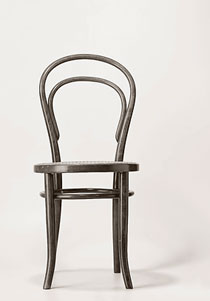
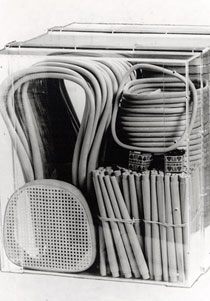
		<div style="float:right; padding:15px 5px 5px 5px"><img src="http://culture-making.com/media/thonet14_210.jpg" alt="image"><img src="http://culture-making.com/media/cube_210.jpg" alt="image"></div><p>It consists of six pieces of wood - two circles, two sticks and a couple of arches - held together by 10 screws and two nuts. Together they make the wooden chair known as Thonet Model No.14, which although no one has ever actually done the math, is thought to have seated more people than any other chair in history.</p><p>The No.14 was the result of years of technical experiments by its inventor, the 19th-century German-born cabinetmaker Michael Thonet. His ambition was characteristically bold. Thonet wanted to produce the first mass-manufactured chair, which would be sold at an affordable price (three florins, slightly less than a bottle of wine).</p><hr />
<div class="author" style="font-size: -1">from "<a href="http://www.iht.com/articles/2008/11/10/style/design10.php?page=1">No. 14: The chair that has seated millions</a>," by Alice Rawsthorn, <a href="http://www.iht.com/articles/2008/11/10/style/design10.php?page=1"><i>International Herald Tribune</i></a>, 7 November 2008</div>		


      ]]></content>
    </entry>

</feed>