<?xml version="1.0" encoding="utf-8"?>
<feed xmlns="http://www.w3.org/2005/Atom" xml:lang="en">

    <title type="text">Culture Making Articles items tagged islam</title>
    <subtitle type="text">Culture Making Articles:Writing on Christianity and culture from Andy Crouch</subtitle>
    <link rel="alternate" type="text/html" href="http://culture-makers.com/" />
    <link rel="self" type="application/atom+xml" href="https://culture-making.com/tag/atom" />
    <updated>2025-01-03T22:54:05Z</updated>
    <rights>Copyright (c) 2025, Andy Crouch</rights>
    <generator uri="http://www.pmachine.com/" version="7.5.15">ExpressionEngine</generator>
    <id>tag:culture-makers.com,2025:01:02</id>

    <entry>
      <title>Süleyman the Magnificent’s magnificent signature</title>
      <link rel="alternate" type="text/html" href="https://culture-making.com/post/sueleyman_the_magnificents_magnificent_signature" />
      <id>tag:culture-makers.com,2025:author/1.2011</id>
      <published>2025-01-02T22:53:00Z</published>
      <updated>2025-01-03T22:54:05Z</updated>
      <author>
            <name>Andy Crouch</name>
            <email>andy@culture-making.com</email>
            
      </author>

      <content type="html"><![CDATA[


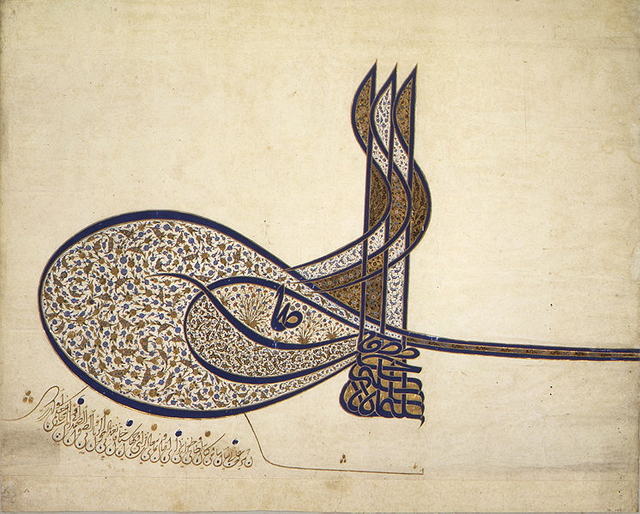
					<b>Nate: </b><em>?When a new Ottoman emperor ascended to the throne, his court calligrapher would create an elaborate signature (called a tughra) for him, to be affixed henceforth to royal documents, coins, etc. Once or twice I've come across <a href="http://en.wikipedia.org/wiki/Süleyman_the_Magnificent">Süleyman the Magnificent</a>'s tughra and was always stopped short: what a fitting, dashing, swaggering mark for the man who rebuilt the walls of Jerusalem, and marched his armies all the way to the gates of Vienna. What I didn't realize is how stylized and similar all the Ottoman emperors' tughras are—unless you're skilled at parsing Arabic calligraphy, they <a href="http://en.wikipedia.org/wiki/File:Tughra_of_Selim_III.JPG">mostly</a> <a href="http://upload.wikimedia.org/wikipedia/commons/4/4d/Tugra_Mahmuds_II.png">look</a> the <a href="http://upload.wikimedia.org/wikipedia/commons/d/d3/Abdul_Hameed_II_Sign.svg">same</a>. What I'd assumed were the most distinct elements of Süleyman's mark—those three bold upstrokes with pennants flying—are common to all.?</em><br />
		
		<a href="http://en.wikipedia.org/wiki/Tughra"><img src="http://www.culture-making.com/media/tughra.jpg" alt="image" /></a><hr />
<div class="author" style="font-size: -1">image from <a href="http://en.wikipedia.org/wiki/Tughra">Tughra</a>, Wikipedia.</div>		


      ]]></content>
    </entry>    <entry>
      <title>The Shettima Kagu Qur’an</title>
      <link rel="alternate" type="text/html" href="https://culture-making.com/post/the_shettima_kagu_quran" />
      <id>tag:culture-makers.com,2025:author/1.1574</id>
      <published>2025-01-02T22:53:00Z</published>
      <updated>2025-01-03T22:54:05Z</updated>
      <author>
            <name>Andy Crouch</name>
            <email>andy@culture-making.com</email>
            
      </author>

      <content type="html"><![CDATA[


					<b>Nate: </b><em>?A linguist friend of mine doing a bit of work on archaic Saharan languages sent me a link to this site at the School of Oriental and African Studies in London, full of lovely scans of annotated Qur'an pages from northeastern Nigeria. The manuscripts, which date from the 16th to 18th centuries, feature Qur'anic texts and commentaries (<a href="http://en.wikipedia.org/wiki/Tafsir">tafs?r</a>) in Arabic along with extensive glosses—the more odd-angled jottings—in "archaic Kanembu," which bears roughly the same relation, my friend notes, to the currently-spoken Kanuri language as does Middle English to that of today. All of which makes for a beautiful piece of parchment, full of layers and meanings.?</em><br />
		
		<a href="http://kanurimanuscripts.soas.ac.uk/pages/preview/589.jpg"><img src="http://culture-making.com/media/589.jpg" alt="image" /></a><hr />
<div class="author" style="font-size: -1">from the "<a href="http://kanurimanuscripts.soas.ac.uk/Manuscript2.html">Shettima Kagu Qur'an</a>," <a href="http://kanurimanuscripts.soas.ac.uk/pages/preview/589.jpg">Early Nigerian Qur'anic Manuscripts</a> :: thanks Andrew!</div>		


      ]]></content>
    </entry>    <entry>
      <title>It comes from sacrifice</title>
      <link rel="alternate" type="text/html" href="https://culture-making.com/post/it_comes_from_sacrifice" />
      <id>tag:culture-makers.com,2025:author/1.1330</id>
      <published>2025-01-02T22:53:00Z</published>
      <updated>2025-01-03T22:54:05Z</updated>
      <author>
            <name>Andy Crouch</name>
            <email>andy@culture-making.com</email>
            
      </author>

      <content type="html"><![CDATA[


					<b><p>Nate</p>: </b><em>?The full title of this essay is "Forgiveness and Irony: What makes the West strong." I have to say I'm far less comfortable with the subtitle—there's quite a bit of us versus them in this piece, and for me the generalizations ring truer (or less complicated) on the us side of things.?</em><br />
		
		<p>By living in a spirit of forgiveness, we not only uphold the core value of citizenship but also find the path to social membership that we need. Happiness does not come from the pursuit of pleasure, nor is it guaranteed by freedom. It comes from sacrifice: that is the great message that all the memorable works of our culture convey. The message has been lost in the noise of repudiation, but we can hear it once again if we devote our energies to retrieving it. And in the Judeo-Christian tradition, the primary act of sacrifice is forgiveness. The one who forgives sacrifices resentment and thereby renounces something that had been dear to his heart.</p><hr />
<div class="author" style="font-size: -1">from "<a href="http://www.city-journal.org/printable.php?id=3647">Forgiveness and Irony</a>," by Roger Scrunton, <a href="http://www.city-journal.org/printable.php?id=3647"><i>City Journal</i></a>, Winter 2009 :: via <a href="http://delicious.com/ayjay">ayjay</a></div>		


      ]]></content>
    </entry>    <entry>
      <title>The abomination of desolation</title>
      <link rel="alternate" type="text/html" href="https://culture-making.com/post/the_abomination_of_desolation" />
      <id>tag:culture-makers.com,2025:author/1.1107</id>
      <published>2025-01-02T22:53:00Z</published>
      <updated>2025-01-03T22:54:05Z</updated>
      <author>
            <name>Andy Crouch</name>
            <email>andy@culture-making.com</email>
            
      </author>

      <content type="html"><![CDATA[


					<b><p>Andy</p>: </b><em>?Think about the most shameful thing that has ever happened to you. It may have been years, even decades, ago, but I guarantee it still causes almost physical pain to remember it. Now consider the cultural effects of a calculated program of shame, directed not so much at individuals as at what they hold most sacred. Even if one does not grant unquestioned credibility to all the sources Michael Peppard draws upon in this sobering article, the United States' casual use of "religious torture" at Abu Ghreib and Guantánamo may have unintended consequences for millennia to come.?</em><br />
		
		<p>The United States has desecrated what most Muslims consider God’s presence on earth (the Qur’an), drowned out the call to prayer with the American anthem and rock songs, used grotesque sexual assaults to undermine piety, mocked religious holidays, and engaged in freelance proselytism.</p><p>How long can we expect the memory of such abuse to endure? Does it qualify as torture according to the definition offered in John Yoo’s famous Justice Department memo—“significant psychological harm of significant duration, e.g., lasting for months or even years”? History suggests that the collective memory of this abuse will last far longer than that. Millennia ago, another religious group with strict codes of ritual purity and devotion to God underwent physical and religious torture at the hands of occupying forces, prompting insurrection. More than two thousand years later, the events accompanying that revolt are still commemorated annually. The people are the Jews, and the holiday is Hanukkah.</p><hr />
<div class="author" style="font-size: -1">from "<a href="http://www.commonwealmagazine.org/article.php3?id_article=2390">The Secret Weapon: Religious Abuse in the War on Terror</a>," by Michael Peppard, <a href="http://www.commonwealmagazine.org/">Commonweal</a>, 5 December 2008</div>		


      ]]></content>
    </entry>    <entry>
      <title>Inshallah</title>
      <link rel="alternate" type="text/html" href="https://culture-making.com/post/inshallah" />
      <id>tag:culture-makers.com,2025:author/1.1001</id>
      <published>2025-01-02T22:53:00Z</published>
      <updated>2025-01-03T22:54:05Z</updated>
      <author>
            <name>Andy Crouch</name>
            <email>andy@culture-making.com</email>
            
      </author>

      <content type="html"><![CDATA[


<div class="author" style="font-size: -1">"<a href="http://ideas.blogs.nytimes.com/2008/10/31/in-meltdown-islamic-banks-are-doing-ok/">In Meltdown, Islamic Banks Are Doing O.K.</a>," a <a href="http://ideas.blogs.nytimes.com/2008/10/31/in-meltdown-islamic-banks-are-doing-ok/">NYTimes.com Ideas Blog</a> post, 31 October, 2008</div><hr />		
		<p><b>Finance | </b>Too bad nobody in the West thought of it: Islamic banking is better weathering the meltdown because sharia law curbs excessive risk-taking, with bans on interest and trading in debt. The strictures on usury mean investments only in “productive enterprises.” [<a href="http://www.washingtonpost.com/wp-dyn/content/article/2008/10/30/AR2008103004434.html">Washington Post</a>]</p>


      ]]></content>
    </entry>    <entry>
      <title>Arabesques</title>
      <link rel="alternate" type="text/html" href="https://culture-making.com/post/arabesques" />
      <id>tag:culture-makers.com,2025:author/1.940</id>
      <published>2025-01-02T22:53:00Z</published>
      <updated>2025-01-03T22:54:05Z</updated>
      <author>
            <name>Andy Crouch</name>
            <email>andy@culture-making.com</email>
            
      </author>

      <content type="html"><![CDATA[


					<b><p>Nate</p>: </b><em>?From a lovely French collection of prints of "Arab art from the monuments of Cairo, from the 7th through the 19th centuries." I love how, though this is just a sheet of disparate samples, they've made a sort of pattern of patterns of it.?</em><br />
		
		<a href="http://bibliodyssey.blogspot.com/2008/10/lart-arabe.html"><img src="http://culture-making.com/media/2936768421_f9e7204f56_o.jpg" alt="image" /></a><hr />
<div class="author" style="font-size: -1">"<a href="http://bibliodyssey.blogspot.com/2008/10/lart-arabe.html">Arabesques: incrustations en stuc sur pierre (du XVIe. au XVIIIe. siècle)</a>," from <i>L'Art arabe d'après les monuments du Kaire depuis le VIIe siècle jusqu'à la fin du XVIIIe par Prisse d'Avennes</i>, <a href="http://bibliodyssey.blogspot.com/2008/10/lart-arabe.html">NYPL Digital Gallery</a> :: via <a href="http://bibliodyssey.blogspot.com/2008/10/lart-arabe.html">BibliOdyssey</a></div>		


      ]]></content>
    </entry>    <entry>
      <title>Riyadh, Saudi Arabia by Shawn Baldwin</title>
      <link rel="alternate" type="text/html" href="https://culture-making.com/post/riyadh_saudi_arabia_by_shawn_baldwin" />
      <id>tag:culture-makers.com,2025:author/1.889</id>
      <published>2025-01-02T22:53:00Z</published>
      <updated>2025-01-03T22:54:05Z</updated>
      <author>
            <name>Andy Crouch</name>
            <email>andy@culture-making.com</email>
            
      </author>

      <content type="html"><![CDATA[


					<b><p>Nate</p>: </b><em>?From Shawn Baldwin's caption: "Young Saudi men shop for mobile phones at a store in Riyadh. For many young Saudi men and women, who have few chances to meet members of the opposite sex, mobile phones and Bluetooth technology allow them the ability to safely flirt in malls, restaurants and traffic signals. The photograph was taken as part of a series I’m working on for the New York Times called ‘Generation Faithful’. The series examines the lives of young people across the Muslim world at a time of religious revival."?</em><br />
		
		<a href="http://vervephoto.wordpress.com/"><img src="http://culture-making.com/media/baldwin_riy.jpg" alt="photo" /></a><hr />
<div class="author" style="font-size: -1">"Riyadh, Saudi Arabia. 2008", from the photo series "Genration Faithful," by <a href="http://www.shawnbaldwin.com/main.php">Shawn Baldwin</a> :: via <a href="http://vervephoto.wordpress.com/">Verve Photo: The New Generation of Documentary Photographers</a>, 19 September, 2008</div>		


      ]]></content>
    </entry>    <entry>
      <title>Chain mosques</title>
      <link rel="alternate" type="text/html" href="https://culture-making.com/post/chain_mosques" />
      <id>tag:culture-makers.com,2025:author/1.646</id>
      <published>2025-01-02T22:53:00Z</published>
      <updated>2025-01-03T22:54:05Z</updated>
      <author>
            <name>Andy Crouch</name>
            <email>andy@culture-making.com</email>
            
      </author>

      <content type="html"><![CDATA[


			<b><p>Nate</p>: </b><em>?Apart from size (and, I guess, the Central Florida location), the parallel really is more McDonald's than Megachurch -- which makes sense when religious devotion has more in common with regular meals (i.e. several times a day) than a once-a-week banquet. One could argue that this is just a form of cultural copying, though I suspect that it's more akin to using the language of fast-food marketing to reclaim a function that mosques have had, in other contexts, for centuries.?</em><br />

<div class="author" style="font-size: -1">an <a href="http://www.utne.com/2008-07-24/Spirituality/Rise-of-the-Mega-Mosque.aspx?blogid=28">Utne Reader</a> post by Bennett Gordon, 24 July 2008 :: via <a href="http://culturelog.tumblr.com/">Culture Log</a></div><hr />		
		<p>Taking a page from the evangelical mega-churches that have popped up around the country, Muslims have begun setting up multi-site “mosque chains” to accommodate increasingly large religious services, <a href="http://www.religionnews.com/index.php?/rnstext/muslims_begin_to_copy_the_megachurch_multi_site_model/">Mallika Rao reports for the Religion News Service</a>. Often branded as more progressive than other mosques, some of the organizations have begun offering gymnasiums, adult education classes, and even mixed-gender prayer areas. The strategy seems to be paying off, both financially and organizationally. Abeer Abdulla, a media specialist for the Islamic Society of Central Florida in Orlando, told Rao, “because of how streamlined we are, you can get off the highway from anywhere and find a mosque that is well-maintained, well-structured and that will always be open.&#8221; </p><p>(Thanks, <a title="Pew Forum" href="http://pewforum.org/news/rss.php?NewsID=16109">Pew Forum</a>.)</p>


      ]]></content>
    </entry>    <entry>
      <title>The wonder (and scandal) of conversion</title>
      <link rel="alternate" type="text/html" href="https://culture-making.com/post/the_wonder_and_scandal_of_conversion" />
      <id>tag:culture-makers.com,2025:author/1.567</id>
      <published>2025-01-02T22:53:00Z</published>
      <updated>2025-01-03T22:54:05Z</updated>
      <author>
            <name>Andy Crouch</name>
            <email>andy@culture-making.com</email>
            
      </author>

      <content type="html"><![CDATA[


					<b><p>Nate</p>: </b><em>?Of course, as the second half of the article notes, conversion is not always so easy -- as the passage of recent anti-conversion laws (and an uptick in persecution) in many regions of India make clear. I've always found it interesting how the English-language press in India invariably uses the passive voice to describe it -- "he was converted to Christianity" -- rather than the perky individualist western-style active: "he converted." One can find echoes to this in different attitudes towards western-individualist choises about marriage, career, etc.?</em><br />
		
		<p>Sometimes conversion is gradual, but quite commonly things come to a head in a single instant, which can be triggered by a text, an image, a ceremony or some private realisation. A religious person would call such a moment a summons from God; a psychologist might speak of an instant when the walls between the conscious and unconscious break down, perhaps because an external stimulus—words, a picture, a rite—connects with something very deep inside. <p>For people of an artistic bent, the catalyst is often a religious image which serves as a window into a new reality. One recurring theme in conversion stories is that cultural forms which are, on the face of it, foreign to the convert somehow feel familiar, like a homecoming. That, the convert feels, “is what I have always believed without being fully aware of it.”</p><p>Take Jennie Baker, an ethnic Chinese nurse who moved from Malaysia to England. She was an evangelical, practising but not quite satisfied with a Christianity that eschews aids to worship such as pictures, incense or elaborate rites. When she first walked into an Orthodox church, and took in the icons that occupied every inch of wall-space, everything in this “new” world made sense to her, and some teachings, like the idea that every home should have a corner for icons and prayer, resonated with her Asian heritage. Soon she and her English husband helped establish a Greek Orthodox parish in Lancashire.
</p><hr />
<div class="author" style="font-size: -1">from "<a href="http://www.economist.com/displayStory.cfm?story_id=11784873">The moment of truth</a>," <a href="http://www.economist.com/displayStory.cfm?story_id=11784873"><i>The Economist</i></a>, 24 July 2008</div>		


      ]]></content>
    </entry>

</feed>