<?xml version="1.0" encoding="utf-8"?>
<feed xmlns="http://www.w3.org/2005/Atom" xml:lang="en">

    <title type="text">Culture Making Articles items tagged calligraphy</title>
    <subtitle type="text">Culture Making Articles:Writing on Christianity and culture from Andy Crouch</subtitle>
    <link rel="alternate" type="text/html" href="http://culture-makers.com/" />
    <link rel="self" type="application/atom+xml" href="https://culture-making.com/tag/atom" />
    <updated>2025-01-03T22:54:05Z</updated>
    <rights>Copyright (c) 2025, Andy Crouch</rights>
    <generator uri="http://www.pmachine.com/" version="7.5.15">ExpressionEngine</generator>
    <id>tag:culture-makers.com,2025:01:02</id>

    <entry>
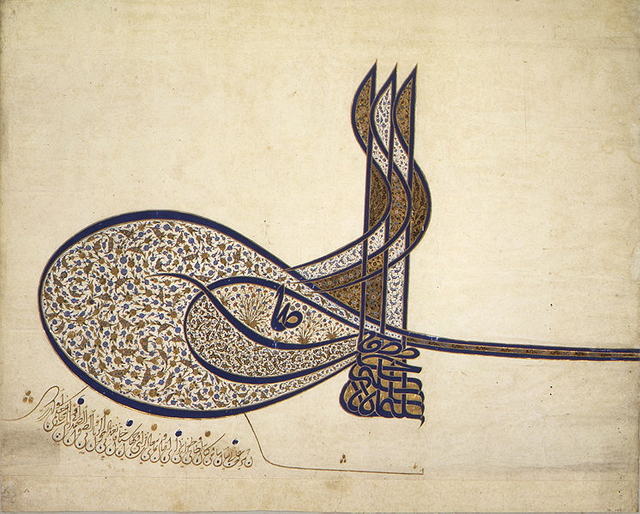
      <title>Süleyman the Magnificent’s magnificent signature</title>
      <link rel="alternate" type="text/html" href="https://culture-making.com/post/sueleyman_the_magnificents_magnificent_signature" />
      <id>tag:culture-makers.com,2025:author/1.2011</id>
      <published>2025-01-02T22:53:00Z</published>
      <updated>2025-01-03T22:54:05Z</updated>
      <author>
            <name>Andy Crouch</name>
            <email>andy@culture-making.com</email>
            
      </author>

      <content type="html"><![CDATA[


					<b>Nate: </b><em>?When a new Ottoman emperor ascended to the throne, his court calligrapher would create an elaborate signature (called a tughra) for him, to be affixed henceforth to royal documents, coins, etc. Once or twice I've come across <a href="http://en.wikipedia.org/wiki/Süleyman_the_Magnificent">Süleyman the Magnificent</a>'s tughra and was always stopped short: what a fitting, dashing, swaggering mark for the man who rebuilt the walls of Jerusalem, and marched his armies all the way to the gates of Vienna. What I didn't realize is how stylized and similar all the Ottoman emperors' tughras are—unless you're skilled at parsing Arabic calligraphy, they <a href="http://en.wikipedia.org/wiki/File:Tughra_of_Selim_III.JPG">mostly</a> <a href="http://upload.wikimedia.org/wikipedia/commons/4/4d/Tugra_Mahmuds_II.png">look</a> the <a href="http://upload.wikimedia.org/wikipedia/commons/d/d3/Abdul_Hameed_II_Sign.svg">same</a>. What I'd assumed were the most distinct elements of Süleyman's mark—those three bold upstrokes with pennants flying—are common to all.?</em><br />
		
		<a href="http://en.wikipedia.org/wiki/Tughra"><img src="http://www.culture-making.com/media/tughra.jpg" alt="image" /></a><hr />
<div class="author" style="font-size: -1">image from <a href="http://en.wikipedia.org/wiki/Tughra">Tughra</a>, Wikipedia.</div>		


      ]]></content>
    </entry>    <entry>
      <title>Calligraphy by Ahmed Shahnawaz Alam</title>
      <link rel="alternate" type="text/html" href="https://culture-making.com/post/calligraphy_by_ahmed_shahnawaz_alam" />
      <id>tag:culture-makers.com,2025:author/1.1881</id>
      <published>2025-01-02T22:53:00Z</published>
      <updated>2025-01-03T22:54:05Z</updated>
      <author>
            <name>Andy Crouch</name>
            <email>andy@culture-making.com</email>
            
      </author>

      <content type="html"><![CDATA[


					<b>Nate: </b><em>?This beautiful gazelle contains lines from the great eighteenth-century Urdu poet <a href="http://en.wikipedia.org/wiki/Mir_Taqi_Mir">Mir Taqi Mir</a>, one of the great masters of the <a href="http://en.wikipedia.org/wiki/Ghazal">ghazal</a> poetic form. (The gazelle-ghazal Arabic pun does not pass unnoticed. Wish I could figure out what the text itself is about—beyond the ghazal-standard "poetic expression of both the pain of loss or separation and the beauty of love in spite of that pain").?</em><br />
		
		<a href="http://www.calligraphy.mvk.ru/en/?idx=144&sw=p&fotka=1213"><img src="http://culture-making.com/media/1243863617.jpg" alt="image" /></a><hr />
<div class="author" style="font-size: -1">"<a href="http://www.calligraphy.mvk.ru/en/?idx=144&sw=p&fotka=1213">Poetry by Meer Taqi Meer, a renown poet of India</a>," paper, self-made ink and bamboo pen (2009), by Shanawaz Alam Ahmed, <a href="http://www.calligraphy.mvk.ru/en/?idx=144&sw=p&fotka=1213">International Exhibition of Calligraphy</a> :: via <a href="http://assemblyman-eph.blogspot.com/2010/04/selections-from-intl-exhibition-of.html">ephemera assemblyman</a></div>		


      ]]></content>
    </entry>

</feed>