<?xml version="1.0" encoding="utf-8"?>
<feed xmlns="http://www.w3.org/2005/Atom" xml:lang="en">

    <title type="text">Culture Making Articles items tagged arabic</title>
    <subtitle type="text">Culture Making Articles:Writing on Christianity and culture from Andy Crouch</subtitle>
    <link rel="alternate" type="text/html" href="http://culture-makers.com/" />
    <link rel="self" type="application/atom+xml" href="https://culture-making.com/tag/atom" />
    <updated>2025-01-03T22:54:05Z</updated>
    <rights>Copyright (c) 2025, Andy Crouch</rights>
    <generator uri="http://www.pmachine.com/" version="7.5.15">ExpressionEngine</generator>
    <id>tag:culture-makers.com,2025:01:02</id>

    <entry>
      <title>Süleyman the Magnificent’s magnificent signature</title>
      <link rel="alternate" type="text/html" href="https://culture-making.com/post/sueleyman_the_magnificents_magnificent_signature" />
      <id>tag:culture-makers.com,2025:author/1.2011</id>
      <published>2025-01-02T22:53:00Z</published>
      <updated>2025-01-03T22:54:05Z</updated>
      <author>
            <name>Andy Crouch</name>
            <email>andy@culture-making.com</email>
            
      </author>

      <content type="html"><![CDATA[


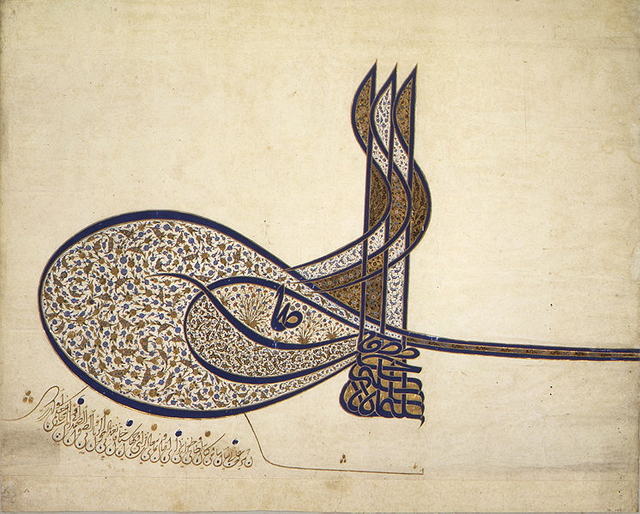
					<b>Nate: </b><em>?When a new Ottoman emperor ascended to the throne, his court calligrapher would create an elaborate signature (called a tughra) for him, to be affixed henceforth to royal documents, coins, etc. Once or twice I've come across <a href="http://en.wikipedia.org/wiki/Süleyman_the_Magnificent">Süleyman the Magnificent</a>'s tughra and was always stopped short: what a fitting, dashing, swaggering mark for the man who rebuilt the walls of Jerusalem, and marched his armies all the way to the gates of Vienna. What I didn't realize is how stylized and similar all the Ottoman emperors' tughras are—unless you're skilled at parsing Arabic calligraphy, they <a href="http://en.wikipedia.org/wiki/File:Tughra_of_Selim_III.JPG">mostly</a> <a href="http://upload.wikimedia.org/wikipedia/commons/4/4d/Tugra_Mahmuds_II.png">look</a> the <a href="http://upload.wikimedia.org/wikipedia/commons/d/d3/Abdul_Hameed_II_Sign.svg">same</a>. What I'd assumed were the most distinct elements of Süleyman's mark—those three bold upstrokes with pennants flying—are common to all.?</em><br />
		
		<a href="http://en.wikipedia.org/wiki/Tughra"><img src="http://www.culture-making.com/media/tughra.jpg" alt="image" /></a><hr />
<div class="author" style="font-size: -1">image from <a href="http://en.wikipedia.org/wiki/Tughra">Tughra</a>, Wikipedia.</div>		


      ]]></content>
    </entry>    <entry>
      <title>Calligraphy by Ahmed Shahnawaz Alam</title>
      <link rel="alternate" type="text/html" href="https://culture-making.com/post/calligraphy_by_ahmed_shahnawaz_alam" />
      <id>tag:culture-makers.com,2025:author/1.1881</id>
      <published>2025-01-02T22:53:00Z</published>
      <updated>2025-01-03T22:54:05Z</updated>
      <author>
            <name>Andy Crouch</name>
            <email>andy@culture-making.com</email>
            
      </author>

      <content type="html"><![CDATA[


					<b>Nate: </b><em>?This beautiful gazelle contains lines from the great eighteenth-century Urdu poet <a href="http://en.wikipedia.org/wiki/Mir_Taqi_Mir">Mir Taqi Mir</a>, one of the great masters of the <a href="http://en.wikipedia.org/wiki/Ghazal">ghazal</a> poetic form. (The gazelle-ghazal Arabic pun does not pass unnoticed. Wish I could figure out what the text itself is about—beyond the ghazal-standard "poetic expression of both the pain of loss or separation and the beauty of love in spite of that pain").?</em><br />
		
		<a href="http://www.calligraphy.mvk.ru/en/?idx=144&sw=p&fotka=1213"><img src="http://culture-making.com/media/1243863617.jpg" alt="image" /></a><hr />
<div class="author" style="font-size: -1">"<a href="http://www.calligraphy.mvk.ru/en/?idx=144&sw=p&fotka=1213">Poetry by Meer Taqi Meer, a renown poet of India</a>," paper, self-made ink and bamboo pen (2009), by Shanawaz Alam Ahmed, <a href="http://www.calligraphy.mvk.ru/en/?idx=144&sw=p&fotka=1213">International Exhibition of Calligraphy</a> :: via <a href="http://assemblyman-eph.blogspot.com/2010/04/selections-from-intl-exhibition-of.html">ephemera assemblyman</a></div>		


      ]]></content>
    </entry>    <entry>
      <title>The Shettima Kagu Qur’an</title>
      <link rel="alternate" type="text/html" href="https://culture-making.com/post/the_shettima_kagu_quran" />
      <id>tag:culture-makers.com,2025:author/1.1574</id>
      <published>2025-01-02T22:53:00Z</published>
      <updated>2025-01-03T22:54:05Z</updated>
      <author>
            <name>Andy Crouch</name>
            <email>andy@culture-making.com</email>
            
      </author>

      <content type="html"><![CDATA[


					<b>Nate: </b><em>?A linguist friend of mine doing a bit of work on archaic Saharan languages sent me a link to this site at the School of Oriental and African Studies in London, full of lovely scans of annotated Qur'an pages from northeastern Nigeria. The manuscripts, which date from the 16th to 18th centuries, feature Qur'anic texts and commentaries (<a href="http://en.wikipedia.org/wiki/Tafsir">tafs?r</a>) in Arabic along with extensive glosses—the more odd-angled jottings—in "archaic Kanembu," which bears roughly the same relation, my friend notes, to the currently-spoken Kanuri language as does Middle English to that of today. All of which makes for a beautiful piece of parchment, full of layers and meanings.?</em><br />
		
		<a href="http://kanurimanuscripts.soas.ac.uk/pages/preview/589.jpg"><img src="http://culture-making.com/media/589.jpg" alt="image" /></a><hr />
<div class="author" style="font-size: -1">from the "<a href="http://kanurimanuscripts.soas.ac.uk/Manuscript2.html">Shettima Kagu Qur'an</a>," <a href="http://kanurimanuscripts.soas.ac.uk/pages/preview/589.jpg">Early Nigerian Qur'anic Manuscripts</a> :: thanks Andrew!</div>		


      ]]></content>
    </entry>

</feed>