<?xml version="1.0" encoding="utf-8"?>
<feed xmlns="http://www.w3.org/2005/Atom" xml:lang="en">

    <title type="text">Culture Making Articles items tagged africa</title>
    <subtitle type="text">Culture Making Articles:Writing on Christianity and culture from Andy Crouch</subtitle>
    <link rel="alternate" type="text/html" href="http://culture-makers.com/" />
    <link rel="self" type="application/atom+xml" href="https://culture-making.com/tag/atom" />
    <updated>2025-01-03T22:54:05Z</updated>
    <rights>Copyright (c) 2025, Andy Crouch</rights>
    <generator uri="http://www.pmachine.com/" version="7.5.15">ExpressionEngine</generator>
    <id>tag:culture-makers.com,2025:01:02</id>

    <entry>
      <title>Love is a cough that cannot be hid</title>
      <link rel="alternate" type="text/html" href="https://culture-making.com/post/love_is_a_cough_that_cannot_be_hid" />
      <id>tag:culture-makers.com,2025:author/1.2033</id>
      <published>2025-01-02T22:53:00Z</published>
      <updated>2025-01-03T22:54:05Z</updated>
      <author>
            <name>Andy Crouch</name>
            <email>andy@culture-making.com</email>
            
      </author>

      <content type="html"><![CDATA[


					<b>Nate: </b><em>?The <a href="http://en.wikipedia.org/wiki/Kanga_(African_garment)">kanga</a> is the East African version of the brightly colored bolts of cloth familiar throughout the continent (and beyond—the Indian sari and Asian sarong aren't too different). Wrapped around the waist or shoulders, tied as headscarves, repurposed as child carriers, sewn into blouses and men's shirts—there's not much the kanga can't do. Though much of the cloth you see in Africa has topical prints and slogans intermingling with the wild patterns, kangas tend to have a single slogan running along the bottom, generally a Swahili proverb or riddle. I have a kanga hanging in my office window that reads HAMADI KIBINDONI SILAHA MKONONI, which turns out to be an encouragement to frugality whose literal meaning is something like "money in your underwear, a weapon in your hand". The kanga pictured above unravels its mystery a little more easily into this post's title.?</em><br />
		
		<a href="http://allmyeyes.blogspot.com/2012/02/love-is-like-cough-and-other-swahili.html"><img src="http://www.culture-making.com/media/mapenzi.jpg" alt="photo" /></a><hr />
<div class="author" style="font-size: -1">from "<a href="http://allmyeyes.blogspot.com/2012/02/love-is-like-cough-and-other-swahili.html">2009 Khanga Designs with Methali</a>," found at <a href="http://zanzibarifestival.myevent.com/3/quiz.htm">Zanzibari Reunion</a> :: via <a href="http://allmyeyes.blogspot.com/2012/02/love-is-like-cough-and-other-swahili.html">ALL MY EYES</a></div>		


      ]]></content>
    </entry>    <entry>
      <title>Technology is not the enemy (uncoolness is)</title>
      <link rel="alternate" type="text/html" href="https://culture-making.com/post/everyone_speaks_text_message_-_nytimes.com" />
      <id>tag:culture-makers.com,2025:author/1.2005</id>
      <published>2025-01-02T22:53:00Z</published>
      <updated>2025-01-03T22:54:05Z</updated>
      <author>
            <name>Andy Crouch</name>
            <email>andy@culture-making.com</email>
            
      </author>

      <content type="html"><![CDATA[


					<b>Nate: </b><em>?Some languages are making a comeback thanks to a strong desire on the part of speakers to send one another text messages in them. For endangered scripts, the revival will be longer in coming, till smartphones work their way cheaply into the right eager hands.?</em><br />
		
		<p>“For a long time, technology was the enemy,” says Inée Slaughter, executive director of the New Mexico-based Indigenous Language Institute, which teaches Native Americans and other indigenous peoples how to use digital technologies to keep their languages vital. Heritage languages were being killed off by increasing urbanization, the spread of formal education and the shift to cash crops, which ended the isolation of indigenous communities. Advances in technology seemed to intensify the decline. “Even in 1999 or 2000, people were saying technology killed their language,” Slaughter says. “Community elders worried about it. As television came into homes, English became pervasive 24/7. Mainstream culture infiltrated, and young kids want to be like that. It was a huge, huge problem, and it’s still there. But now we know ways technology can be helpful.”</p><hr />
<div class="author" style="font-size: -1">from "<a href="http://www.nytimes.com/2011/12/11/magazine/everyone-speaks-text-message.html?_r=1&ref=magazine&pagewanted=all">Everyone Speaks Text Message</a>," by Tina Rosenberg, <a href="http://www.nytimes.com/2011/12/11/magazine/everyone-speaks-text-message.html?_r=1&ref=magazine&pagewanted=all"><i>The New York TImes</i></a>, 9 December 2011</div>		


      ]]></content>
    </entry>    <entry>
      <title>Secular praise songs from Western Kenya</title>
      <link rel="alternate" type="text/html" href="https://culture-making.com/post/secular_praise_songs_from_western_kenya" />
      <id>tag:culture-makers.com,2025:author/1.1044</id>
      <published>2025-01-02T22:53:00Z</published>
      <updated>2025-01-03T22:54:05Z</updated>
      <author>
            <name>Andy Crouch</name>
            <email>andy@culture-making.com</email>
            
      </author>

      <content type="html"><![CDATA[


					<b><p>Nate</p>: </b><em>?This is from a really wonderful blog (my <a href="http://www.voanews.com/english/africa/blog/">tax dollars at work</a>!) that posts decades-old African pop music, accompanied by lengthy history and commentary. Here's the brief background: "The Kawere Boys were formed by Cheplin Ngode Kotula in Kericho, Kenya in 1974, and over the next four years became one of the more popular Benga groups in Luo land. ... These recordings were not only popular throughout Luo land, but also sold well in Tanzania, Malawi, South Africa, Nigeria, Cameroun, and West Africa." It's fascinating and heartening to learn these tales of cultural spread that bypass the usual centers of power (Europe, the U.S., heck, even Nairobi). Also—fascinating relationship between artist and patron: the patron doesn't just make the song possible, he is the song's subject.?</em><br />
		
		<div style="float:right; padding:15px 5px 5px 5px"><img src="http://culture-making.com/media/pd_africanblog_kaweremuma_420.jpg" alt="image"></div><p><a href="http://www.voanews.com//english/africa/blog/images/Media/KAWERE_BOYS_Muma_Ben.Mp3">The Kawere Boys ‘Muma Ben’ (1974) mp3</a></p>
<p>Most of the songs in the Kawere repertoire seem to be praise songs for patrons who had invited the group to perform. These songs can be thought of as pre-internet age social networking. The singer usually starts by introducing himself, goes on to introduce the object of his praise, as well as the patron’s relatives, friends, and neighbors, before explaining the nature of his relationship to the patron in question. For example, in ‘Muma Ben’, the song starts with an introduction of ‘Muma Ben from Saye Konyango’, then introduces Muma Ben’s family, and ends with praise for the hospitality the singer received when he was invited to Muma Ben’s house. If you were to map out all of the relationships outlined in the Kawere Boys singles in our collection, and if you had a deep understanding of Luo culture, you could get a good idea of the social networks the Kawere Boys relied upon for their livelihood.</p><hr />
<div class="author" style="font-size: -1">from "<a href="http://www.voanews.com/english/africa/blog/index.cfm?mode=entry&entry=9176649F-F9A9-411F-29F74F07F256F725">The Kawere Boys</a>," by Matthew LaVoie, <a href="http://www.voanews.com/english/africa/blog/index.cfm?mode=entry&entry=9176649F-F9A9-411F-29F74F07F256F725">Voice of America African Music Treasures Blog</a>, 12 November 2008 :: first posted here 12 November 2008</div>		


      ]]></content>
    </entry>    <entry>
      <title>Design, color, and cultural power</title>
      <link rel="alternate" type="text/html" href="https://culture-making.com/post/design_color_and_cultural_power" />
      <id>tag:culture-makers.com,2025:author/1.1941</id>
      <published>2025-01-02T22:53:00Z</published>
      <updated>2025-01-03T22:54:05Z</updated>
      <author>
            <name>Andy Crouch</name>
            <email>andy@culture-making.com</email>
            
      </author>

      <content type="html"><![CDATA[


					<b>Nate: </b><em>?A fascinating long interview with a Portuguese communication designer who has taught design courses and workshops in Maputo, Mozambique. In situations like the ones she describes with her students, there's always the risk and temptation (for both teacher and students) of straying from helpful cultural empowerment to a sort of patronizing teacher-as-messiah role. I like the exchange below because she doesn't say "And to think nobody had ever told them that their local cultural knowledge had value!" but rather, "Of course they knew it had value in their everyday lives; my job was simply to help them extend that value into the specific practices we were studying."?</em><br />
		
		<p>It’s interesting to see that although people appreciate their very rich culture, they do not connect its traditions to contemporary knowledge and practices. For example, students in the graphic design course I taught at ENAV asked me to give them lessons in color, insisting they knew nothing about it. This really surprised me. My immediate answer was, “But you should teach <i>me!</i> You’re surrounded by color and use it in such powerful ways in every aspect of daily life. I admire you for it!” Their response was to laugh and say, “But Teacher! That’s not design! We need to use <i>design</i> colors.” From talking to my students and people in the cultural sector, I got the impression that design was this distant, quite artificial, field they had to adapt to. Their main concern is learning software.</p><hr />
<div class="author" style="font-size: -1">from "<a href="http://changeobserver.designobserver.com/entry.html?entry=14278">"But Teacher! That’s Not Design!"</a>," by Vera Sacchetti, <a href="http://changeobserver.designobserver.com/entry.html?entry=14278">Change Observer</a>, 8 July 2010 :: via <a href="http://delicious.com/amaah">koranteng</a></div>		


      ]]></content>
    </entry>    <entry>
      <title>A young person’s guide to the vuvuzela</title>
      <link rel="alternate" type="text/html" href="https://culture-making.com/post/vuvuzela" />
      <id>tag:culture-makers.com,2025:author/1.1936</id>
      <published>2025-01-02T22:53:00Z</published>
      <updated>2025-01-03T22:54:05Z</updated>
      <author>
            <name>Andy Crouch</name>
            <email>andy@culture-making.com</email>
            
      </author>

      <content type="html"><![CDATA[


			<p><object width="420" height="252"><param name="movie" value="http://www.youtube.com/v/wf2P8SnOwLo&amp;color1=0xb1b1b1&amp;color2=0xd0d0d0&amp;hl=en_US&amp;feature=player_embedded&amp;fs=1"></param><param name="allowFullScreen" value="true"></param><param name="allowScriptAccess" value="always"></param><embed src="http://www.youtube.com/v/wf2P8SnOwLo&amp;color1=0xb1b1b1&amp;color2=0xd0d0d0&amp;hl=en_US&amp;feature=player_embedded&amp;fs=1" type="application/x-shockwave-flash" allowfullscreen="true" allowScriptAccess="always" width="420" height="252"></embed></object></p><br />
<b>Andy: </b><em>?A delightfully deadpan introduction to the classical repertoire for . . . the vuvuzela.?</em><br />
<hr /><span style="font-size: -1">from "<a href="http://www.youtube.com/watch?v=wf2P8SnOwLo">Vuvuzela Concert</a>," by Zeit Online, 28 June 2010 :: via <a href="http://therestisnoise.com">Alex Ross</a> via Ted Olsen</span>


      ]]></content>
    </entry>    <entry>
      <title>Everyday South Africans and their bicycles</title>
      <link rel="alternate" type="text/html" href="https://culture-making.com/post/everyday_south_africans_and_their_bicycles" />
      <id>tag:culture-makers.com,2025:author/1.1922</id>
      <published>2025-01-02T22:53:00Z</published>
      <updated>2025-01-03T22:54:05Z</updated>
      <author>
            <name>Andy Crouch</name>
            <email>andy@culture-making.com</email>
            
      </author>

      <content type="html"><![CDATA[


					<b>Nate: </b><em>?Upon viewing the new Shakira <a href="http://worldcup.vevo.com/?v=wakawaka">World Cup song's video</a>, an African historian friend of mine tweeted "Planning to cringe all month w/ South Africa standing in as the 'real Africa.' Drums + Feathers anyone?" Hopefully the soccer coverage will dig a bit deeper than that, or at least provide the world with a few urban African cliches to balance out the rural ones. On a more positive note, I really like these portraits of South African cyclists, which are paired with interviews about the pictured bikes and (as if they hadn't won my heart already), Google Maps pinpointing each photo's exact location. The photographers are <a href="http://www.kickstarter.com/projects/bicycleportraits/bicycle-portraits-everyday-south-africans-and-thei">raising money</a> to publish a hardcover book of the portraits.?</em><br />
		
		<a href="http://www.dayonepublications.com/Bicycle_Portraits/Index.html"><img src="http://culture-making.com/media/david_mufamadi_1652.jpg" alt="photo" /></a><hr />
<div class="author" style="font-size: -1">"<a href="http://www.dayonepublications.com/Bicycle_Portraits/David_Mufamadi.html">David Mufamadi, Charles St., Brooklyn, Pretoria</a>," by Nic Grobler, <a href="http://www.dayonepublications.com/Bicycle_Portraits/Index.html">Bicycle Portraits - everyday South Africans and their bicycles</a>, 2010 :: via <a href="http://www.wired.com/gadgetlab/2010/06/bike-portraits-a-fascinating-gallery-of-south-african-cyclists/#">Wired.com Gadget Lab</a></div>		


      ]]></content>
    </entry>    <entry>
      <title>As sherp as muckle needles</title>
      <link rel="alternate" type="text/html" href="https://culture-making.com/post/as_sherp_as_muckle_needles" />
      <id>tag:culture-makers.com,2025:author/1.1856</id>
      <published>2025-01-02T22:53:00Z</published>
      <updated>2025-01-03T22:54:05Z</updated>
      <author>
            <name>Andy Crouch</name>
            <email>andy@culture-making.com</email>
            
      </author>

      <content type="html"><![CDATA[


					<b>Nate: </b><em>?The absurdly prolific author Alexander McCall Smith has a new book for younger readers featuring the characters from the bestselling <a href="http://www.amazon.com/No-Ladies-Detective-Agency-Book/dp/1400034779/cmcom-20">No. 1 Ladies' Detective Agency</a> series. As part of a promotion with the <a href="http://www.scottisharts.org.uk/1/artsinscotland/literature/features/preciousandthepuggies.aspx">Scottish Arts Council</a>, it is currently only available in a Scots translation in its first year of publication. It's a fun and fascinating way to affirm and promote the <a href="http://en.wikipedia.org/wiki/Scots_language">Scots language</a>—and even gain it new worldwide readers, as it's close enough to English for a patient reader to puzzle it out with pleasure.?</em><br />
		
		<p>Whit wid ye dae if ye fund yersel face tae face wi a muckle lion? Staund as still as a stookie? Mak yer feet yer freens and rin? Creep awa quiet-like? Mibbe ye wid jist steek yer een and hope that ye were haein a dream – which is whit Obed did at first when he saw the frichtsome lion starin strecht at him. But when he opened his een again, the lion wis aye there, and whit wis waur, wis stertin tae open its muckle mooth. Precious sooked in her braith. ‘Did ye see his teeth?’ she spiered. Obed noddit his heid. ‘The moonlicht wis gey bricht,’ he said. ‘His teeth were white and as sherp as muckle needles.’</p><hr />
<div class="author" style="font-size: -1">from <a href="http://www.amazon.com/Precious-Puggies-Ramotswes-Very-First/dp/1845022807/cmcom-20"><i>Precious and the Puggies</i></a>, Chapter Twa, by Alexander McCall Smith, translatit intae Scots by James Robertson and wi bonnie illustrations by Iain McIntosh, 2010 :: via <a href="http://www.metafilter.com/90660/Nummer-Wan-Ladies-Detective-Agency">MetaFilter</a></div>		


      ]]></content>
    </entry>    <entry>
      <title>The right book at the right time</title>
      <link rel="alternate" type="text/html" href="https://culture-making.com/post/the_right_book_at_the_right_time" />
      <id>tag:culture-makers.com,2025:author/1.1851</id>
      <published>2025-01-02T22:53:00Z</published>
      <updated>2025-01-03T22:54:05Z</updated>
      <author>
            <name>Andy Crouch</name>
            <email>andy@culture-making.com</email>
            
      </author>

      <content type="html"><![CDATA[


			<b>Nate: </b><em>?Ah, the life-changing power of the right book at the right time. The reissue of <a href="http://www.amazon.com/African-Greenland-Review-Books-Classics/dp/0940322889/cmcom-20">An African in Greenland</a> moves right to the top of my travel writing to-read list.?</em><br />

<div class="author" style="font-size: -1">a <a href="http://www.futilitycloset.com/2010/03/15/northern-exposure/?utm_source=feedburner&utm_medium=feed&utm_campaign=Feed:+FutilityCloset+(Futility+Closet)&utm_content=Google+Reader">Futility Closet</a> post by Greg Ross, 15 March 2010</div><hr />		
		<p>Ordered to join a jungle snake cult in his native Togo, Tété-Michel Kpomassie chanced to find a book about Greenland in a local Jesuit library. At the first opportunity he ran away.</p>
<p>Kpomassie’s 1981 autobiography, <i>An African in Greenland</i>, tells of his odyssey through West Africa and Europe seeking a route to the frozen island. He finally arrived in the mid-1960s, a black giant among the Inuit:</p>
<blockquote>
<p>As soon as they saw me, all stopped talking. So intense was the silence, you could have heard a gnat in flight. Then they started to smile again, the women with slightly lowered eyes. When I was standing before them on the wharf, they all raised their heads to look me full in the face. Some children clung to their mothers’ coats, and others began to scream with fright or to weep.
</p>
</blockquote>
<p>Kpomassie happily spent the next two years driving a dogsled and hunting seal in a kayak. After eight years, he had reached the land of his dreams — a country with no trees and no snakes.</p>


      ]]></content>
    </entry>    <entry>
      <title>The problem with stereotypes is not that they are untrue, but that they are incomplete</title>
      <link rel="alternate" type="text/html" href="https://culture-making.com/post/the_problem_with_stereotypes_is_not_that_they_are_untrue_but_that_they_are_" />
      <id>tag:culture-makers.com,2025:author/1.1837</id>
      <published>2025-01-02T22:53:00Z</published>
      <updated>2025-01-03T22:54:05Z</updated>
      <author>
            <name>Andy Crouch</name>
            <email>andy@culture-making.com</email>
            
      </author>

      <content type="html"><![CDATA[


			<p align="center"><object width="420" height="253"><param name="movie" value="http://www.youtube.com/v/D9Ihs241zeg&amp;hl=en_US&amp;fs=1&amp;"></param><param name="allowFullScreen" value="true"></param><param name="allowscriptaccess" value="always"></param><embed src="http://www.youtube.com/v/D9Ihs241zeg&amp;hl=en_US&amp;fs=1&amp;" type="application/x-shockwave-flash" allowscriptaccess="always" allowfullscreen="true" width="420" height="253"></embed></object></p><br />
<b>Christy: </b><em>?I first discovered Nigerian author <a href="http://en.wikipedia.org/wiki/Chimamanda_Ngozi_Adichie">Chimamanda Ngozi Adichie</a> when she was featured on the cover of my copy of <a href="http://www.pw.org/content/julyaugust_2009">Poets and Writers</a> magazine. She was so striking on the cover, with her bold red head wrap and beautiful gaze, and her interview revealed a very intelligent, inspiring woman—I couldn't wait to read her work. In this video, Ms. Adichie talks about the danger of hearing only a single story about another person or country, risking a critical misunderstanding about their depth, beauty, intelligence, and humanity.?</em><br />
<hr /><span style="font-size: -1">from "<a href="http://www.ted.com/talks/chimamanda_adichie_the_danger_of_a_single_story.html">The danger of a single story</a>," by Chimamanda Adichie, <a href="http://www.ted.com/talks/chimamanda_adichie_the_danger_of_a_single_story.html">TED.com</a>, July 2009</span>


      ]]></content>
    </entry>    <entry>
      <title>The lion and the mouse</title>
      <link rel="alternate" type="text/html" href="https://culture-making.com/post/the_lion_and_the_mouse" />
      <id>tag:culture-makers.com,2025:author/1.1798</id>
      <published>2025-01-02T22:53:00Z</published>
      <updated>2025-01-03T22:54:05Z</updated>
      <author>
            <name>Andy Crouch</name>
            <email>andy@culture-making.com</email>
            
      </author>

      <content type="html"><![CDATA[


					<b>Christy: </b><em>?Last month the author and artist <a href="http://www.jerrypinkneystudio.com/">Jerry Pinkney</a> was awarded the highest honor for an illustrator of children's books: the <a href="http://www.ala.org/ala/mgrps/divs/alsc/awardsgrants/bookmedia/caldecottmedal/caldecottmedal.cfm">Caldecott Medal</a>. His wordless retelling of the classic Aesop fable, <a href="http://www.amazon.com/Lion-Mouse-Jerry-Pinkney/dp/0316013560/cmcom-20">The Lion and the Mouse</a>, contains stunningly beautiful renderings of this heartwarming story, set in the African Serengeti, that reminds young and old alike that no act of kindness is ever wasted. <a href="http://www.hachettebookgroup.com/_swf/hbgusa_lightwindowFlvPlayer.swf?quickStart=true&swfPath=/_swf/hbgusa_lightwindowFlvPlayer.swf&flvPath=/_swf/video/lbyr/hbg_jpinkney_master.flv&titleCard=&">In this video</a> he invites us into his studio to get a bit of background on this remarkable work of art.?</em><br />
		
		<a href="http://www.hachettebookgroup.com/_swf/hbgusa_lightwindowFlvPlayer.swf?quickStart=true&swfPath=/_swf/hbgusa_lightwindowFlvPlayer.swf&flvPath=/_swf/video/lbyr/hbg_jpinkney_master.flv&titleCard=&"><img src="http://culture-making.com/media/lionmouse.jpg" alt="image" /></a><hr />
<div class="author" style="font-size: -1">from <i><a href="60/cmcom-20">The Lion and the Mouse</a></i>, by Jerry Pinkney, 2010</div>		


      ]]></content>
    </entry>    <entry>
      <title>Life and taxes</title>
      <link rel="alternate" type="text/html" href="https://culture-making.com/post/life_and_taxes" />
      <id>tag:culture-makers.com,2025:author/1.1710</id>
      <published>2025-01-02T22:53:00Z</published>
      <updated>2025-01-03T22:54:05Z</updated>
      <author>
            <name>Andy Crouch</name>
            <email>andy@culture-making.com</email>
            
      </author>

      <content type="html"><![CDATA[


					<b>Nate: </b><em>?A fascinating look at the birth and life of policies and institutions, and of their surprising multigenerational effects.?</em><br />
		
		<div style="float:right; padding:15px 5px 5px 5px"><img src="http://culture-making.com/media/Nigeria_710_250.jpg" alt="image"></div><p>In colonial Nigeria in the last years of the 19th century, a strange quirk of history led the British rulers to draw an arbitrary boundary line along the 7?10? N line of latitude, separating the population into two separate administrative districts.</p>
<p>Below the line, the colonial government raised money by levying taxes on imported alcohol and other goods that came through Southern Protectorate’s sea ports. Above the line, the administrators of the landlocked Northern Protectorate had no sea ports, and instead raised money through direct taxes. In the areas near the border, this took the form of a simple poll tax, where tax officials collected from each citizen the equivalent of between $4 and $20 in today’s dollars.</p>
<p>Could this seemingly minor difference—created over a century ago by a long-defunct colonial administration, and long ago erased by subsequent administrative divisions—possibly still matter today?</p>
<p>Yes, it could, according to Daniel Berger, a PhD student in politics at NYU.&nbsp; Berger’s paper, <a href="http://homepages.nyu.edu/~db1299/Nigeria.pdf">Taxes, Institutions and Local Governance: Evidence from a Natural Experiment in Colonial Nigeria</a>, finds that the “simple act of having to collect taxes caused governments to be forced to build the capacity which can now provide basic government services.” As a result, governance today is “significantly better” in areas just above the line than in those just below it.</p><hr />
<div class="author" style="font-size: -1">from "<a href="http://aidwatchers.com/2009/11/history-matters-if-you-paid-a-4-poll-tax-in-1910-your-great-grandchild-gets-a-polio-vaccine-today/">History Matters: If you paid a $4 poll tax in 1910, your great-grandchild gets a polio vaccine today</a>," <a href="http://aidwatchers.com/2009/11/history-matters-if-you-paid-a-4-poll-tax-in-1910-your-great-grandchild-gets-a-polio-vaccine-today/">Aid Watch</a>, 9 November 2009 :: thanks Koranteng</div>		


      ]]></content>
    </entry>    <entry>
      <title>The Shettima Kagu Qur’an</title>
      <link rel="alternate" type="text/html" href="https://culture-making.com/post/the_shettima_kagu_quran" />
      <id>tag:culture-makers.com,2025:author/1.1574</id>
      <published>2025-01-02T22:53:00Z</published>
      <updated>2025-01-03T22:54:05Z</updated>
      <author>
            <name>Andy Crouch</name>
            <email>andy@culture-making.com</email>
            
      </author>

      <content type="html"><![CDATA[


					<b>Nate: </b><em>?A linguist friend of mine doing a bit of work on archaic Saharan languages sent me a link to this site at the School of Oriental and African Studies in London, full of lovely scans of annotated Qur'an pages from northeastern Nigeria. The manuscripts, which date from the 16th to 18th centuries, feature Qur'anic texts and commentaries (<a href="http://en.wikipedia.org/wiki/Tafsir">tafs?r</a>) in Arabic along with extensive glosses—the more odd-angled jottings—in "archaic Kanembu," which bears roughly the same relation, my friend notes, to the currently-spoken Kanuri language as does Middle English to that of today. All of which makes for a beautiful piece of parchment, full of layers and meanings.?</em><br />
		
		<a href="http://kanurimanuscripts.soas.ac.uk/pages/preview/589.jpg"><img src="http://culture-making.com/media/589.jpg" alt="image" /></a><hr />
<div class="author" style="font-size: -1">from the "<a href="http://kanurimanuscripts.soas.ac.uk/Manuscript2.html">Shettima Kagu Qur'an</a>," <a href="http://kanurimanuscripts.soas.ac.uk/pages/preview/589.jpg">Early Nigerian Qur'anic Manuscripts</a> :: thanks Andrew!</div>		


      ]]></content>
    </entry>    <entry>
      <title>The subtle clicks of N|uu</title>
      <link rel="alternate" type="text/html" href="https://culture-making.com/post/the_subtle_clicks_of_nuu" />
      <id>tag:culture-makers.com,2025:author/1.1545</id>
      <published>2025-01-02T22:53:00Z</published>
      <updated>2025-01-03T22:54:05Z</updated>
      <author>
            <name>Andy Crouch</name>
            <email>andy@culture-making.com</email>
            
      </author>

      <content type="html"><![CDATA[


					<b>Nate: </b><em>?"New high-speed, ultrasound imaging of the human tongue potentially could change how linguists describe 'click languages' and help speech scientists understand the physics of speech production. Here, Ouma Hannie Koerant, a speaker of N|uu, a severely endangered click language spoken by fewer than 10 people in the Northern Cape Province of South Africa, prepares to have her mouth and tongue imaged as she pronounces N|uu words." Hats off to this brave woman and her scientific collaborators in a bittersweet act of last-gasp culture-keeping. Incidentally, the | in N|uu is a dental click (written as c in major South African languages like Zulu and Xhosa; the sound is "comparable to a sucking of teeth"). Those so inclined can also practice their alveolar clicks (q or !), "comperable to a bottle top 'pop'", and their laterals (x or ?), "comparable to a click one may do for a walking horse". There are also lip-smacking bilabial clicks (?), and flat-tongued palatals (?). I did my best to learn basic Xhosa click pronunciation a few years ago when I was reading Zakes Mda's fine novel <a href="http://www.amazon.com/dp/0374528349/cmcom-20/">The Heart of Redness</a>, to make sense of names like Qolorha, Ximiya, and Nongqawuse. Less esoterically, most of us are familiar with the name and San-language voice of N!xau, the late star of the film <a href="http://en.wikipedia.org/wiki/The_Gods_Must_Be_Crazy">The Gods Must Be Crazy</a> and its four (!) sequels.?</em><br />
		
		<a href="http://www.sciencedaily.com/releases/2009/07/090715131551.htm"><img src="http://culture-making.com/media/090715131551-large.jpg" alt="photo" /></a><hr />
<div class="author" style="font-size: -1">photo by Johanna Brugman and Bonny Sands, from "<a href="http://www.sciencedaily.com/releases/2009/07/090715131551.htm">Classifying 'Clicks' In African Languages To Clear Up 100-year-old Mystery</a>," <a href="http://www.sciencedaily.com/releases/2009/07/090715131551.htm">ScienceDaily</a>, 18 July 2009 :: additional <a href="http://en.wikipedia.org/wiki/Click_consonant">click info</a> from Wikipedia</div>		


      ]]></content>
    </entry>    <entry>
      <title>Man on Flying Machine, by Yinka Shonibare</title>
      <link rel="alternate" type="text/html" href="https://culture-making.com/post/man_on_flying_machine_by_yinka_shonibare" />
      <id>tag:culture-makers.com,2025:author/1.1509</id>
      <published>2025-01-02T22:53:00Z</published>
      <updated>2025-01-03T22:54:05Z</updated>
      <author>
            <name>Andy Crouch</name>
            <email>andy@culture-making.com</email>
            
      </author>

      <content type="html"><![CDATA[


					<b>Nate: </b><em>?The Nigerian-British artist Yinka Shonibare has made a whole fascinating series of race/class remix sculptures featuring mannequins of 18th-century European dandies dressed in period clothing cut from "African" Dutch-wax fabrics (made in Manchester and the Netherlands, purchased by the artist in Brixton Market, London). He's currently got a big exhibition up at the <a href="http://www.brooklynmuseum.org/exhibitions/yinka_shonibare_mbe/">Brooklyn Museum</a>.?</em><br />
		
		<a href="http://www.jamescohan.com/artists/yinka-shonibare-mbe/selected-works-all/"><img src="http://www.culture-making.com/media/e3154742.jpg" alt="image" /></a><hr />
<div class="author" style="font-size: -1">"<a href="http://www.jamescohan.com/artists/yinka-shonibare-mbe/selected-works-all/">Man on Flying Machine</a>" (2008), by Yinka Shonibare, <a href="http://www.jamescohan.com/artists/yinka-shonibare-mbe/selected-works-all/">James Cohan Gallery</a> :: via <a href="#">Daily Serving</a></div>		


      ]]></content>
    </entry>    <entry>
      <title>Into the scrum</title>
      <link rel="alternate" type="text/html" href="https://culture-making.com/post/into_the_scrum" />
      <id>tag:culture-makers.com,2025:author/1.1488</id>
      <published>2025-01-02T22:53:00Z</published>
      <updated>2025-01-03T22:54:05Z</updated>
      <author>
            <name>Andy Crouch</name>
            <email>andy@culture-making.com</email>
            
      </author>

      <content type="html"><![CDATA[


					<b>Nate: </b><em>?The world-changing potential of new technologies is often best realized not by people whose initial goal was to change the world, but by those who dove into smaller passion projects, put in their hours and honed their craft without an eye on earth-shattering outcomes.?</em><br />
		
		<p>From his experience as a founder of Global Voices, an aggregator of citizen media from around the world, Mr. Zuckerman says he has learned to value the roots laid down by a community of bloggers. </p><p>In Kenya, he said, bloggers were important commentators and reporters in 2007-8 on a disputed election, and people would ask why there were so many bloggers in Kenya. </p><p>It turned out, he said, that “Kenya has the second-most bloggers in Africa and that mostly they are not writing about politics; many are writing about rugby.” There was, he said, “a fascinating latent capacity — people who knew how to use the tools, knew how to write well, to tell a story with words and pictures.”</p><p>The Russia-Georgia war, he said, offered a contrast. </p><p>“Suddenly a bunch of people flocked to blogging tools,” he said. “We had never heard about of lot of those people. A number of people were manufacturing blogs from whole cloth for propaganda purposes. It was hard to know who they were, if they were credible. In Kenya, we knew who they were; we knew their favorite rugby team.”</p><hr />
<div class="author" style="font-size: -1">from "<a href="http://www.nytimes.com/2009/06/22/technology/internet/22link.html?_r=1&hpw;">As Blogs Are Censored, It’s Kittens to the Rescue</a>," by Noam Cohen, <a href="http://www.nytimes.com/2009/06/22/technology/internet/22link.html?_r=1&hpw;">NYTimes.com</a>, 21 June 2009</div>		


      ]]></content>
    </entry>    <entry>
      <title>West African teddies, by Glenna Gordon</title>
      <link rel="alternate" type="text/html" href="https://culture-making.com/post/west_african_teddies_by_glenna_gordon" />
      <id>tag:culture-makers.com,2025:author/1.1466</id>
      <published>2025-01-02T22:53:00Z</published>
      <updated>2025-01-03T22:54:05Z</updated>
      <author>
            <name>Andy Crouch</name>
            <email>andy@culture-making.com</email>
            
      </author>

      <content type="html"><![CDATA[


					<b>Nate: </b><em>?Great photo-essay on the popularity of second-hand stuffed animals—all locally called teddies, no matter the species—in Monrovia, Liberia. "They are popular gifts for birthdays, graduations, even weddings."?</em><br />
		
		<a href="http://news.bbc.co.uk/2/hi/in_pictures/8046756.stm"><img src="http://culture-making.com/media/_45766908_01_img_7513ed_766.jpg" alt="photo" /></a><hr />
<div class="author" style="font-size: -1">"<a href="http://news.bbc.co.uk/2/hi/in_pictures/8046756.stm">In pictures: West African teddies</a>," photographs and text by <a href="http://www.glennagordon.com/main.php">Glenna Gordon</a>, <a href="http://news.bbc.co.uk/2/hi/in_pictures/8046756.stm">BBC News</a>, 20 May 2009</div>		


      ]]></content>
    </entry>    <entry>
      <title>47 kinds of greens</title>
      <link rel="alternate" type="text/html" href="https://culture-making.com/post/47_kinds_of_greens" />
      <id>tag:culture-makers.com,2025:author/1.1410</id>
      <published>2025-01-02T22:53:00Z</published>
      <updated>2025-01-03T22:54:05Z</updated>
      <author>
            <name>Andy Crouch</name>
            <email>andy@culture-making.com</email>
            
      </author>

      <content type="html"><![CDATA[


					<b>Nate: </b><em>?Ironically, this article was written by the mother of one of my very-widely-traveled friends. I especially love the string of starchy verbs in the third paragraph.?</em><br />
		
		<p>There&#8217;s a profound yet simple proverb about ethnocentrism in many African societies (e.g., the Baganda, Akamba, Kikuyu, Bemba, Haya, Igbo, and Yoruba). Translated, it means &#8220;<b>The one who has not traveled widely thinks his/her mother is the best cook.</b>&#8221;</p><p>This proverb often comes to mind when I hear Americans talking about African food, especially Sub-Saharan African food, in a patronizing, superior way, and also lumping a whole continent together in a way they would never dream of doing for other global locations. A missionary in Ghana once sniffed and said to me disparagingly &#8220;They eat grass,&#8221; when referring to the greens cooked in stews. In Pennsylvania we carefully distinguish among varieties of apples (Rome, Gala, Granny Smith, Red or Golden Delicious, Macintosh, Pink Lady, Ginger Gold, Braeburn, Crispin, Cameo, etc., etc.). In Ghana that discrimination applies to greens, of which it&#8217;s documented that people savor 47 different kinds. Just because our palates haven&#8217;t been trained to detect the textures, degrees of bitterness, saltiness, etc. doesn&#8217;t mean that the food is inferior.</p><p>Similarly, people often say that Africans eat some kind of starch, but they lump them all together, without detecting the differences among, say, types of yams, rice, plantains, millets, sorghum, corn, sweet potatoes, potatoes, cassava, taro (cocoyams), even wheat, along with very different methods of preparation (fermented, unfermented, pounded, dried, fresh, boiled, fried, roasted, steamed, stirred, etc.).</p><hr />
<div class="author" style="font-size: -1">from "<a href="http://www.betumi.com/2009/04/question-4-isnt-african-food-too.html">Question 4: Isn't African food too...?</a>," by Fran Osseo-Asare, <a href="http://www.betumi.com/2009/04/question-4-isnt-african-food-too.html">BetumiBlog</a>, 22 April 2009</div>		


      ]]></content>
    </entry>    <entry>
      <title>To arrr is human</title>
      <link rel="alternate" type="text/html" href="https://culture-making.com/post/to_arrr_is_human" />
      <id>tag:culture-makers.com,2025:author/1.1405</id>
      <published>2025-01-02T22:53:00Z</published>
      <updated>2025-01-03T22:54:05Z</updated>
      <author>
            <name>Andy Crouch</name>
            <email>andy@culture-making.com</email>
            
      </author>

      <content type="html"><![CDATA[


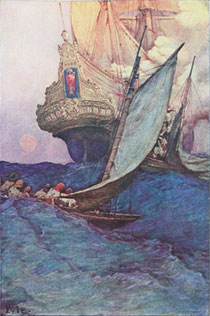
					<b>Nate: </b><em>?Why are pirates not just fascinating but downright charming, at least in the abstract? Why is it so tempting to think that the solution to our culture's embarrassing pirate fetish is to rename what we call piracy as something different: "software bootleggers"; "Somali ship-jackers"? Why is the idea of "<a href="http://www.talklikeapirate.com/">International Talk Like an Armed Robber Day</a>" unthinkable?  Put another way, why did the Jolly Roger fly from the flagpole at Apple Computer's headquarters while inside they were creating the first Macintosh? Why is the best way to get kids to attend an after-school program to hide its classrooms in the back of a <a href="http://www.826valencia.org/store/">pirate supply store</a>??</em><br />
		
		<div style="float:right; padding:15px 5px 5px 5px"><img src="http://culture-making.com/media/6a00d8341c562c53ef01156f32fb5b970c-320wi.jpg" alt="image"></div><p>There is another aspect to our fascination with pirates. It is existential rather than political. It is about civilization and its limits, about our need for a sense of home versus a need to break those boundaries altogether. The sea has always played a big role in that dialectic. The sea is, potentially, an avenue for intercommunication and exchange among men. It is, in short, a vast shipping lane. But it is also an outer boundary. The land stops at the sea. The city stops at the sea. We human beings have conquered this earth, mostly and swiftly, but the sea is still unnatural territory for us, we aren\&#8216;t as sure on its surfaces as we are on those harder surfaces more suited to bipeds.</p>
<p>The pirate takes that insecurity and runs with it. Indeed, the word pirate can ultimately be traced back to the ancient Greek word &#8220;peira,&#8221; which means trial, attempt, experiment. To have <i>peira</i>, to posses <i>peira</i>, is to have gone through an experience. If I try something, I get to know it. In fact, it is out of the collecting of <i>peira</i> that a person constructs the greater web of experience (ex-<i>peira</i>) that makes one person, one person, and another, another.</p><p>The pirate is, quite literally, taking a chance. In doing so, pirates reenact the basic process that everyone goes through in becoming a person. You start out with very little sense of the world, and you gradually gain experience and put it all together. Pirates are simply less complacent than the rest of us. For reasons specific to historical circumstance and the accident of birth, some people decide to take that ultimate chance and continue to push the boundary of <i>peira</i>, to become a <i>peirate</i> — a pirate. Such figures dive back into the chaos of the sea, the edges of civilization, the end of the world. That such a journey is wrapped in physical danger, violence, moral ambiguity, cruelty, and heroism is only natural. Things are messy at the limits. Sureness dissolves at the boundaries.</p><hr />
<div class="author" style="font-size: -1">from "<a href="http://www.thesmartset.com/article/article04160901.aspx">Bootylicious</a>," by Morgan Meis, <a href="http://www.thesmartset.com/article/article04160901.aspx">The Smart Set</a>, 16 April 2009 :: via <a href="http://www.3quarksdaily.com/3quarksdaily/2009/04/bootylicious-the-love-affair-with-pirates.html">3quarksdaily</a></div>		


      ]]></content>
    </entry>    <entry>
      <title>The slightly universal language?</title>
      <link rel="alternate" type="text/html" href="https://culture-making.com/post/the_slightly_universal_language" />
      <id>tag:culture-makers.com,2025:author/1.1399</id>
      <published>2025-01-02T22:53:00Z</published>
      <updated>2025-01-03T22:54:05Z</updated>
      <author>
            <name>Andy Crouch</name>
            <email>andy@culture-making.com</email>
            
      </author>

      <content type="html"><![CDATA[


			<b>Nate: </b><em>?A fascinating study on music, emotion, and cultural encounters—click through to hear some of the audio clips used, including some traditional Mala music. Still, I worry that your average lay reader might take it as proof of the feel-good, world-music-fueled idea that "music is the universal language" while the researchers' actual conclusion is a lot more limited: music was mildly effective in conveying emotion in one direction between two specific, very different cultures: more so than a spoken sentence, but less so than a smile or frown.?</em><br />

<div class="author" style="font-size: -1">a <a href="http://www.kottke.org/09/04/understanding-emotions-in-music">Kottke.org</a> post, 17 April 2009</div><hr />		
		<p>When western music was played to members of the Mafa people from Cameroon who have never been exposed to western music, movies, or art, <a href="http://scienceblogs.com/cognitivedaily/2009/04/even_isolated_cultures_underst.php">they were able to recognize the emotions conveyed by the music</a>, even though the Mafa don&#8217;t associate emotions with their own music.</p>


      ]]></content>
    </entry>    <entry>
      <title>Comforts and delights</title>
      <link rel="alternate" type="text/html" href="https://culture-making.com/post/comforts_and_delights" />
      <id>tag:culture-makers.com,2025:author/1.1387</id>
      <published>2025-01-02T22:53:00Z</published>
      <updated>2025-01-03T22:54:05Z</updated>
      <author>
            <name>Andy Crouch</name>
            <email>andy@culture-making.com</email>
            
      </author>

      <content type="html"><![CDATA[


<div style="float:right; padding:15px 5px 5px 5px"><img src="http://culture-making.com/media/commentlogo.jpg" alt="image"></div><p>Yesterday <a href="http://cardus.ca/comment/"><i>Comment Magazine</i></a> has posted an <a href="http://cardus.ca/comment/article/952/">interview</a> Gideon Strauss conducted with me over email a few weeks back, about my role as a curator for Culture-Making.com and, inevitably, my love of Swahili dictionaries. It’s part of their new “Comforts and Delights” feature; a few times a year I’ll be weighing in there with my thoughts about interesting cultural artifacts.</p><br />


      ]]></content>
    </entry>

</feed>